



 Chat with AI
Exam 8: Monopoly

Exam 1: Introducing the Economic Way of Thinking254 Questions
Exam 2: Production Possibilities, Opportunity Cost, and Economic Growth209 Questions
Exam 3: Market Demand and Supply361 Questions
Exam 4: Markets in Action259 Questions
Exam 5: Price Elasticity of Demand181 Questions
Exam 6: Production Costs254 Questions
Exam 7: Perfect Competition226 Questions
Exam 8: Monopoly175 Questions
Exam 9: Monopolistic Competition and Oligopoly166 Questions
Exam 10: Labor Markets and Income Distribution185 Questions
Exam 11: Gross Domestic Product207 Questions
Exam 12: Business Cycles and Unemployment199 Questions
Exam 13: Inflation131 Questions
Exam 14: Aggregate Demand and Supply83 Questions
Exam 15: Fiscal Policy205 Questions
Exam 16: The Public Sector131 Questions
Exam 17: Federal Deficits, Surpluses, and the National Debt102 Questions
Exam 18: Money and the Federal Reserve System159 Questions
Exam 19: Money Creation250 Questions
Exam 20: Policy Disputes Using the Self-Correcting Aggregate Demand and Supply Model246 Questions
Exam 21: International Trade and Finance251 Questions
Exam 22: Economies in Transition108 Questions
Exam 23: Growth and the Less-Developed Countries121 Questions
Select questions type


For a monopolist, marginal revenue is always:

Free
(Multiple Choice)
4.8/5  (70)
(70) Correct Answer: Verified
A
Exhibit 8-8 Profit maximizing for a monopolist 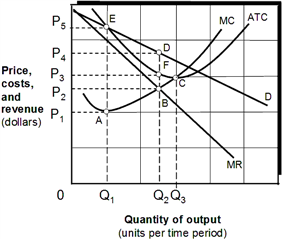 The profit-maximizing output for the monopolist in Exhibit 8-8 is:
Free
(Multiple Choice)
5.0/5 (85)
(85) Correct Answer:Verified
VerifiedC
Exhibit 8-7 Monopolist 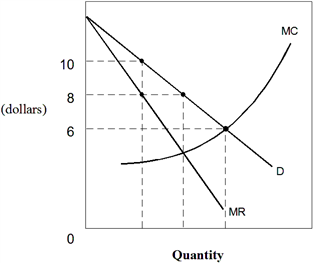 According to the information provided in Exhibit 8-7, if the Rudd Ice Company was a monopoly and is currently charging a price of $8, what would you advise Rudd to do?
Free
(Multiple Choice)
4.9/5 (85)
(85) Correct Answer:Verified
VerifiedA
A monopoly can be created when a firm gains sole control of the entire supply of a strategic input.
(True/False)
4.9/5 (78)
(78) A natural monopoly maximizes profits at the point at which price equals minimum average total cost.
(True/False)
4.9/5 (80)
(80) Suppose a monopolist and a perfectly competitive firm have the same cost curves. The monopolistic firm would:
(Multiple Choice)
4.9/5 (84)
(84) At the point where the marginal revenue equals zero for a monopolist facing a straight-line demand curve, total revenue is:
(Multiple Choice)
4.8/5 (76)
(76) In a natural monopoly, the long-run average cost curve declines and therefore average cost is lower when there is only one seller.
(True/False)
4.8/5 (83)
(83) One necessary condition for effective price discrimination is:
(Multiple Choice)
4.8/5 (93)
(93) Assume a monopolist's marginal cost and marginal revenue curves intersect and the demand curve passes above its average total cost curve. The firm will:
(Multiple Choice)
4.8/5 (68)
(68) Exhibit 8-1 Monopolist's demand curve  In Exhibit 8-1, the marginal revenue curve corresponding to the monopolist's demand curve would be a straight line drawn between points:
 (Multiple Choice)
4.7/5 (77)
(77) Which of the following correctly describes price discrimination?
(Multiple Choice)
4.8/5 (71)
(71) 
Filters
- Essay(0)
- Multiple Choice(0)
- Short Answer(0)
- True False(0)
- Matching(0)