



 Chat with AI
Exam 8: Monopoly

Exam 1: Introducing the Economic Way of Thinking254 Questions
Exam 2: Production Possibilities, Opportunity Cost, and Economic Growth209 Questions
Exam 3: Market Demand and Supply361 Questions
Exam 4: Markets in Action259 Questions
Exam 5: Price Elasticity of Demand181 Questions
Exam 6: Production Costs254 Questions
Exam 7: Perfect Competition226 Questions
Exam 8: Monopoly175 Questions
Exam 9: Monopolistic Competition and Oligopoly166 Questions
Exam 10: Labor Markets and Income Distribution185 Questions
Exam 11: Gross Domestic Product207 Questions
Exam 12: Business Cycles and Unemployment199 Questions
Exam 13: Inflation131 Questions
Exam 14: Aggregate Demand and Supply83 Questions
Exam 15: Fiscal Policy205 Questions
Exam 16: The Public Sector131 Questions
Exam 17: Federal Deficits, Surpluses, and the National Debt102 Questions
Exam 18: Money and the Federal Reserve System159 Questions
Exam 19: Money Creation250 Questions
Exam 20: Policy Disputes Using the Self-Correcting Aggregate Demand and Supply Model246 Questions
Exam 21: International Trade and Finance251 Questions
Exam 22: Economies in Transition108 Questions
Exam 23: Growth and the Less-Developed Countries121 Questions
Select questions type


A monopoly market is characterized by a single seller of a product which has few, if any suitable substitutes.
(True/False)
4.7/5  (77)
(77) A monopoly will be maximizing profits if it is operating at the point where:
(Multiple Choice)
5.0/5 (78)
(78) To earn an economic profit in the short-run, a monopolist sets marginal revenue equal to zero.
(True/False)
4.9/5 (70)
(70) An industry in which total costs are kept to a minimum because only one firm serves the whole market is called a:
(Multiple Choice)
4.7/5 (87)
(87) Which of the following firms best fits the definition of a monopoly?
(Multiple Choice)
4.9/5 (69)
(69) The demand curve any monopolist uses in making output decisions is:
(Multiple Choice)
4.9/5 (77)
(77) Exhibit 8-1 Monopolist's demand curve 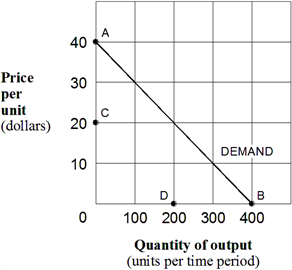 At an output of 100 units, marginal revenue for a monopolist with the demand curve shown in Exhibit 8-1 would be:
 (Multiple Choice)
5.0/5 (97)
(97) Costs in a natural monopoly are lower because there is only one producer.
(True/False)
4.8/5 (69)
(69) Compared to a perfectly competitive firm with the same cost structure, a monopoly firm will charge a:
(Multiple Choice)
4.7/5 (72)
(72) If a monopolist finds that at the present level of output marginal revenue exceeds marginal cost, the firm should:
(Multiple Choice)
4.8/5 (76)
(76) Which of the following best e xplains why the monopolist's marginal revenue is less than the selling price?
(Multiple Choice)
4.8/5 (90)
(90) To maximize its profit, a monopoly should choose a price where demand is:
(Multiple Choice)
5.0/5 (76)
(76) If pizza used to be produced in a perfectly competitive market, and now the pizza market has become a monopoly, we can expect:
(Multiple Choice)
4.9/5 (83)
(83) The two theoretical extremes of the market structure spectrum are occupied at one end by perfect competition and on the other end by monopoly.
(True/False)
4.8/5 (73)
(73) 
Filters
- Essay(0)
- Multiple Choice(0)
- Short Answer(0)
- True False(0)
- Matching(0)