



 Chat with AI
Exam 6: Production Costs

Exam 1: Introducing the Economic Way of Thinking254 Questions
Exam 2: Production Possibilities, Opportunity Cost, and Economic Growth209 Questions
Exam 3: Market Demand and Supply361 Questions
Exam 4: Markets in Action259 Questions
Exam 5: Price Elasticity of Demand181 Questions
Exam 6: Production Costs254 Questions
Exam 7: Perfect Competition226 Questions
Exam 8: Monopoly175 Questions
Exam 9: Monopolistic Competition and Oligopoly166 Questions
Exam 10: Labor Markets and Income Distribution185 Questions
Exam 11: Gross Domestic Product207 Questions
Exam 12: Business Cycles and Unemployment199 Questions
Exam 13: Inflation131 Questions
Exam 14: Aggregate Demand and Supply83 Questions
Exam 15: Fiscal Policy205 Questions
Exam 16: The Public Sector131 Questions
Exam 17: Federal Deficits, Surpluses, and the National Debt102 Questions
Exam 18: Money and the Federal Reserve System159 Questions
Exam 19: Money Creation250 Questions
Exam 20: Policy Disputes Using the Self-Correcting Aggregate Demand and Supply Model246 Questions
Exam 21: International Trade and Finance251 Questions
Exam 22: Economies in Transition108 Questions
Exam 23: Growth and the Less-Developed Countries121 Questions
Select questions type


Bill lives in Montana and likes to grow zucchini. He applies fertilizer to his crops twice during the growing season and notices that the second layer of fertilizer increases his crop, but not as much as the first layer. What economic concept best explains this observation?

Free
(Multiple Choice)
4.8/5  (74)
(74) Correct Answer: Verified
B
Marginal product measures the change in:
Free
(Multiple Choice)
5.0/5 (82)
(82) Correct Answer:Verified
VerifiedD
Exhibit 6-8 Costs schedules for producing pizza 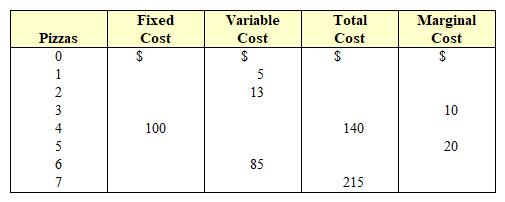 By filling in the blanks in Exhibit 6-8, the variable cost of producing 4 pizzas is shown to be equal to:
Free
(Multiple Choice)
4.8/5 (78)
(78) Correct Answer:Verified
VerifiedB
Diseconomies of scale occur when high levels of output are produced in a short period of time.
(True/False)
4.8/5 (88)
(88) The ____ is the situation in which the marginal product of labor is greater than zero and declining as more labor is hired.
(Multiple Choice)
4.7/5 (87)
(87) Exhibit 6-7 Cost schedule for a firm 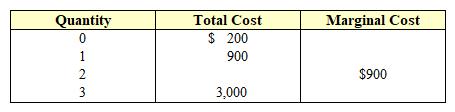 In Exhibit 6-7, by filling in the blanks it can be determined that the marginal cost of the first unit of output is:
 (Multiple Choice)
4.8/5 (67)
(67) Exhibit 6-16 Long-run average cost curves 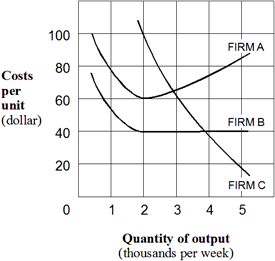 Which firm in Exhibit 6-16 displays a long-run average cost curve with diseconomies beginning at 2,000 units of output per week?
 (Multiple Choice)
5.0/5 (86)
(86) If both the marginal cost and the average variable cost curves are U-shaped. At the minimum point on the average variable cost curve, the marginal cost must be:
(Multiple Choice)
4.7/5 (88)
(88) Applying a price of labor to the law of diminishing returns generates:
(Multiple Choice)
5.0/5 (64)
(64) During the short-run period of the production process, a firm will be:
(Multiple Choice)
4.9/5 (85)
(85) Exhibit 6-17 Long-run average cost curve 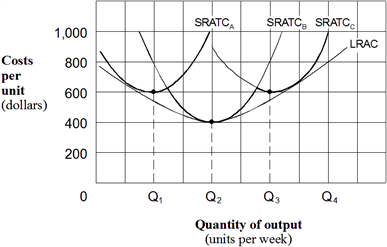 Given the short-run average total cost curves in Exhibit 6-17, what level of output per week minimizes average total cost?
 (Multiple Choice)
4.9/5 (97)
(97) The situation in which the marginal product of labor is greater than zero and declining as more labor is hired is called the law of:
(Multiple Choice)
4.9/5 (81)
(81) Exhibit 6-12 Cost schedule for producing pizza 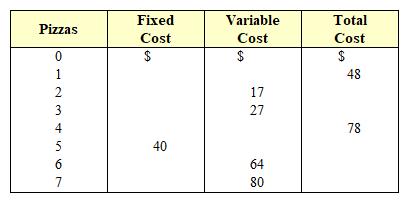 By filling in the blanks in Exhibit 6-12, the AFC of 3 pizzas is shown to be equal to:
 (Multiple Choice)
4.9/5 (85)
(85) A firm's marginal product curve slopes downward throughout its length.
(True/False)
4.9/5 (80)
(80) The increase in total output that results from a unit increase in one unit of a variable input is equal to the input's:
(Multiple Choice)
4.9/5 (87)
(87) Exhibit 6-5 Workers and output data 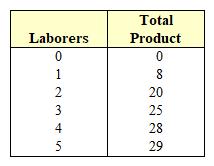 In Exhibit 6-5, the marginal product of the second worker is:
 (Multiple Choice)
4.7/5 (72)
(72) If a firm enlarges its factory size and realizes higher average (per unit) costs of production then:
(Multiple Choice)
5.0/5 (68)
(68) 
Filters
- Essay(0)
- Multiple Choice(0)
- Short Answer(0)
- True False(0)
- Matching(0)