



 Chat with AI
Exam 6: Production Costs

Exam 1: Introducing the Economic Way of Thinking254 Questions
Exam 2: Production Possibilities, Opportunity Cost, and Economic Growth209 Questions
Exam 3: Market Demand and Supply361 Questions
Exam 4: Markets in Action259 Questions
Exam 5: Price Elasticity of Demand181 Questions
Exam 6: Production Costs254 Questions
Exam 7: Perfect Competition226 Questions
Exam 8: Monopoly175 Questions
Exam 9: Monopolistic Competition and Oligopoly166 Questions
Exam 10: Labor Markets and Income Distribution185 Questions
Exam 11: Gross Domestic Product207 Questions
Exam 12: Business Cycles and Unemployment199 Questions
Exam 13: Inflation131 Questions
Exam 14: Aggregate Demand and Supply83 Questions
Exam 15: Fiscal Policy205 Questions
Exam 16: The Public Sector131 Questions
Exam 17: Federal Deficits, Surpluses, and the National Debt102 Questions
Exam 18: Money and the Federal Reserve System159 Questions
Exam 19: Money Creation250 Questions
Exam 20: Policy Disputes Using the Self-Correcting Aggregate Demand and Supply Model246 Questions
Exam 21: International Trade and Finance251 Questions
Exam 22: Economies in Transition108 Questions
Exam 23: Growth and the Less-Developed Countries121 Questions
Select questions type


Exhibit 6-15 Long-run average cost 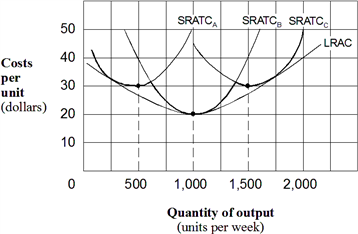 If the firm represented in Exhibit 6-15 is operating with a plant whose size corresponds to short-run average total cost curve A, the level of output that would minimize its short-run average total cost is:
 (Multiple Choice)
4.8/5  (75)
(75) Exhibit 6-3 A marginal product curve 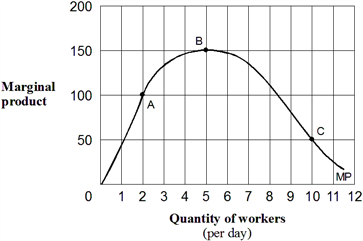 As shown in Exhibit 6-3, the marginal product of labor for the last worker hired when 2 workers are employed per day is:
 (Multiple Choice)
4.8/5 (84)
(84) In the short-run, total fixed costs always exceed total variable costs.
(True/False)
4.8/5 (82)
(82) Exhibit 6-4 A marginal product curve 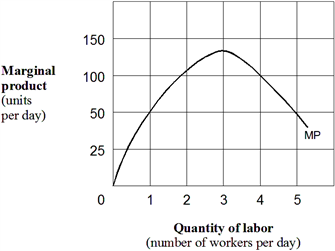 As shown in Exhibit 6-4, the law of diminishing returns applies in the range of:
 (Multiple Choice)
4.8/5 (79)
(79) The change in total cost that results from the production of one additional unit is called:
(Multiple Choice)
4.9/5 (78)
(78) Which of the following is an example of a fixed cost for a fishing company?
(Multiple Choice)
4.8/5 (79)
(79) If average fixed costs equal $60 and average total costs equal $120 when output is 100, the total variable cost must be:
(Multiple Choice)
4.9/5 (78)
(78) A large aircraft manufacturer, like Boeing, may have a cost advantage over a new smaller manufacturer because of:
(Multiple Choice)
5.0/5 (69)
(69) When the cost curves have U-shapes, at the point where marginal cost equals average total cost:
(Multiple Choice)
4.9/5 (78)
(78) Distinguish economies and diseconomies of scale. How can the extent to which economies and diseconomies of scale explain the size and number of real world firms in an industry?
(Essay)
4.7/5 (80)
(80) Exhibit 6-8 Costs schedules for producing pizza 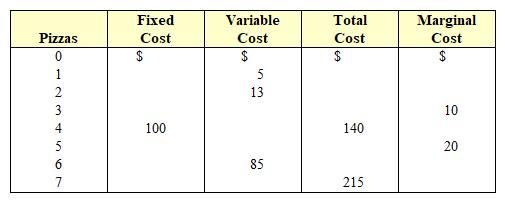 By filling in the blanks in Exhibit 6-8, the average total cost of producing 5 pizzas is shown to be equal to:
 (Multiple Choice)
4.8/5 (91)
(91) A car leasing company that expands its size by buying its competitors may run the risk of increasing production cost per unit due to:
(Multiple Choice)
4.7/5 (69)
(69) If a firm's use of labor obeys the law of diminishing returns, then:
(Multiple Choice)
4.8/5 (83)
(83) Which of the following is true if the total variable cost curve is rising?
(Multiple Choice)
4.9/5 (91)
(91) Economies of scale exist over all ranges of output for which short-run average total cost exceeds long-run average cost.
(True/False)
4.9/5 (80)
(80) Diseconomies of scale exist over the range of output for which the long-run average cost curve is:
(Multiple Choice)
5.0/5 (89)
(89) 
Filters
- Essay(0)
- Multiple Choice(0)
- Short Answer(0)
- True False(0)
- Matching(0)