



 Chat with AI
Exam 6: Production Costs

Exam 1: Introducing the Economic Way of Thinking254 Questions
Exam 2: Production Possibilities, Opportunity Cost, and Economic Growth209 Questions
Exam 3: Market Demand and Supply361 Questions
Exam 4: Markets in Action259 Questions
Exam 5: Price Elasticity of Demand181 Questions
Exam 6: Production Costs254 Questions
Exam 7: Perfect Competition226 Questions
Exam 8: Monopoly175 Questions
Exam 9: Monopolistic Competition and Oligopoly166 Questions
Exam 10: Labor Markets and Income Distribution185 Questions
Exam 11: Gross Domestic Product207 Questions
Exam 12: Business Cycles and Unemployment199 Questions
Exam 13: Inflation131 Questions
Exam 14: Aggregate Demand and Supply83 Questions
Exam 15: Fiscal Policy205 Questions
Exam 16: The Public Sector131 Questions
Exam 17: Federal Deficits, Surpluses, and the National Debt102 Questions
Exam 18: Money and the Federal Reserve System159 Questions
Exam 19: Money Creation250 Questions
Exam 20: Policy Disputes Using the Self-Correcting Aggregate Demand and Supply Model246 Questions
Exam 21: International Trade and Finance251 Questions
Exam 22: Economies in Transition108 Questions
Exam 23: Growth and the Less-Developed Countries121 Questions
Select questions type


Exhibit 6-12 Cost schedule for producing pizza 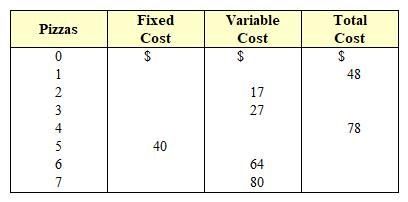 By filling in the blanks in Exhibit 6-12, the ATC of 3 pizzas is shown to be equal to:
 (Multiple Choice)
4.7/5  (94)
(94) Exhibit 6-12 Cost schedule for producing pizza 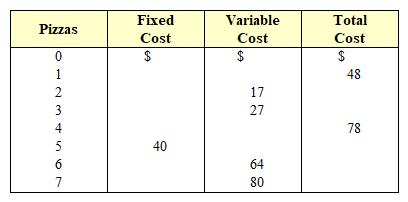 By filling in the blanks in Exhibit 6-12, the AVC of 3 pizzas is shown to be equal to:
 (Multiple Choice)
4.8/5 (83)
(83) A downward-sloping portion of a long-run average total cost curve is the result of:
(Multiple Choice)
4.7/5 (72)
(72) Which of the following is true at the point where diminishing returns set in?
(Multiple Choice)
4.9/5 (75)
(75) Marginal cost is calculated by dividing the change in total cost by the change in total output.
(True/False)
4.8/5 (81)
(81) In order for the law of diminishing returns to be present, we must have:
(Multiple Choice)
4.8/5 (57)
(57) The sum of the explicit and implicit costs incurred in the production process is called
(Multiple Choice)
4.7/5 (71)
(71) Which of the following is most likely to be true of economic and accounting profits?
(Multiple Choice)
4.9/5 (67)
(67) Exhibit 6-7 Cost schedule for a firm 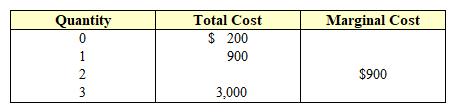 In Exhibit 6-7, by filling in the blanks it can be determined that the total cost of the second unit of output is:
 (Multiple Choice)
4.8/5 (66)
(66) Suppose that when output is 20, marginal cost is $20, and average total cost is $30. Then which of the following is most likely to be true .
(Multiple Choice)
4.8/5 (89)
(89) Economies of scale can be caused by all of the following except:
(Multiple Choice)
4.8/5 (79)
(79) During the course of a week, McDonald's has enough time to hire or layoff workers, but it does not have enough time to expand its kitchen or add an additional seating area. In this situation, McDonald's:
(Multiple Choice)
4.8/5 (73)
(73) The minimum point on the marginal cost curve corresponds to the:
(Multiple Choice)
4.8/5 (67)
(67) The difference between a firm's total revenues and total costs when all explicit and implicit costs are included is the firm's:
(Multiple Choice)
4.9/5 (94)
(94) Exhibit 6-17 Long-run average cost curve 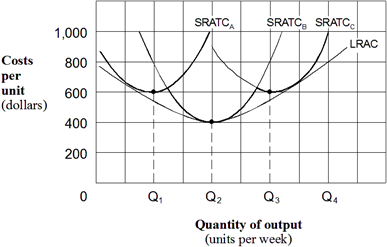 In Exhibit 6-17, short-run average total cost, short-run marginal cost, and long-run average cost are all equal at which level of output per week?
 (Multiple Choice)
4.9/5 (74)
(74) If a firm's long-run average cost curve is rising, it is experiencing:
(Multiple Choice)
4.9/5 (91)
(91) Exhibit 6-1 Production of pizza data 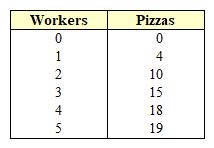 Exhibit 6-1 shows the change in the production of pizzas as more workers are hired. The marginal product of the fifth employee equals:
 (Multiple Choice)
5.0/5 (80)
(80) An economist left her $100,000-a-year teaching position to work full-time in her own consulting business. In the first year, she had total revenue of $200,000 and business expenses of $100,000. She made a(n):
(Multiple Choice)
4.9/5 (85)
(85) 
Filters
- Essay(0)
- Multiple Choice(0)
- Short Answer(0)
- True False(0)
- Matching(0)