



 Chat with AI
Exam 6: Production Costs

Exam 1: Introducing the Economic Way of Thinking254 Questions
Exam 2: Production Possibilities, Opportunity Cost, and Economic Growth209 Questions
Exam 3: Market Demand and Supply361 Questions
Exam 4: Markets in Action259 Questions
Exam 5: Price Elasticity of Demand181 Questions
Exam 6: Production Costs254 Questions
Exam 7: Perfect Competition226 Questions
Exam 8: Monopoly175 Questions
Exam 9: Monopolistic Competition and Oligopoly166 Questions
Exam 10: Labor Markets and Income Distribution185 Questions
Exam 11: Gross Domestic Product207 Questions
Exam 12: Business Cycles and Unemployment199 Questions
Exam 13: Inflation131 Questions
Exam 14: Aggregate Demand and Supply83 Questions
Exam 15: Fiscal Policy205 Questions
Exam 16: The Public Sector131 Questions
Exam 17: Federal Deficits, Surpluses, and the National Debt102 Questions
Exam 18: Money and the Federal Reserve System159 Questions
Exam 19: Money Creation250 Questions
Exam 20: Policy Disputes Using the Self-Correcting Aggregate Demand and Supply Model246 Questions
Exam 21: International Trade and Finance251 Questions
Exam 22: Economies in Transition108 Questions
Exam 23: Growth and the Less-Developed Countries121 Questions
Select questions type


Bill is an accountant for a small machine shop. His boss has asked him to calculate the shop's total fixed cost. Which method will get Bill the correct answer?
(Multiple Choice)
4.9/5  (71)
(71) Suppose a firm has an output of 10,000 cans and a total fixed cost of $2,000. At an output of 5,000 the difference between the total cost and the total variable cost is:
(Multiple Choice)
4.8/5 (87)
(87) Cash payments to a steel mill for steel used in production would be an example of:
(Multiple Choice)
4.8/5 (84)
(84) Exhibit 6-11 Short-run cost curves schedule for pizzeria's hourly production 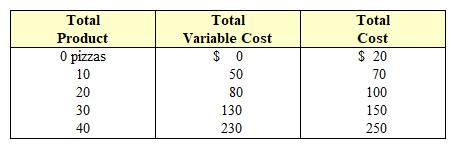 In Exhibit 6-11, the pizzeria's fixed cost is equal to:
 (Multiple Choice)
4.8/5 (88)
(88) Exhibit 6-14 Cost curves 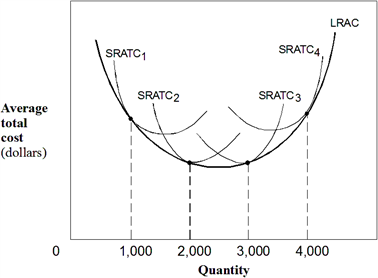 In Exhibit 6-14, a firm finds that it is experiencing numerous managerial and information problems. The position of its short- and long-run average total cost curves suggest that it is operating at a production level:
 (Multiple Choice)
4.8/5 (73)
(73) The situation in which the marginal product of labor is greater than zero and declining as more labor is hired is called the law of:
(Multiple Choice)
4.9/5 (89)
(89) Exhibit 6-8 Costs schedules for producing pizza 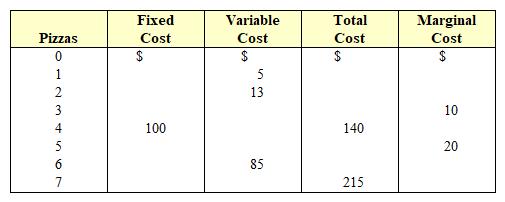 By filling in the blanks in Exhibit 6-8, the total cost of producing zero pizzas is shown to be equal to:
 (Multiple Choice)
4.9/5 (66)
(66) A firm can produce 450 gallons of milk per day with 4 workers and 500 gallons per day with 5 workers. The marginal product of the fifth worker expressed in gallons per worker per day, is:
(Multiple Choice)
4.9/5 (90)
(90) Exhibit 6-1 Production of pizza data 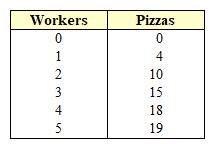 Exhibit 6-1 shows the change in the short-run production of pizzas as more workers are hired. The table shows the marginal product of the labor input is decreasing with the hiring of the third worker. A possible reason for this diminishing marginal product is:
 (Multiple Choice)
4.9/5 (72)
(72) Which of the following is an implication of the law of diminishing returns?
(Multiple Choice)
4.8/5 (91)
(91) Exhibit 6-11 Short-run cost curves schedule for pizzeria's hourly production 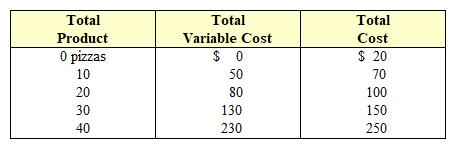 In Exhibit 6-11, the average total cost or producing 40 pizzas per hour is equal to:
 (Multiple Choice)
4.9/5 (78)
(78) A firm has $200 million in total revenue and explicit costs of $190 million. If its owners have invested $100 million in the company at an opportunity cost of 10 percent interest per year, the firm's accounting profit is:
(Multiple Choice)
4.7/5 (88)
(88) Exhibit 6-9 Cost schedule for firm X 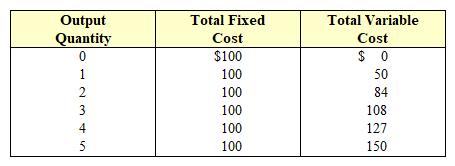 As shown in Exhibit 6-9, the total cost of producing 4 units is:
 (Multiple Choice)
4.8/5 (78)
(78) Suppose a publisher faces the following costs of producing 10,000 newspapers each month: $5,500 cost of labor; $2,200 monthly mortgage payment; $250 cost of electricity to run the printing presses; $800 for ink and paper; and $200 in city property taxes (based on the value of the building and land). Its total variable costs are:
(Multiple Choice)
4.9/5 (76)
(76) The amount of money that could have been made by renting a piece of land to be used for building an office building instead of using the land for employee parking is a(n):
(Multiple Choice)
4.7/5 (74)
(74) At the point where marginal cost equals average variable cost,
(Multiple Choice)
5.0/5 (80)
(80) Which of the following is an implicit cost of going to college?
(Multiple Choice)
4.9/5 (87)
(87) 
Filters
- Essay(0)
- Multiple Choice(0)
- Short Answer(0)
- True False(0)
- Matching(0)