



 Chat with AI
Exam 2: Production Possibilities, Opportunity Cost, and Economic Growth

Exam 1: Introducing the Economic Way of Thinking254 Questions
Exam 2: Production Possibilities, Opportunity Cost, and Economic Growth209 Questions
Exam 3: Market Demand and Supply361 Questions
Exam 4: Markets in Action259 Questions
Exam 5: Price Elasticity of Demand181 Questions
Exam 6: Production Costs254 Questions
Exam 7: Perfect Competition226 Questions
Exam 8: Monopoly175 Questions
Exam 9: Monopolistic Competition and Oligopoly166 Questions
Exam 10: Labor Markets and Income Distribution185 Questions
Exam 11: Gross Domestic Product207 Questions
Exam 12: Business Cycles and Unemployment199 Questions
Exam 13: Inflation131 Questions
Exam 14: Aggregate Demand and Supply83 Questions
Exam 15: Fiscal Policy205 Questions
Exam 16: The Public Sector131 Questions
Exam 17: Federal Deficits, Surpluses, and the National Debt102 Questions
Exam 18: Money and the Federal Reserve System159 Questions
Exam 19: Money Creation250 Questions
Exam 20: Policy Disputes Using the Self-Correcting Aggregate Demand and Supply Model246 Questions
Exam 21: International Trade and Finance251 Questions
Exam 22: Economies in Transition108 Questions
Exam 23: Growth and the Less-Developed Countries121 Questions
Select questions type


Economic growth may be represented by a(n):

Free
(Multiple Choice)
4.9/5  (81)
(81) Correct Answer: Verified
B
Any point inside the production possibility curve is:
Free
(Multiple Choice)
4.9/5 (81)
(81) Correct Answer:Verified
VerifiedC
Exhibit 2-17 Production possibilities curve 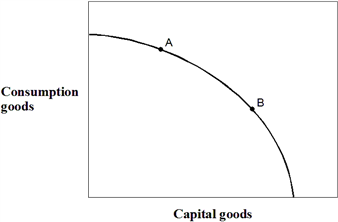 In Exhibit 2-17, if countries A and B currently have the same production possibilities curve (PPC) as given in the figure, but this year country A locates at point A on its PPC and country B locates at point B on its PPC, then country A:
Free
(Multiple Choice)
4.9/5 (76)
(76) Correct Answer:Verified
VerifiedC
A nation can accelerate economic growth by increasing its production of consumer goods.
(True/False)
4.8/5 (84)
(84) The amount of a good that must be given up to produce another good is the concept of:
(Multiple Choice)
4.8/5 (76)
(76) Compare two economies A and B that start out with identical production possibilities curves. Economy A chooses an efficient point with 6 consumption goods and 3 capital goods, while economy B also chooses an efficient point, but with 4 consumption goods and 5 capital goods. In the future we can predict:
(Multiple Choice)
4.8/5 (70)
(70) On a production possibilities curve diagram, greater entrepreneurship:
(Multiple Choice)
4.9/5 (78)
(78) The law of increasing costs holds that the opportunity cost:
(Multiple Choice)
4.8/5 (83)
(83) Exhibit 2-16 Production possibilities curve 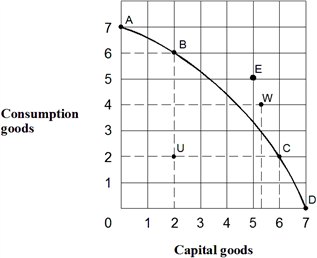 From the information in Exhibit 2-16, which of the following points on the production possibilities curve are attainable with the resources and technology currently available?
 (Multiple Choice)
4.9/5 (76)
(76) Which fundamental economic question requires society to choose the technological and resource mix used to produce goods?
(Multiple Choice)
4.8/5 (86)
(86) The law of increasing opportunity costs causes the production possibilities curve to:
(Multiple Choice)
4.8/5 (87)
(87) On the production possibilities curve, a movement between points that yields a loss of one good in order to raise the output of another good will maintain efficient production.
(True/False)
4.7/5 (75)
(75) Exhibit 2-1 Production possibilities curve data  In Exhibit 2-1, the opportunity cost of producing the fourth unit of capital is:
 (Multiple Choice)
4.9/5 (81)
(81) If society leaves some of its resources unemployed, then it will be operating at a point:
(Multiple Choice)
4.9/5 (77)
(77) If some resources went to waste rather to use in production, the economy would operate outside its production possibility curve.
(True/False)
4.9/5 (75)
(75) While waiting in line to buy two tacos at 80 cents each and a medium drink for 90 cents, Jordan notices that the restaurant has a value meal containing three tacos and a medium drink all for $3. For Jordan, the marginal cost of the third taco would be:
(Multiple Choice)
4.8/5 (78)
(78) A major technological advance would be represented on a production possibilities curve by a(n):
(Multiple Choice)
4.8/5 (82)
(82) 
Filters
- Essay(0)
- Multiple Choice(0)
- Short Answer(0)
- True False(0)
- Matching(0)