



 Chat with AI
Exam 10: Labor Markets and Income Distribution

Exam 1: Introducing the Economic Way of Thinking254 Questions
Exam 2: Production Possibilities, Opportunity Cost, and Economic Growth209 Questions
Exam 3: Market Demand and Supply361 Questions
Exam 4: Markets in Action259 Questions
Exam 5: Price Elasticity of Demand181 Questions
Exam 6: Production Costs254 Questions
Exam 7: Perfect Competition226 Questions
Exam 8: Monopoly175 Questions
Exam 9: Monopolistic Competition and Oligopoly166 Questions
Exam 10: Labor Markets and Income Distribution185 Questions
Exam 11: Gross Domestic Product207 Questions
Exam 12: Business Cycles and Unemployment199 Questions
Exam 13: Inflation131 Questions
Exam 14: Aggregate Demand and Supply83 Questions
Exam 15: Fiscal Policy205 Questions
Exam 16: The Public Sector131 Questions
Exam 17: Federal Deficits, Surpluses, and the National Debt102 Questions
Exam 18: Money and the Federal Reserve System159 Questions
Exam 19: Money Creation250 Questions
Exam 20: Policy Disputes Using the Self-Correcting Aggregate Demand and Supply Model246 Questions
Exam 21: International Trade and Finance251 Questions
Exam 22: Economies in Transition108 Questions
Exam 23: Growth and the Less-Developed Countries121 Questions
Select questions type


Other things equal, assume consumer demand for children's toys increases. The result is a(n):

Free
(Multiple Choice)
4.8/5  (82)
(82) Correct Answer: Verified
D
Medicaid is an example of a cash assistance poverty program.
Free
(True/False)
4.7/5 (72)
(72) Correct Answer:Verified
VerifiedFalse
Exhibit 10-6 Demand for labor curves 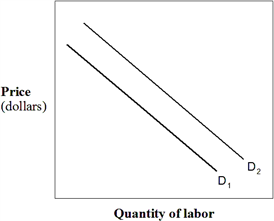 In Exhibit 10-6, which of the following could have caused the shift in labor demand from D1 to D2?
Free
(Multiple Choice)
4.9/5 (91)
(91) Correct Answer:Verified
VerifiedE
Exhibit 10-4 Sally's labor supply data 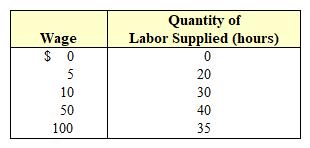 In Exhibit 10-4, if Sally can produce 2 units of output for every hour that she works, then:
 (Multiple Choice)
4.9/5 (80)
(80) In a competitive labor market a firm will continue to employ workers for as long as an additional worker's marginal revenue product exceeds the wage rate.
(True/False)
4.8/5 (68)
(68) Which of the following are not counted when we compare a family's income to the poverty line?
(Multiple Choice)
4.8/5 (70)
(70) Which of the following are not counted when we compare a family's income to the poverty line?
(Multiple Choice)
4.9/5 (87)
(87) Exhibit 10-1 Labor and output data 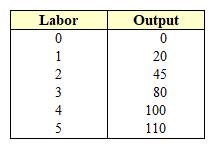 In Exhibit 10-1, if product price is fixed at $8, the MRP of the 2nd worker is equal to:
 (Multiple Choice)
4.7/5 (85)
(85) If a union is able to successfully lobby Congress to limit imports of rival products, and thus to raise the demand (and thus price) for goods or services they make, then which of the following best describes the outcome?
(Multiple Choice)
4.8/5 (90)
(90) Since 1959 the fraction of persons below the poverty line has fallen.
(True/False)
4.7/5 (76)
(76) Exhibit 10-5 A perfectly competitive labor market 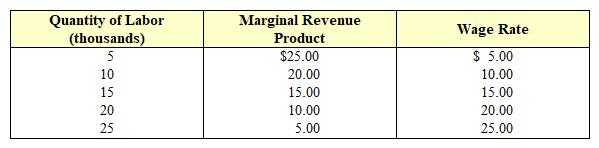 In Exhibit 10-5, at what wage rate will the firms hire these workers?
 (Multiple Choice)
4.9/5 (70)
(70) Describe the two basic strategies of unions in increasing wage rates for their members.
(Essay)
4.8/5 (71)
(71) In a competitive labor market, the demand for labor X that produces product Y will increase if the demand for product Y increases.
(True/False)
4.9/5 (64)
(64) If the MRP is less than the wage, the firm should hire more labor.
(True/False)
4.9/5 (69)
(69) 
Filters
- Essay(0)
- Multiple Choice(0)
- Short Answer(0)
- True False(0)
- Matching(0)