



 Chat with AI
Exam 10: Labor Markets and Income Distribution

Exam 1: Introducing the Economic Way of Thinking254 Questions
Exam 2: Production Possibilities, Opportunity Cost, and Economic Growth209 Questions
Exam 3: Market Demand and Supply361 Questions
Exam 4: Markets in Action259 Questions
Exam 5: Price Elasticity of Demand181 Questions
Exam 6: Production Costs254 Questions
Exam 7: Perfect Competition226 Questions
Exam 8: Monopoly175 Questions
Exam 9: Monopolistic Competition and Oligopoly166 Questions
Exam 10: Labor Markets and Income Distribution185 Questions
Exam 11: Gross Domestic Product207 Questions
Exam 12: Business Cycles and Unemployment199 Questions
Exam 13: Inflation131 Questions
Exam 14: Aggregate Demand and Supply83 Questions
Exam 15: Fiscal Policy205 Questions
Exam 16: The Public Sector131 Questions
Exam 17: Federal Deficits, Surpluses, and the National Debt102 Questions
Exam 18: Money and the Federal Reserve System159 Questions
Exam 19: Money Creation250 Questions
Exam 20: Policy Disputes Using the Self-Correcting Aggregate Demand and Supply Model246 Questions
Exam 21: International Trade and Finance251 Questions
Exam 22: Economies in Transition108 Questions
Exam 23: Growth and the Less-Developed Countries121 Questions
Select questions type


The highest fifth of all families receive approximately ____ of the distribution of annual money income among families.
(Multiple Choice)
4.9/5  (76)
(76) Which of the following statements concerning the supply of labor is true ?
(Multiple Choice)
4.8/5 (71)
(71) Exhibit 10-1 Labor and output data 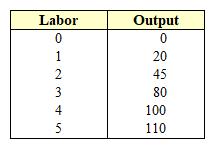 In Exhibit 10-1, the marginal product of the 4th unit of labor is equal to:
 (Multiple Choice)
4.8/5 (76)
(76) The U.S. has one of the highest unionization rates of all the industrialized countries around the world.
(True/False)
4.9/5 (87)
(87) Consider a law that limits women's access to certain "dangerous" occupations like coal mining and military combat service. Such a law would likely reduce women's wages because:
(Multiple Choice)
4.9/5 (70)
(70) Exhibit 10-7 Income distribution for three countries 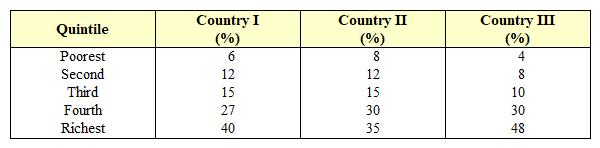 Exhibit 10-7 shows the percentage of income received by each population quintile. In Country II we can conclude that the:
 (Multiple Choice)
4.8/5 (101)
(101) Exhibit 10-2 Labor supply curve 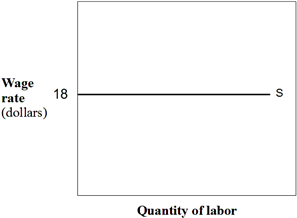 In Exhibit 10-2, the wage for the 6th employee is equal to:
 (Multiple Choice)
4.8/5 (89)
(89) An improvement in technology that increases the marginal product will shift the demand for labor curve to the right.
(True/False)
4.9/5 (87)
(87) Discrimination raises the average wage of members of one group of workers in spite of laws that require equal pay for all workers.
(True/False)
4.8/5 (70)
(70) If a union is able to successfully lobby Congress to limit imports of rival products, and thus to raise the demand (and thus price) for the goods or services they make, then which of the following best describes the outcome?
(Multiple Choice)
4.7/5 (82)
(82) The demand curve for labor of Coca-Cola manufacturers will not shift to the right if:
(Multiple Choice)
4.7/5 (80)
(80) The geographic region in the United States with the highest poverty rate is the South.
(True/False)
4.8/5 (84)
(84) An increase in the demand for a product will shift the demand for labor used to produce the product:
(Multiple Choice)
4.9/5 (90)
(90) An increase in demand for French fries will cause equilibrium wage rates:
(Multiple Choice)
4.9/5 (85)
(85) What is the official definition of the poverty line? What are some causes of poverty?
(Essay)
4.8/5 (87)
(87) Assume consumer demand for CD-ROMs increases. The result is a(n):
(Multiple Choice)
4.9/5 (96)
(96) Tucker Corporation sells its products for $5.00. Tucker's industrial engineers have informed management that hiring one additional worker will increase output by five units per hour. Tucker should hire the additional worker only if the wage rate is:
(Multiple Choice)
4.9/5 (83)
(83) 
Filters
- Essay(0)
- Multiple Choice(0)
- Short Answer(0)
- True False(0)
- Matching(0)