



 Chat with AI
Exam 10: Labor Markets and Income Distribution

Exam 1: Introducing the Economic Way of Thinking254 Questions
Exam 2: Production Possibilities, Opportunity Cost, and Economic Growth209 Questions
Exam 3: Market Demand and Supply361 Questions
Exam 4: Markets in Action259 Questions
Exam 5: Price Elasticity of Demand181 Questions
Exam 6: Production Costs254 Questions
Exam 7: Perfect Competition226 Questions
Exam 8: Monopoly175 Questions
Exam 9: Monopolistic Competition and Oligopoly166 Questions
Exam 10: Labor Markets and Income Distribution185 Questions
Exam 11: Gross Domestic Product207 Questions
Exam 12: Business Cycles and Unemployment199 Questions
Exam 13: Inflation131 Questions
Exam 14: Aggregate Demand and Supply83 Questions
Exam 15: Fiscal Policy205 Questions
Exam 16: The Public Sector131 Questions
Exam 17: Federal Deficits, Surpluses, and the National Debt102 Questions
Exam 18: Money and the Federal Reserve System159 Questions
Exam 19: Money Creation250 Questions
Exam 20: Policy Disputes Using the Self-Correcting Aggregate Demand and Supply Model246 Questions
Exam 21: International Trade and Finance251 Questions
Exam 22: Economies in Transition108 Questions
Exam 23: Growth and the Less-Developed Countries121 Questions
Select questions type


Explain why wage rates might rise a Joe's Quik-Print Shop if Joe replace his aging copy machines with state-of-the-art copy machines.
(Essay)
4.8/5  (88)
(88) Of the following demographic groups, which has the lowest poverty rate in the U.S.?
(Multiple Choice)
4.9/5 (74)
(74) Suppose a change in technology increases the marginal product of labor. The result is a(n):
(Multiple Choice)
4.9/5 (77)
(77) A decrease in the price of the output will decrease the firm's demand for labor.
(True/False)
5.0/5 (83)
(83) A firm's demand for labor depends on, in part, the demand for the firm's product. To summarize this idea, economists say that the demand for labor is:
(Multiple Choice)
4.9/5 (75)
(75) According to the statistics, the distribution of money income:
(Multiple Choice)
4.9/5 (74)
(74) One reason the supply of carpenters is greater than the supply of physicians is because:
(Multiple Choice)
4.9/5 (74)
(74) A union may negotiate limits on workload in order to increase the demand for labor and raise workers' salaries. This practice is known as:
(Multiple Choice)
4.8/5 (79)
(79) Which of the following will decrease the demand for fast-food burger workers' labor?
(Multiple Choice)
4.9/5 (75)
(75) Since World War II, the percentage of U.S. workers who are unionized has declined from about 86 percent to its current level of 60 percent.
(True/False)
4.9/5 (87)
(87) The firm's demand for labor curve is exactly the same as the:
(Multiple Choice)
4.9/5 (88)
(88) Exhibit 10-3 Supply and demand curves for food servers 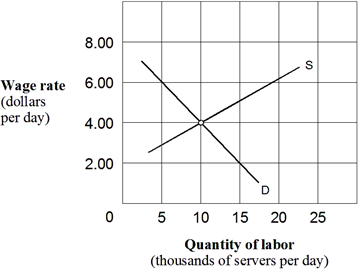 In Exhibit 10-3, the equilibrium wage and the number of food servers employed per day, respectively, are:
 (Multiple Choice)
4.8/5 (82)
(82) Which of the following determines equilibrium wages in perfectly competitive labor markets?
(Multiple Choice)
4.8/5 (83)
(83) The number of workers hired by a firm at a particular wage rate can be calculated if you know which of the following?
(Multiple Choice)
4.8/5 (82)
(82) Which of the following determines equilibrium wages in perfectly competitive labor markets?
(Multiple Choice)
4.9/5 (80)
(80) Describe the factors that could cause an increase in the wage rate of workers.
(Essay)
4.8/5 (82)
(82) What happens to the marginal product (MP) of labor when the market price of the good produced increases?
(Multiple Choice)
4.8/5 (75)
(75) 
Filters
- Essay(0)
- Multiple Choice(0)
- Short Answer(0)
- True False(0)
- Matching(0)