



 Chat with AI
Exam 10: Labor Markets and Income Distribution

Exam 1: Introducing the Economic Way of Thinking254 Questions
Exam 2: Production Possibilities, Opportunity Cost, and Economic Growth209 Questions
Exam 3: Market Demand and Supply361 Questions
Exam 4: Markets in Action259 Questions
Exam 5: Price Elasticity of Demand181 Questions
Exam 6: Production Costs254 Questions
Exam 7: Perfect Competition226 Questions
Exam 8: Monopoly175 Questions
Exam 9: Monopolistic Competition and Oligopoly166 Questions
Exam 10: Labor Markets and Income Distribution185 Questions
Exam 11: Gross Domestic Product207 Questions
Exam 12: Business Cycles and Unemployment199 Questions
Exam 13: Inflation131 Questions
Exam 14: Aggregate Demand and Supply83 Questions
Exam 15: Fiscal Policy205 Questions
Exam 16: The Public Sector131 Questions
Exam 17: Federal Deficits, Surpluses, and the National Debt102 Questions
Exam 18: Money and the Federal Reserve System159 Questions
Exam 19: Money Creation250 Questions
Exam 20: Policy Disputes Using the Self-Correcting Aggregate Demand and Supply Model246 Questions
Exam 21: International Trade and Finance251 Questions
Exam 22: Economies in Transition108 Questions
Exam 23: Growth and the Less-Developed Countries121 Questions
Select questions type


The government defines poverty as an income level less than three times the cost of a minimal diet.
(True/False)
4.8/5  (86)
(86) Wage discrimination means workers with equal productivity are paid unequal wages, or workers with unequal productivity are paid equal wages.
(True/False)
4.8/5 (85)
(85) Exhibit 10-1 Labor and output data 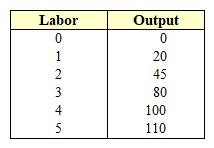 In Exhibit 10-1, if product price is fixed at $5, the MRP of the third worker is equal to:
 (Multiple Choice)
4.7/5 (85)
(85) Which of the following most closely represents the share of total U.S. income to the poorest 20 percent of all U.S. families?
(Multiple Choice)
4.8/5 (77)
(77) 
Filters
- Essay(0)
- Multiple Choice(0)
- Short Answer(0)
- True False(0)
- Matching(0)