



 Chat with AI
Exam 9: Monopolistic Competition and Oligopoly

Exam 1: Introducing the Economic Way of Thinking254 Questions
Exam 2: Production Possibilities, Opportunity Cost, and Economic Growth209 Questions
Exam 3: Market Demand and Supply361 Questions
Exam 4: Markets in Action259 Questions
Exam 5: Price Elasticity of Demand181 Questions
Exam 6: Production Costs254 Questions
Exam 7: Perfect Competition226 Questions
Exam 8: Monopoly175 Questions
Exam 9: Monopolistic Competition and Oligopoly166 Questions
Exam 10: Labor Markets and Income Distribution185 Questions
Exam 11: Gross Domestic Product207 Questions
Exam 12: Business Cycles and Unemployment199 Questions
Exam 13: Inflation131 Questions
Exam 14: Aggregate Demand and Supply83 Questions
Exam 15: Fiscal Policy205 Questions
Exam 16: The Public Sector131 Questions
Exam 17: Federal Deficits, Surpluses, and the National Debt102 Questions
Exam 18: Money and the Federal Reserve System159 Questions
Exam 19: Money Creation250 Questions
Exam 20: Policy Disputes Using the Self-Correcting Aggregate Demand and Supply Model246 Questions
Exam 21: International Trade and Finance251 Questions
Exam 22: Economies in Transition108 Questions
Exam 23: Growth and the Less-Developed Countries121 Questions
Select questions type


When a perfectly competitive firm or a monopolistically competitive firm is making zero economic profit,

Free
(Multiple Choice)
4.8/5  (83)
(83) Correct Answer: Verified
A
Exhibit 9-2 A monopolistic competitive firm  To maximize long-run profits, the monopolistically competitive firm shown in Exhibit 9-2 will charge a price per unit of:
Free
(Multiple Choice)
4.9/5 (83)
(83) Correct Answer:Verified
VerifiedD
Exhibit 9-6 Two-Firm Payoff Matrix 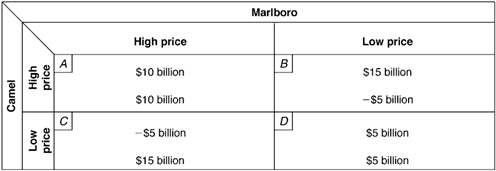 Suppose costs are identical for the two firms in Exhibit 9-6. Each firm assumes without formal agreement that if it sets the high price its rival will not charge a lower price. Under these "tit-for-tat" conditions, equilibrium will be established by:
Free
(Multiple Choice)
4.8/5 (96)
(96) Correct Answer:Verified
VerifiedD
Pricing and output determination under an oligopoly is more complicated than pricing and output determinations in other industries. The primary reason for the complication is the:
(Multiple Choice)
4.9/5 (78)
(78) Which of the following is true in long-run equilibrium for both perfect competition and monopolistic competition?
(Multiple Choice)
4.7/5 (83)
(83) Exhibit 9-1 A monopolistic competitive firm  In the long run, the demand curve for the monopolistic competitive firm shown in Exhibit 9-1:
 (Multiple Choice)
4.9/5 (84)
(84) Suppose that R. J. Reynolds raises the price of cigarettes by 10 percent. Although they have no requirement or agreement to do so, the other cigarette firms decide to raise their prices accordingly. This situation is best described as:
(Multiple Choice)
4.8/5 (79)
(79) Which of the following is the best example of a firm operating in a monopolistically competitive market?
(Multiple Choice)
4.9/5 (89)
(89) Which of the following statements best describes firms under monopolistic competition?
(Multiple Choice)
4.9/5 (91)
(91) Which of the following is a characteristic of the monopolistic competition market structure?
(Multiple Choice)
4.9/5 (81)
(81) Cartel members have an incentive to cheat on the cartel because:
(Multiple Choice)
4.8/5 (89)
(89) In the short run, the monopolistic competitive firm will charge a price equal to marginal cost.
(True/False)
4.8/5 (86)
(86) The automobile, steel, and oil markets are all examples of:
(Multiple Choice)
4.9/5 (75)
(75) Suppose an oil cartel has an agreement to restrict members' production in order to maintain a price of $30 per barrel. A single cartel member may want to cheat and exceed its quota so that it can:
(Multiple Choice)
4.9/5 (85)
(85) Which of the following is not a characteristic of the monopolistic competition market structure?
(Multiple Choice)
4.7/5 (72)
(72) Exhibit 9-1 A monopolistic competitive firm  As presented in Exhibit 9-l, the short-run profit per unit of output for the monopolistic competitive firm is:
 (Multiple Choice)
4.8/5 (74)
(74) 
Filters
- Essay(0)
- Multiple Choice(0)
- Short Answer(0)
- True False(0)
- Matching(0)