



 Chat with AI
Exam 9: Monopolistic Competition and Oligopoly

Exam 1: Introducing the Economic Way of Thinking254 Questions
Exam 2: Production Possibilities, Opportunity Cost, and Economic Growth209 Questions
Exam 3: Market Demand and Supply361 Questions
Exam 4: Markets in Action259 Questions
Exam 5: Price Elasticity of Demand181 Questions
Exam 6: Production Costs254 Questions
Exam 7: Perfect Competition226 Questions
Exam 8: Monopoly175 Questions
Exam 9: Monopolistic Competition and Oligopoly166 Questions
Exam 10: Labor Markets and Income Distribution185 Questions
Exam 11: Gross Domestic Product207 Questions
Exam 12: Business Cycles and Unemployment199 Questions
Exam 13: Inflation131 Questions
Exam 14: Aggregate Demand and Supply83 Questions
Exam 15: Fiscal Policy205 Questions
Exam 16: The Public Sector131 Questions
Exam 17: Federal Deficits, Surpluses, and the National Debt102 Questions
Exam 18: Money and the Federal Reserve System159 Questions
Exam 19: Money Creation250 Questions
Exam 20: Policy Disputes Using the Self-Correcting Aggregate Demand and Supply Model246 Questions
Exam 21: International Trade and Finance251 Questions
Exam 22: Economies in Transition108 Questions
Exam 23: Growth and the Less-Developed Countries121 Questions
Select questions type


In an oligopoly, the outcome is uncertain because price and output decisions depend on the response of rivals.
(True/False)
4.9/5  (75)
(75) A group of firms that collude to limit competition is called a(n):
(Multiple Choice)
4.8/5 (63)
(63) Exhibit 9-3 A monopolistic competitive firm in the long run  As represented in Exhibit 9-3, the maximum long-run economic profit earned by this monopolistic competitive firm is:
 (Multiple Choice)
4.9/5 (83)
(83) An oligopoly market structure is characterized by firms closely watching their rivals' pricing policies.
(True/False)
4.9/5 (90)
(90) Easy entry and exit cause oligopoly profits to be zero in the long run.
(True/False)
4.9/5 (93)
(93) Compare and contrast the four market models in terms of the profit-maximizing output level for each, the shut-down rule for each, the probability of long-run economic profits being earned, and their social desirability.
(Essay)
4.9/5 (91)
(91) Nonprice competition, price leadership, and cartels are models in the ____ market structure(s).
(Multiple Choice)
5.0/5 (71)
(71) In the long-run, surviving firms in monopolistic competition earn:
(Multiple Choice)
4.8/5 (68)
(68) Under which one of the following market structures are sellers most likely to consider the reaction of rival sellers when they set the price of their product?
(Multiple Choice)
4.8/5 (85)
(85) Entry of new firms will occur in a monopolistic competitive industry until:
(Multiple Choice)
4.8/5 (87)
(87) Game theory is an especially useful model for analysis in the following types of markets:
(Multiple Choice)
4.9/5 (78)
(78) Exhibit 9-3 A monopolistic competitive firm in the long run  To maximize long-run profits, the monopolistically competitive firm shown in Exhibit 9-3 will charge a price per unit of:
 (Multiple Choice)
4.8/5 (71)
(71) Which of the following is evidence of an ineffective cartel?
(Multiple Choice)
4.9/5 (75)
(75) Which of the following is the best example of a monopolistic competitor?
(Multiple Choice)
4.8/5 (80)
(80) Exhibit 9-5 Two-Firm Payoff Matrix 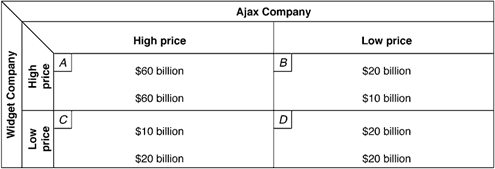 Assume costs are identical for the two firms in Exhibit 9-5. If both firms were allowed to form a cartel and agree on their prices, equilibrium would be established by:
 (Multiple Choice)
4.8/5 (69)
(69) Which of the following statements best describes the price, output, and profit conditions of monopolistic competition?
(Multiple Choice)
4.8/5 (80)
(80) 
Filters
- Essay(0)
- Multiple Choice(0)
- Short Answer(0)
- True False(0)
- Matching(0)