



 Chat with AI
Exam 13: Inflation

Exam 1: Introducing the Economic Way of Thinking254 Questions
Exam 2: Production Possibilities, Opportunity Cost, and Economic Growth209 Questions
Exam 3: Market Demand and Supply361 Questions
Exam 4: Markets in Action259 Questions
Exam 5: Price Elasticity of Demand181 Questions
Exam 6: Production Costs254 Questions
Exam 7: Perfect Competition226 Questions
Exam 8: Monopoly175 Questions
Exam 9: Monopolistic Competition and Oligopoly166 Questions
Exam 10: Labor Markets and Income Distribution185 Questions
Exam 11: Gross Domestic Product207 Questions
Exam 12: Business Cycles and Unemployment199 Questions
Exam 13: Inflation131 Questions
Exam 14: Aggregate Demand and Supply83 Questions
Exam 15: Fiscal Policy205 Questions
Exam 16: The Public Sector131 Questions
Exam 17: Federal Deficits, Surpluses, and the National Debt102 Questions
Exam 18: Money and the Federal Reserve System159 Questions
Exam 19: Money Creation250 Questions
Exam 20: Policy Disputes Using the Self-Correcting Aggregate Demand and Supply Model246 Questions
Exam 21: International Trade and Finance251 Questions
Exam 22: Economies in Transition108 Questions
Exam 23: Growth and the Less-Developed Countries121 Questions
Select questions type


Exhibit 13-2 Consumer Price Index 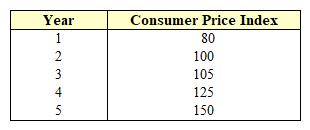 As shown in Exhibit 13-2, the rate of inflation for Year 5 is:
Free
(Multiple Choice)
4.9/5  (84)
(84) Correct Answer: Verified
C
The Consumer Price Index compares the:
Free
(Multiple Choice)
4.7/5 (83)
(83) Correct Answer:Verified
VerifiedB
Which of the following correctly defines inflation?
Free
(Multiple Choice)
4.9/5 (81)
(81) Correct Answer:Verified
VerifiedB
Assume that the real rate of interest is 5 percent and a lender charges a nominal interest rate of 15 percent. If a borrower expects that the rate of inflation next year will be 10 percent and the actual rate of inflation next year is 12 percent:
(Multiple Choice)
4.7/5 (75)
(75) If the nominal interest rate is 5 percent and there is no inflation, then the real interest rate:
(Multiple Choice)
4.8/5 (84)
(84) The consumer price index (CPI) includes only a market basket of goods and services purchased by the typical urban consumer.
(True/False)
4.8/5 (80)
(80) If the consumer price index in Year 1 was 200 and the CPI for Year 2 was 230, the rate of inflation was:
(Multiple Choice)
4.9/5 (89)
(89) As inflation drives up prices, people attempt to find substitutes and adjust what they buy. The resulting substitution bias problem causes the CPI to:
(Multiple Choice)
4.8/5 (69)
(69) Disinflation and deflation mean a decrease in the average price level.
(True/False)
4.8/5 (81)
(81) Tina Cole and her husband bought a deferred annuity that started paying them $700 a month in retirement benefits. They, along with millions of other people who live on fixed incomes, are examples of:
(Multiple Choice)
4.9/5 (81)
(81) Suppose the consumer price index (CPI) for Year X is 130. This means the average price of goods and services is:
(Multiple Choice)
4.7/5 (81)
(81) If the consumer price index (CPI) in Year 1 was 200 and the CPI in Year 2 was 215, the rate of inflation was:
(Multiple Choice)
4.7/5 (74)
(74) Exhibit 13-1 Consumer Price Index 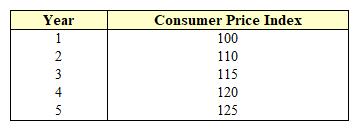 As shown in Exhibit 13-1, the rate of inflation for Year 2 is:
 (Multiple Choice)
4.8/5 (76)
(76) Suppose you received a 5 percent increase in your nominal wage. Over the year, inflation ran about 2 percent. Which of the following is true ?
(Multiple Choice)
4.8/5 (76)
(76) During periods of inflation, all prices of all products are rising.
(True/False)
4.8/5 (81)
(81) In which of the following years was inflation in the United States the highest?
(Multiple Choice)
4.7/5 (75)
(75) 
Filters
- Essay(0)
- Multiple Choice(0)
- Short Answer(0)
- True False(0)
- Matching(0)