



 Chat with AI
Exam 13: Inflation

Exam 1: Introducing the Economic Way of Thinking254 Questions
Exam 2: Production Possibilities, Opportunity Cost, and Economic Growth209 Questions
Exam 3: Market Demand and Supply361 Questions
Exam 4: Markets in Action259 Questions
Exam 5: Price Elasticity of Demand181 Questions
Exam 6: Production Costs254 Questions
Exam 7: Perfect Competition226 Questions
Exam 8: Monopoly175 Questions
Exam 9: Monopolistic Competition and Oligopoly166 Questions
Exam 10: Labor Markets and Income Distribution185 Questions
Exam 11: Gross Domestic Product207 Questions
Exam 12: Business Cycles and Unemployment199 Questions
Exam 13: Inflation131 Questions
Exam 14: Aggregate Demand and Supply83 Questions
Exam 15: Fiscal Policy205 Questions
Exam 16: The Public Sector131 Questions
Exam 17: Federal Deficits, Surpluses, and the National Debt102 Questions
Exam 18: Money and the Federal Reserve System159 Questions
Exam 19: Money Creation250 Questions
Exam 20: Policy Disputes Using the Self-Correcting Aggregate Demand and Supply Model246 Questions
Exam 21: International Trade and Finance251 Questions
Exam 22: Economies in Transition108 Questions
Exam 23: Growth and the Less-Developed Countries121 Questions
Select questions type


Consider an economy with only two goods: bread and wine. In 1982, the typical family bought 4 loaves of bread at 50¢ per loaf and 2 bottles of wine for $9 per bottle. In Year X, bread cost 75¢ per loaf and wine cost $10 per bottle. The CPI for Year X (using a 1982 base year) is:
(Multiple Choice)
5.0/5  (74)
(74) Suppose that the consumer price index (CPI) was 160 in Year X and 166 in Year Y, inflation during Year Y was approximately:
(Multiple Choice)
4.8/5 (66)
(66) Demand-pull inflation is typically caused by rapidly rising costs of production.
(True/False)
4.8/5 (89)
(89) Which of the following is the largest single component of the market basket used to compute the consumer price index (CPI)?
(Multiple Choice)
4.9/5 (81)
(81) A measure comparing the prices of consumer goods and services that a household typically purchases to the prices of those goods and services purchased in a base year is
(Multiple Choice)
4.8/5 (88)
(88) Inflation was a major problem in the United States during the early years of the Great Depression.
(True/False)
4.9/5 (80)
(80) When the inflation rate rises, the purchasing power of nominal income:
(Multiple Choice)
4.8/5 (88)
(88) Union contracts with built-in cost-of-living adjustments and home mortgages that vary with the rate of inflation are:
(Multiple Choice)
4.8/5 (80)
(80) Cost-push inflation happens when technological innovation unexpectedly lowers the cost of production, causing increased demand for goods and services.
(True/False)
4.8/5 (66)
(66) Exhibit 13-2 Consumer Price Index 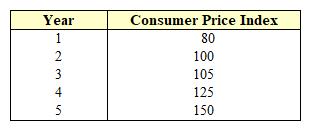 As shown in Exhibit 13-2, the rate of inflation for Year 3 is:
 (Multiple Choice)
4.7/5 (84)
(84) The substitution bias is believed to cause the consumer price index to:
(Multiple Choice)
4.7/5 (61)
(61) Suppose that your income during Year X was $50,000, and the CPI for Year X was 150 (base year = Z. Back in Year Z your income was $30,000. Has your real income increased or decreased from Z to year X? By how much?
(Multiple Choice)
4.8/5 (85)
(85) The nominal rate of interest is any rate of interest below 3 percent.
(True/False)
4.9/5 (75)
(75) Suppose the Organization of Petroleum Exporting Countries (OPEC) sharply increased the price of oil, which triggered higher inflation rates in the United States. This type of inflation is best classified as:
(Multiple Choice)
4.8/5 (77)
(77) 
Filters
- Essay(0)
- Multiple Choice(0)
- Short Answer(0)
- True False(0)
- Matching(0)