



 Chat with AI
Exam 13: Inflation

Exam 1: Introducing the Economic Way of Thinking254 Questions
Exam 2: Production Possibilities, Opportunity Cost, and Economic Growth209 Questions
Exam 3: Market Demand and Supply361 Questions
Exam 4: Markets in Action259 Questions
Exam 5: Price Elasticity of Demand181 Questions
Exam 6: Production Costs254 Questions
Exam 7: Perfect Competition226 Questions
Exam 8: Monopoly175 Questions
Exam 9: Monopolistic Competition and Oligopoly166 Questions
Exam 10: Labor Markets and Income Distribution185 Questions
Exam 11: Gross Domestic Product207 Questions
Exam 12: Business Cycles and Unemployment199 Questions
Exam 13: Inflation131 Questions
Exam 14: Aggregate Demand and Supply83 Questions
Exam 15: Fiscal Policy205 Questions
Exam 16: The Public Sector131 Questions
Exam 17: Federal Deficits, Surpluses, and the National Debt102 Questions
Exam 18: Money and the Federal Reserve System159 Questions
Exam 19: Money Creation250 Questions
Exam 20: Policy Disputes Using the Self-Correcting Aggregate Demand and Supply Model246 Questions
Exam 21: International Trade and Finance251 Questions
Exam 22: Economies in Transition108 Questions
Exam 23: Growth and the Less-Developed Countries121 Questions
Select questions type


Inflation occurs when there is an increase in the purchasing power of money.
(True/False)
4.7/5  (80)
(80) Real income for a given year would be less than nominal income in that year if:
(Multiple Choice)
4.8/5 (73)
(73) Demand-pull inflation occurs during a period of time in which total spending is increasing less than total output (GDP) is increasing.
(True/False)
4.9/5 (98)
(98) The CPI (using a 2000 base year) for 1965 is 26.0. Suppose a household's annual take-home pay in 1965 was $8,320. What would be an equivalent home pay in 2000?
(Multiple Choice)
4.7/5 (62)
(62) Exhibit 13-2 Consumer Price Index 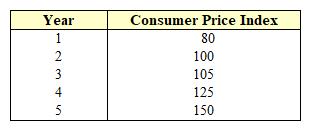 As shown in Exhibit 13-2, the rate of inflation for Year 2 is:
 (Multiple Choice)
4.8/5 (85)
(85) As the price of gasoline rose during the 1970s, consumers cut back on their use of gasoline relative to other consumer goods. This situation contributed to which bias in the consumer price index?
(Multiple Choice)
4.8/5 (86)
(86) Cost-push inflation is a result of an increase in the per unit costs of production.
(True/False)
5.0/5 (88)
(88) If the bank offers you a nominal interest rate of 9 percent on a student loan, and if inflation is 6 percent, then what is the real interest rate?
(Multiple Choice)
4.9/5 (70)
(70) If the rate of inflation in a given time period turns out to be higher than lenders and borrowers anticipated, then the effect will be:
(Multiple Choice)
4.9/5 (88)
(88) Demand-pull inflation is most pronounced during a recession (as opposed to the recovery phase of the business cycle).
(True/False)
4.8/5 (66)
(66) Last year the Jones family earned $40,000. This year their income is $42,000. In an economy with an inflation rate of 10 percent, which of the following is correct?
(Multiple Choice)
5.0/5 (86)
(86) A dramatic and sustained increase in oil prices would most likely:
(Multiple Choice)
4.8/5 (73)
(73) 
Filters
- Essay(0)
- Multiple Choice(0)
- Short Answer(0)
- True False(0)
- Matching(0)