



 Chat with AI
Exam 9: Monopolistic Competition and Oligopoly

Exam 1: Introducing the Economic Way of Thinking254 Questions
Exam 2: Production Possibilities, Opportunity Cost, and Economic Growth209 Questions
Exam 3: Market Demand and Supply361 Questions
Exam 4: Markets in Action259 Questions
Exam 5: Price Elasticity of Demand181 Questions
Exam 6: Production Costs254 Questions
Exam 7: Perfect Competition226 Questions
Exam 8: Monopoly175 Questions
Exam 9: Monopolistic Competition and Oligopoly166 Questions
Exam 10: Labor Markets and Income Distribution185 Questions
Exam 11: Gross Domestic Product207 Questions
Exam 12: Business Cycles and Unemployment199 Questions
Exam 13: Inflation131 Questions
Exam 14: Aggregate Demand and Supply83 Questions
Exam 15: Fiscal Policy205 Questions
Exam 16: The Public Sector131 Questions
Exam 17: Federal Deficits, Surpluses, and the National Debt102 Questions
Exam 18: Money and the Federal Reserve System159 Questions
Exam 19: Money Creation250 Questions
Exam 20: Policy Disputes Using the Self-Correcting Aggregate Demand and Supply Model246 Questions
Exam 21: International Trade and Finance251 Questions
Exam 22: Economies in Transition108 Questions
Exam 23: Growth and the Less-Developed Countries121 Questions
Select questions type


Which of the following is a game theory strategy for oligopolists to avoid a low-price outcome?
(Multiple Choice)
4.8/5  (77)
(77) For both a monopolist and a monopolistically competitive firm:
(Multiple Choice)
4.7/5 (74)
(74) Which of the following is always a characteristic of the oligopoly market structure?
(Multiple Choice)
4.9/5 (75)
(75) Which of the following is the best example of an oligopoly?
(Multiple Choice)
4.9/5 (82)
(82) A monopolistically competitive firm, like a perfectly competitive firm, is a price taker.
(True/False)
5.0/5 (79)
(79) The marginal revenue curve of a monopolistically competitive firm will always lie:
(Multiple Choice)
4.8/5 (67)
(67) The industry that most closely approximates the conditions of the oligopoly model is:
(Multiple Choice)
4.8/5 (69)
(69) Perfect competition and monopolistic competition are similar because under both market structures,
(Multiple Choice)
4.8/5 (72)
(72) Which of the following is characteristic of a monopolistically competitive firm?
(Multiple Choice)
4.9/5 (76)
(76) Which of the following market structures describes an industry in which a group of firms formally agree to control prices and output of a product?
(Multiple Choice)
4.8/5 (79)
(79) Exhibit 9-5 Two-Firm Payoff Matrix 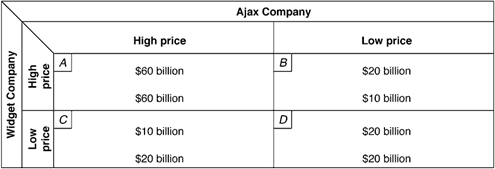 Suppose costs are identical for the two firms in Exhibit 9-5. Each firm assumes without formal agreement that if it sets the high price its rival will not charge a lower price. Under these "tit-for-tat" conditions, equilibrium will be established by:
 (Multiple Choice)
4.9/5 (78)
(78) The theory of monopolistic competition predicts that in long-run equilibrium a monopolistically competitive firm will:
(Multiple Choice)
4.7/5 (64)
(64) Which of the following is true about long-run equilibrium in a monopolistically competitive market?
(Multiple Choice)
4.9/5 (63)
(63) Which of the following is the result of competing through advertising for a monopolistically competitive firm?
(Multiple Choice)
4.9/5 (76)
(76) A picture frame company operates in a monopolistically competitive market. Its short-run equilibrium price is $80 and its ATC is $65. It sells 100 picture frames a week. From this we can tell:
(Multiple Choice)
4.8/5 (81)
(81) Exhibit 9-4 Two-Firm Payoff Matrix 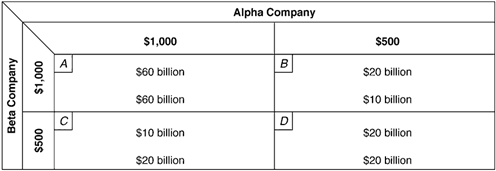 Suppose costs are identical for the two firms in Exhibit 9-4. Each firm assumes without formal agreement that if it sets the high price its rival will not charge a lower price. Under these "tit-for-tat" conditions, equilibrium will be established by:
 (Multiple Choice)
4.8/5 (82)
(82) Which of the following is a game theory strategy for oligopolists to avoid a low-price outcome?
(Multiple Choice)
4.8/5 (91)
(91) 
Filters
- Essay(0)
- Multiple Choice(0)
- Short Answer(0)
- True False(0)
- Matching(0)