



 Chat with AI
Exam 9: Monopolistic Competition and Oligopoly

Exam 1: Introducing the Economic Way of Thinking254 Questions
Exam 2: Production Possibilities, Opportunity Cost, and Economic Growth209 Questions
Exam 3: Market Demand and Supply361 Questions
Exam 4: Markets in Action259 Questions
Exam 5: Price Elasticity of Demand181 Questions
Exam 6: Production Costs254 Questions
Exam 7: Perfect Competition226 Questions
Exam 8: Monopoly175 Questions
Exam 9: Monopolistic Competition and Oligopoly166 Questions
Exam 10: Labor Markets and Income Distribution185 Questions
Exam 11: Gross Domestic Product207 Questions
Exam 12: Business Cycles and Unemployment199 Questions
Exam 13: Inflation131 Questions
Exam 14: Aggregate Demand and Supply83 Questions
Exam 15: Fiscal Policy205 Questions
Exam 16: The Public Sector131 Questions
Exam 17: Federal Deficits, Surpluses, and the National Debt102 Questions
Exam 18: Money and the Federal Reserve System159 Questions
Exam 19: Money Creation250 Questions
Exam 20: Policy Disputes Using the Self-Correcting Aggregate Demand and Supply Model246 Questions
Exam 21: International Trade and Finance251 Questions
Exam 22: Economies in Transition108 Questions
Exam 23: Growth and the Less-Developed Countries121 Questions
Select questions type


Firms in a monopolistically competitive market structure maximize their profit by producing an output where:
(Multiple Choice)
4.8/5  (80)
(80) Exhibit 9-2 A monopolistic competitive firm  As represented in Exhibit 9-2, the maximum long-run economic profit earned by this monopolistic competitive firm is:
 (Multiple Choice)
4.8/5 (77)
(77) Compared to monopoly, the market results with monopolistic competition are usually expected to be:
(Multiple Choice)
4.9/5 (74)
(74) A monopolistic competitive firm is inefficient because the firm:
(Multiple Choice)
5.0/5 (75)
(75) Exhibit 9-4 Two-Firm Payoff Matrix 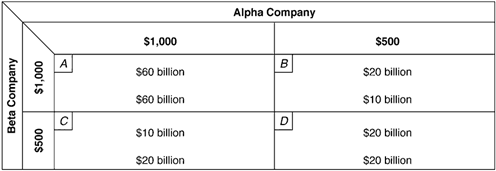 Suppose costs are identical for the two firms in Exhibit 9-4. If both firms assume the other will compete and charge a lower price, equilibrium will be established by:
 (Multiple Choice)
4.9/5 (72)
(72) Exhibit 9-1 A monopolistic competitive firm  As represented in Exhibit 9-1, the maximum long-run economic profit earned by this monopolistic competitive firm is:
 (Multiple Choice)
4.8/5 (79)
(79) A monopolistically competitive firm, like a perfectly competitive firm, is a price taker.
(True/False)
4.9/5 (58)
(58) When Pepsi is considering a price hike, it needs to consider how Coke may react. This situation is called:
(Multiple Choice)
4.7/5 (81)
(81) The demand curve in monopolistic competition slopes downward because of:
(Multiple Choice)
4.7/5 (87)
(87) The theory of oligopolistic interdependence means that the outcome is uncertain because price and output decisions depend on responses of rivals.
(True/False)
4.9/5 (86)
(86) Exhibit 9-4 Two-Firm Payoff Matrix 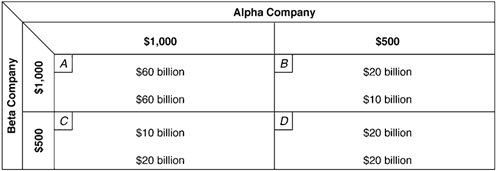 Assume costs are identical for the two firms in Exhibit 9-4. If both firms were allowed to form a cartel and agree on their prices, equilibrium would be established by:
 (Multiple Choice)
4.9/5 (85)
(85) Tombstones are produced in a monopolistic competitive market. One producer, Rolling Stones, sells 20 tombstones a week at a price of $500 each. Its average total cost is $600. From this information, we can tell:
(Multiple Choice)
4.9/5 (71)
(71) Which of the following is the best example of a monopolistically competitive market?
(Multiple Choice)
4.7/5 (67)
(67) Which of the following is true for perfect competition, monopolistic competition, and monopoly?
(Multiple Choice)
4.9/5 (86)
(86) In the short run both the monopolistically competitive firm and the perfectly competitive firm will charge a price equal to marginal cost.
(True/False)
4.7/5 (98)
(98) As new firms enter a monopolistic competitive industry, it can be expected that:
(Multiple Choice)
4.9/5 (79)
(79) A market situation where a small number of sellers dominate the entire industry is called:
(Multiple Choice)
4.7/5 (67)
(67) One key characteristic that is distinctive of an oligopoly market is that:
(Multiple Choice)
4.9/5 (70)
(70) Which of the following is always associated with monopolistic competition?
(Multiple Choice)
4.9/5 (83)
(83) 
Filters
- Essay(0)
- Multiple Choice(0)
- Short Answer(0)
- True False(0)
- Matching(0)