



 Chat with AI
Exam 2: Production Possibilities, Opportunity Cost, and Economic Growth

Exam 1: Introducing the Economic Way of Thinking254 Questions
Exam 2: Production Possibilities, Opportunity Cost, and Economic Growth209 Questions
Exam 3: Market Demand and Supply361 Questions
Exam 4: Markets in Action259 Questions
Exam 5: Price Elasticity of Demand181 Questions
Exam 6: Production Costs254 Questions
Exam 7: Perfect Competition226 Questions
Exam 8: Monopoly175 Questions
Exam 9: Monopolistic Competition and Oligopoly166 Questions
Exam 10: Labor Markets and Income Distribution185 Questions
Exam 11: Gross Domestic Product207 Questions
Exam 12: Business Cycles and Unemployment199 Questions
Exam 13: Inflation131 Questions
Exam 14: Aggregate Demand and Supply83 Questions
Exam 15: Fiscal Policy205 Questions
Exam 16: The Public Sector131 Questions
Exam 17: Federal Deficits, Surpluses, and the National Debt102 Questions
Exam 18: Money and the Federal Reserve System159 Questions
Exam 19: Money Creation250 Questions
Exam 20: Policy Disputes Using the Self-Correcting Aggregate Demand and Supply Model246 Questions
Exam 21: International Trade and Finance251 Questions
Exam 22: Economies in Transition108 Questions
Exam 23: Growth and the Less-Developed Countries121 Questions
Select questions type


Investment is an economic term for the act of increasing the stock of money available for business loans.
(True/False)
4.9/5  (75)
(75) A point outside the production possibilities curve represents a combination of goods that is:
(Multiple Choice)
4.9/5 (99)
(99) Exhibit 2-8 Production possibilities curve data  As shown in Exhibit 2-8, a total output of 0 units of capital goods and 10 units of consumer goods is:
 (Multiple Choice)
4.9/5 (80)
(80) The law of increasing costs indicates that the opportunity cost of producing a good:
(Multiple Choice)
4.8/5 (68)
(68) A production possibilities curve is drawn based on the assumptions that resources are fixed and fully employed and technology advances at the rate of growth of the economy overall.
(True/False)
4.9/5 (75)
(75) While waiting in line to buy one cheeseburger for $1.50 and a medium drink for $1.00, Sally notices that she could get a value meal that contains both the cheeseburger and medium drink and also a medium order of fries for $2.75. She thinks to herself, "Is it worth the extra 25 cents to get the medium fries?" To an economist, Sally's decision is an example of:
(Multiple Choice)
4.9/5 (71)
(71) People in poor countries may have difficulties achieving economic growth because:
(Multiple Choice)
4.9/5 (80)
(80) The various combinations of goods and services that can be produced, when an economy uses its available resources and technology efficiently, is called:
(Multiple Choice)
4.9/5 (78)
(78) Unemployment or underemployment of labor might explain why an economy would be operating inside its production possibilities curve (PPC).
(True/False)
4.8/5 (76)
(76) Exhibit 2-3 Production possibilities curve data  According to the data given in Exhibit 2-3, the production of 1 unit of capital goods and 14 units of consumer goods:
 (Multiple Choice)
4.7/5 (70)
(70) Assuming an economy is already experiencing full employment, then it must produce more consumer goods and fewer capital goods if it wishes to experience greater rates of economic growth over time.
(True/False)
4.8/5 (84)
(84) Just before class, Jim tells Stuart, "Stuart, you shouldn't skip class today because you have paid tuition to enroll in the class." Stuart ignores Jim's advice, and instead makes the decision of whether to attend based on the importance to his grade that he feels he'd be missing that day in class relative to his value of the extra time he could have to finish the video game he is playing. To an economist, Stuart is:
(Multiple Choice)
4.8/5 (84)
(84) Which of the following is true about the production possibilities curve when a technological progress occurs? The curve:
(Multiple Choice)
4.9/5 (81)
(81) A local restaurant offers an "all you can eat" Sunday brunch for $12. Susan eats four servings, but leaves half of a fifth helping uneaten. Why?
(Multiple Choice)
4.8/5 (68)
(68) Exhibit 2-15 Production possibilities curve 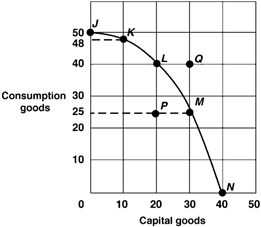 In Exhibit 2-15, what can we conclude about point Q?
 (Multiple Choice)
4.9/5 (73)
(73) Other things being equal, a decreased supply of natural resources would be represented on a production possibilities curve by a(n):
(Multiple Choice)
4.7/5 (83)
(83) All points on the production possibilities curve represent efficient levels of production.
(True/False)
4.9/5 (78)
(78) Exhibit 2-9 Production possibilities curve 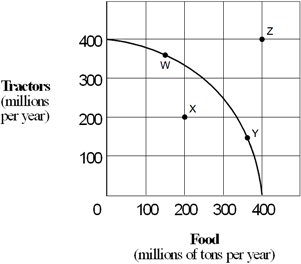 If the economy represented in Exhibit 2-9 is operating at Point W:
 (Multiple Choice)
4.8/5 (87)
(87) 
Filters
- Essay(0)
- Multiple Choice(0)
- Short Answer(0)
- True False(0)
- Matching(0)