



 Chat with AI
Exam 2: Production Possibilities, Opportunity Cost, and Economic Growth

Exam 1: Introducing the Economic Way of Thinking254 Questions
Exam 2: Production Possibilities, Opportunity Cost, and Economic Growth209 Questions
Exam 3: Market Demand and Supply361 Questions
Exam 4: Markets in Action259 Questions
Exam 5: Price Elasticity of Demand181 Questions
Exam 6: Production Costs254 Questions
Exam 7: Perfect Competition226 Questions
Exam 8: Monopoly175 Questions
Exam 9: Monopolistic Competition and Oligopoly166 Questions
Exam 10: Labor Markets and Income Distribution185 Questions
Exam 11: Gross Domestic Product207 Questions
Exam 12: Business Cycles and Unemployment199 Questions
Exam 13: Inflation131 Questions
Exam 14: Aggregate Demand and Supply83 Questions
Exam 15: Fiscal Policy205 Questions
Exam 16: The Public Sector131 Questions
Exam 17: Federal Deficits, Surpluses, and the National Debt102 Questions
Exam 18: Money and the Federal Reserve System159 Questions
Exam 19: Money Creation250 Questions
Exam 20: Policy Disputes Using the Self-Correcting Aggregate Demand and Supply Model246 Questions
Exam 21: International Trade and Finance251 Questions
Exam 22: Economies in Transition108 Questions
Exam 23: Growth and the Less-Developed Countries121 Questions
Select questions type


Mikki decides to work five hours the night before her economics exam. She earns an extra $75, but her exam score is 10 points lower than it would have been had she stayed home and studied. Her opportunity cost is the:
(Multiple Choice)
4.9/5  (85)
(85) Of factors which affect any economy's production potential, the best two listed below are:
(Multiple Choice)
4.8/5 (70)
(70) Which of the following is true of the production possibilities curve?
(Multiple Choice)
4.8/5 (88)
(88) If an economy is producing at full employment, it means that:
(Multiple Choice)
4.8/5 (87)
(87) What shape is the production possibilities curve usually expected to exhibit?
(Multiple Choice)
4.8/5 (81)
(81) Exhibit 2-2 Production possibilities curve  In Exhibit 2-2, the opportunity cost of coffee when moving from A to B is:
 (Multiple Choice)
4.8/5 (71)
(71) Because of the problem of scarcity, each economic system must make which of the following choices?
(Multiple Choice)
4.9/5 (77)
(77) The process through which an economy's production possibilities curve shifts outward is:
(Multiple Choice)
4.8/5 (95)
(95) The highest valued alternative that must be given up in order to choose an option is called the:
(Multiple Choice)
4.9/5 (77)
(77) The most efficient point on the production possibilities curve is the midpoint on the curve.
(True/False)
4.9/5 (74)
(74) Exhibit 2-13 Production possibilities curve 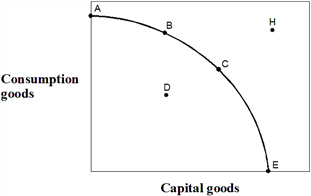 In Exhibit 2-13, the combination of goods given by point H could:
 (Multiple Choice)
4.9/5 (86)
(86) A farmer is deciding whether or not to add fertilizer to his or her crops. If the farmer adds 1 pound of fertilizer per acre, the value of the resulting crops rises from $80 to $100 per acre. According to marginal analysis, the farmer should add fertilizer if it costs less than:
(Multiple Choice)
4.9/5 (81)
(81) Exhibit 2-8 Production possibilities curve data  As shown in Exhibit 2-8, the concept of increasing opportunity costs is reflected in the fact that:
 (Multiple Choice)
4.9/5 (81)
(81) Exhibit 2-16 Production possibilities curve 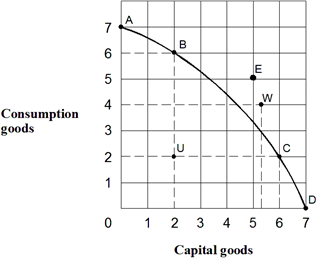 In Exhibit 2-16, which of the following points on the production possibilities curve are efficient production points?
 (Multiple Choice)
4.8/5 (93)
(93) Which of the following is not true about a production possibilities curve? The curve:
(Multiple Choice)
4.9/5 (76)
(76) The production possibility curve is bowed outward from the origin because of:
(Multiple Choice)
4.9/5 (94)
(94) An outward shift of an economy's production possibilities curve is caused by:
(Multiple Choice)
4.9/5 (94)
(94) A nation's current location on its production possibilities curve can determine the future location of that nation's production possibilities curve.
(True/False)
4.9/5 (90)
(90) 
Filters
- Essay(0)
- Multiple Choice(0)
- Short Answer(0)
- True False(0)
- Matching(0)