



 Chat with AI
Exam 6: Production Costs

Exam 1: Introducing the Economic Way of Thinking254 Questions
Exam 2: Production Possibilities, Opportunity Cost, and Economic Growth209 Questions
Exam 3: Market Demand and Supply361 Questions
Exam 4: Markets in Action259 Questions
Exam 5: Price Elasticity of Demand181 Questions
Exam 6: Production Costs254 Questions
Exam 7: Perfect Competition226 Questions
Exam 8: Monopoly175 Questions
Exam 9: Monopolistic Competition and Oligopoly166 Questions
Exam 10: Labor Markets and Income Distribution185 Questions
Exam 11: Gross Domestic Product207 Questions
Exam 12: Business Cycles and Unemployment199 Questions
Exam 13: Inflation131 Questions
Exam 14: Aggregate Demand and Supply83 Questions
Exam 15: Fiscal Policy205 Questions
Exam 16: The Public Sector131 Questions
Exam 17: Federal Deficits, Surpluses, and the National Debt102 Questions
Exam 18: Money and the Federal Reserve System159 Questions
Exam 19: Money Creation250 Questions
Exam 20: Policy Disputes Using the Self-Correcting Aggregate Demand and Supply Model246 Questions
Exam 21: International Trade and Finance251 Questions
Exam 22: Economies in Transition108 Questions
Exam 23: Growth and the Less-Developed Countries121 Questions
Select questions type


A young chef is considering opening his own sushi bar. To do so, he would have to quit his current job, which pays $20,000 a year, and take over a store building that he owns and currently rents to his brother for $6,000 a year. His expenses at the sushi bar would be $50,000, for food and $2,000 for gas and electricity. What are his implicit costs?
(Multiple Choice)
4.7/5  (84)
(84) Exhibit 6-8 Costs schedules for producing pizza 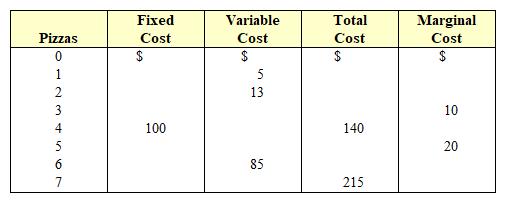 By filling in the blanks in Exhibit 6-8, the fixed cost of producing 6 pizzas is shown to be equal to:
 (Multiple Choice)
4.9/5 (70)
(70) Total fixed costs are costs that are fixed with respect to:
(Multiple Choice)
4.9/5 (71)
(71) Exhibit 6-14 Cost curves 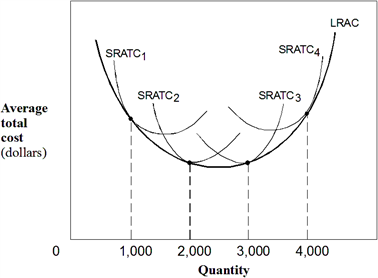 In Exhibit 6-14, constant returns to scale only exist for output levels between:
 (Multiple Choice)
4.8/5 (93)
(93) Exhibit 6-13 Cost curves 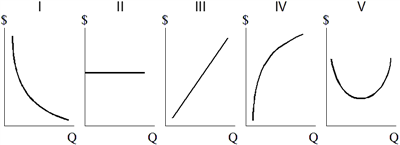 In Exhibit 13, TFC is shown by the graph labeled:
 (Multiple Choice)
4.8/5 (81)
(81) Exhibit 6-12 Cost schedule for producing pizza 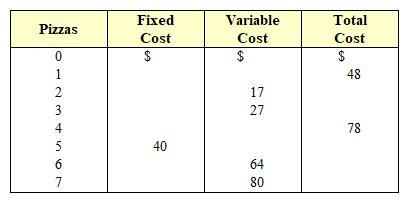 By filling in the blanks in Exhibit 6-12, the AVC of 4 pizzas is shown to be equal to:
 (Multiple Choice)
4.8/5 (90)
(90) Exhibit 6-3 A marginal product curve 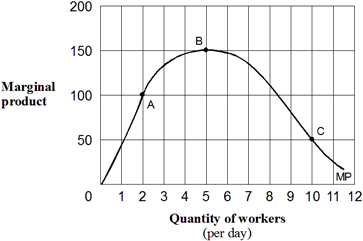 As shown in Exhibit 6-3, the marginal product of labor for the last worker hired when 5 workers are employed per day is:
 (Multiple Choice)
4.8/5 (71)
(71) If the minimum points of all the possible short-run average total cost curves become successively lower as quantity of output increases, then:
(Multiple Choice)
4.8/5 (66)
(66) Each potential short-run average total cost curve is tangent to the long-run average cost curve at:
(Multiple Choice)
4.8/5 (71)
(71) Exhibit 6-8 Costs schedules for producing pizza 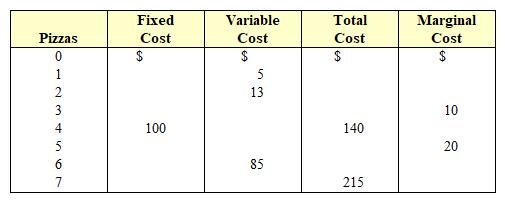 By filling in the blanks in Exhibit 6-8, the total cost of producing 5 pizzas is shown to be equal to:
 (Multiple Choice)
4.8/5 (75)
(75) If a firm has total revenue of $200 million, explicit costs of $190 million, and implicit costs of $30 million, its economic profit is:
(Multiple Choice)
4.9/5 (64)
(64) Assume both the marginal cost and the average variable cost curves are U-shaped. At the minimum point on the AVC curve, marginal cost must be:
(Multiple Choice)
4.9/5 (74)
(74) Sam quits his job as an airline pilot and opens his own pilot training school. He was earning $40,000 as a pilot. He withdraws $10,000 from his savings where he was earning 6 percent interest and uses the money in his new business. He uses a building he owns as a hanger and could rent it out for $5,000 per year. He rents a computer for $1,200, buys office supplies for $500, rents an airplane for $6,000, pays $1,300 for fuel and maintenance, and hires one worker for $30,000. Sam's total revenue from pilot training classes this year equaled $90,400. Sam's explicit costs this year equals:
(Multiple Choice)
4.9/5 (87)
(87) Which of the following is true if the total cost curve is rising?
(Multiple Choice)
4.8/5 (83)
(83) A firm estimates that when output is 10, its total costs are $900. It also finds that when output is 11, its total costs are $920. The marginal cost of the eleventh unit of output is:
(Multiple Choice)
4.9/5 (81)
(81) If two workers can produce 22 units of output, and the addition of a third worker increases output to 30 units, the marginal product of the third worker is
(Multiple Choice)
4.9/5 (71)
(71) 
Filters
- Essay(0)
- Multiple Choice(0)
- Short Answer(0)
- True False(0)
- Matching(0)