



 Chat with AI
Exam 8: Monopoly

Exam 1: Introducing the Economic Way of Thinking254 Questions
Exam 2: Production Possibilities, Opportunity Cost, and Economic Growth209 Questions
Exam 3: Market Demand and Supply361 Questions
Exam 4: Markets in Action259 Questions
Exam 5: Price Elasticity of Demand181 Questions
Exam 6: Production Costs254 Questions
Exam 7: Perfect Competition226 Questions
Exam 8: Monopoly175 Questions
Exam 9: Monopolistic Competition and Oligopoly166 Questions
Exam 10: Labor Markets and Income Distribution185 Questions
Exam 11: Gross Domestic Product207 Questions
Exam 12: Business Cycles and Unemployment199 Questions
Exam 13: Inflation131 Questions
Exam 14: Aggregate Demand and Supply83 Questions
Exam 15: Fiscal Policy205 Questions
Exam 16: The Public Sector131 Questions
Exam 17: Federal Deficits, Surpluses, and the National Debt102 Questions
Exam 18: Money and the Federal Reserve System159 Questions
Exam 19: Money Creation250 Questions
Exam 20: Policy Disputes Using the Self-Correcting Aggregate Demand and Supply Model246 Questions
Exam 21: International Trade and Finance251 Questions
Exam 22: Economies in Transition108 Questions
Exam 23: Growth and the Less-Developed Countries121 Questions
Select questions type


A monopoly can successfully price discriminate as long as there are no close substitutes for its product.
(True/False)
4.8/5  (77)
(77) Exhibit 8-6 Monopoly 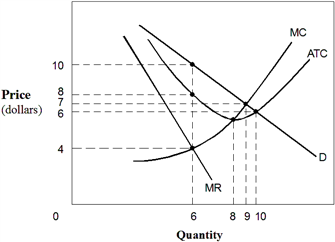 When the monopolist is maximizing total profit in Exhibit 8-6, the average total cost of producing that output level is:
 (Multiple Choice)
4.8/5 (93)
(93) Although a monopoly can charge any price it wishes, it chooses:
(Multiple Choice)
4.8/5 (77)
(77) For a monopoly to successfully price discriminate, its customers must:
(Multiple Choice)
4.9/5 (62)
(62) Exhibit 8-10 A monopolist 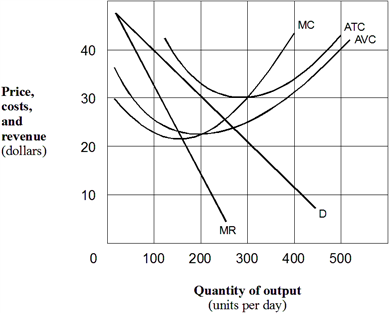 In Exhibit 8-10, the monopolist would charge which of the following prices to maximize profit or minimize its loss?
 (Multiple Choice)
4.9/5 (78)
(78) Because monopolists are protected by high barriers to entry, they:
(Multiple Choice)
4.9/5 (84)
(84) An example of price discrimination is the price charged for:
(Multiple Choice)
4.9/5 (71)
(71) Exhibit 8-4 Demand and cost curves for a monopolist  As shown in Exhibit 8-4, in order to maximize its profit (or minimize its loss), what price should the monopoly charge for its product?
 (Multiple Choice)
4.8/5 (87)
(87) Assume a monopolist charges a price corresponding to the intersection of the marginal cost and marginal revenue curves. If this price is between its average variable cost and average total cost curves, the firm will:
(Multiple Choice)
4.9/5 (85)
(85) A monopoly firm can sell its fourth unit of output for a price of $250. In order to sell more than five units, it must expect to receive a price:
(Multiple Choice)
4.9/5 (82)
(82) If the average total cost curve is always above the demand curve for a monopolist:
(Multiple Choice)
4.8/5 (78)
(78) Which of the following statements best describes the price, output, and profit conditions of monopoly?
(Multiple Choice)
4.9/5 (66)
(66) Suppose a monopolist's demand curve lies below its average variable cost curve. The firm will:
(Multiple Choice)
4.7/5 (90)
(90) 
Filters
- Essay(0)
- Multiple Choice(0)
- Short Answer(0)
- True False(0)
- Matching(0)