



 Chat with AI
Exam 8: Monopoly

Exam 1: Introducing the Economic Way of Thinking254 Questions
Exam 2: Production Possibilities, Opportunity Cost, and Economic Growth209 Questions
Exam 3: Market Demand and Supply361 Questions
Exam 4: Markets in Action259 Questions
Exam 5: Price Elasticity of Demand181 Questions
Exam 6: Production Costs254 Questions
Exam 7: Perfect Competition226 Questions
Exam 8: Monopoly175 Questions
Exam 9: Monopolistic Competition and Oligopoly166 Questions
Exam 10: Labor Markets and Income Distribution185 Questions
Exam 11: Gross Domestic Product207 Questions
Exam 12: Business Cycles and Unemployment199 Questions
Exam 13: Inflation131 Questions
Exam 14: Aggregate Demand and Supply83 Questions
Exam 15: Fiscal Policy205 Questions
Exam 16: The Public Sector131 Questions
Exam 17: Federal Deficits, Surpluses, and the National Debt102 Questions
Exam 18: Money and the Federal Reserve System159 Questions
Exam 19: Money Creation250 Questions
Exam 20: Policy Disputes Using the Self-Correcting Aggregate Demand and Supply Model246 Questions
Exam 21: International Trade and Finance251 Questions
Exam 22: Economies in Transition108 Questions
Exam 23: Growth and the Less-Developed Countries121 Questions
Select questions type


Exhibit 8-8 Profit maximizing for a monopolist 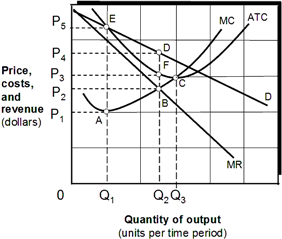 As shown in Exhibit 8-8, the monopolist's profit maximizing price-quantity point is:
 (Multiple Choice)
4.9/5  (79)
(79) Exhibit 8-2 Demand and cost information for a monopoly  The marginal revenue of the second unit of output in Exhibit 8-2 is:
 (Multiple Choice)
4.9/5 (80)
(80) The act of buying a commodity in one market at a lower price and selling it in another market at a higher price is known as:
(Multiple Choice)
4.9/5 (52)
(52) Using the rule that focuses on the marginal approach to maximizing profits, a monopolist charges a price where the:
(Multiple Choice)
4.9/5 (71)
(71) Exhibit 8-5 Demand and cost data for a monopolist  Refer to Exhibit 8-5. The demand schedule and cost schedule for a monopolist are provided. Which output level maximizes profit?
 (Multiple Choice)
4.8/5 (89)
(89) Exhibit 8-7 Monopolist 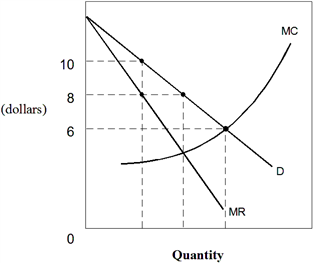 According to the information provided in Exhibit 8-7, if the Rudd Ice Company was a monopoly and is currently charging a price of $10, what would you advise Rudd to do?
 (Multiple Choice)
5.0/5 (76)
(76) A price-discriminating monopoly charges the lowest price to the group that:
(Multiple Choice)
4.9/5 (65)
(65) The monopolist, unlike the perfectly competitive firm, can continue to earn an economic profit in the long run because of:
(Multiple Choice)
4.8/5 (77)
(77) Exhibit 8-5 Demand and cost data for a monopolist  By calculating the data provided in Exhibit 8-5, how much is the profit if the firm decides to produce 7 units?
 (Multiple Choice)
4.9/5 (77)
(77) For a monopolist to practice effective price discrimination, one necessary condition is:
(Multiple Choice)
4.9/5 (77)
(77) In contrast to a perfectly competitive firm, a monopolist earns:
(Multiple Choice)
4.8/5 (75)
(75) Which of the following is not associated with the monopoly market structure?
(Multiple Choice)
4.8/5 (75)
(75) Which of the following statements best describe the price, output, and profit conditions of monopoly?
(Multiple Choice)
4.7/5 (73)
(73) An example of price discrimination is the price charged for:
(Multiple Choice)
4.8/5 (77)
(77) A monopolist will earn economic profits as long as his price exceeds:
(Multiple Choice)
5.0/5 (85)
(85) Exhibit 8-10 A monopolist 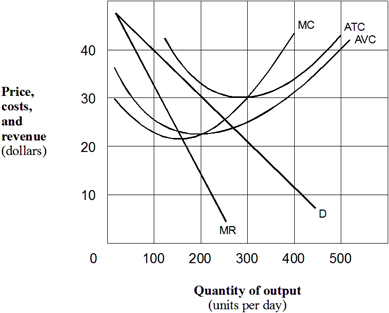 In Exhibit 8-10, the profit-maximizing or loss-minimizing output for the monopolist is:
 (Multiple Choice)
4.9/5 (67)
(67) A perfectly competitive firm is a price taker, but a monopoly is a price maker.
(True/False)
4.8/5 (78)
(78) 
Filters
- Essay(0)
- Multiple Choice(0)
- Short Answer(0)
- True False(0)
- Matching(0)