



 Chat with AI
Exam 8: Monopoly

Exam 1: Introducing the Economic Way of Thinking254 Questions
Exam 2: Production Possibilities, Opportunity Cost, and Economic Growth209 Questions
Exam 3: Market Demand and Supply361 Questions
Exam 4: Markets in Action259 Questions
Exam 5: Price Elasticity of Demand181 Questions
Exam 6: Production Costs254 Questions
Exam 7: Perfect Competition226 Questions
Exam 8: Monopoly175 Questions
Exam 9: Monopolistic Competition and Oligopoly166 Questions
Exam 10: Labor Markets and Income Distribution185 Questions
Exam 11: Gross Domestic Product207 Questions
Exam 12: Business Cycles and Unemployment199 Questions
Exam 13: Inflation131 Questions
Exam 14: Aggregate Demand and Supply83 Questions
Exam 15: Fiscal Policy205 Questions
Exam 16: The Public Sector131 Questions
Exam 17: Federal Deficits, Surpluses, and the National Debt102 Questions
Exam 18: Money and the Federal Reserve System159 Questions
Exam 19: Money Creation250 Questions
Exam 20: Policy Disputes Using the Self-Correcting Aggregate Demand and Supply Model246 Questions
Exam 21: International Trade and Finance251 Questions
Exam 22: Economies in Transition108 Questions
Exam 23: Growth and the Less-Developed Countries121 Questions
Select questions type


Exhibit 8-6 Monopoly  The maximum possible total monopoly profit in Exhibit 8-6 is:
 (Multiple Choice)
4.8/5  (90)
(90) There is only one gas station within hundreds of miles. The owner finds that when she charges $3 a gallon, she sells 199 gallons a day, and when she charges $2.99 a gallon, she sells 200 gallons a day. The marginal revenue of the 200th gallon of gas is:
(Multiple Choice)
4.8/5 (87)
(87) An example of price discrimination is the price charged for:
(Multiple Choice)
4.7/5 (89)
(89) When a monopoly price discriminates, it charges the highest price to the group of buyers with the least elastic demand.
(True/False)
5.0/5 (78)
(78) What should a profit maximizing monopolist do if she is currently producing where MC
(Multiple Choice)
4.8/5 (85)
(85) Suppose a monopolist charges a price corresponding to the intersection of the marginal cost and marginal revenue curves. If this price is between its average variable cost and average total cost curves, the firm will:
(Multiple Choice)
4.7/5 (76)
(76) Total revenue is maximized along what portion of a monopolist's demand curve?
(Multiple Choice)
4.8/5 (72)
(72) Exhibit 8-10 A monopolist 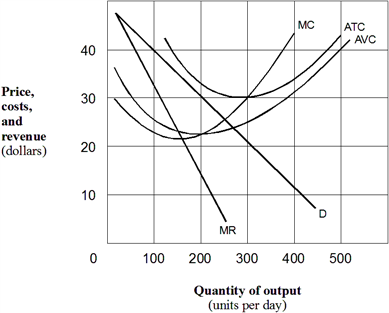 In Exhibit 8-10, at the profit-maximizing or loss-minimizing output, the monopolist's total economic profit is:
 (Multiple Choice)
4.7/5 (84)
(84) An argument in favor of price discrimination is that this pricing strategy permits some consumers who otherwise would be excluded from a market to buy a good or service.
(True/False)
4.8/5 (80)
(80) Exhibit 8-8 Profit maximizing for a monopolist 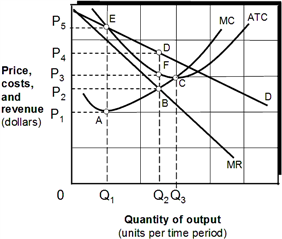 As shown in Exhibit 8-8, if the monopolist produces the profit-maximizing output, total revenue is the rectangular area:
 (Multiple Choice)
4.9/5 (83)
(83) Marginal revenue equals zero at which point on the monopolist's demand curve?
(Multiple Choice)
4.8/5 (81)
(81) A natural monopoly exists whenever economies of scale are very extensive.
(True/False)
4.9/5 (65)
(65) At the level of output where the marginal cost and marginal revenue curves intersect, a monopolist's demand curve passes above its average total cost curve. The firm will:
(Multiple Choice)
4.8/5 (88)
(88) What is a natural monopoly? Why is government justified in regulating a natural monopoly?
(Essay)
4.9/5 (99)
(99) A monopolist always selects a price on the elastic portion of its demand curve.
(True/False)
4.8/5 (78)
(78) A monopolist will be able to earn positive pure economic profits regardless of the price elasticity of demand.
(True/False)
4.8/5 (90)
(90) Regardless of the demand for its product, a monopolist will be able to earn positive economic profits.
(True/False)
4.9/5 (83)
(83) 
Filters
- Essay(0)
- Multiple Choice(0)
- Short Answer(0)
- True False(0)
- Matching(0)