



 Chat with AI
Exam 21: International Trade and Finance

Exam 1: Introducing the Economic Way of Thinking254 Questions
Exam 2: Production Possibilities, Opportunity Cost, and Economic Growth209 Questions
Exam 3: Market Demand and Supply361 Questions
Exam 4: Markets in Action259 Questions
Exam 5: Price Elasticity of Demand181 Questions
Exam 6: Production Costs254 Questions
Exam 7: Perfect Competition226 Questions
Exam 8: Monopoly175 Questions
Exam 9: Monopolistic Competition and Oligopoly166 Questions
Exam 10: Labor Markets and Income Distribution185 Questions
Exam 11: Gross Domestic Product207 Questions
Exam 12: Business Cycles and Unemployment199 Questions
Exam 13: Inflation131 Questions
Exam 14: Aggregate Demand and Supply83 Questions
Exam 15: Fiscal Policy205 Questions
Exam 16: The Public Sector131 Questions
Exam 17: Federal Deficits, Surpluses, and the National Debt102 Questions
Exam 18: Money and the Federal Reserve System159 Questions
Exam 19: Money Creation250 Questions
Exam 20: Policy Disputes Using the Self-Correcting Aggregate Demand and Supply Model246 Questions
Exam 21: International Trade and Finance251 Questions
Exam 22: Economies in Transition108 Questions
Exam 23: Growth and the Less-Developed Countries121 Questions
Select questions type


If the current account and capital account are both in surplus, the official reserve account does not have to be in deficit.
(True/False)
4.8/5  (84)
(84) Assume the United States can use a given amount of its resources to produce either 20 airplanes or 8 automobiles and Japan can employ the same amount of its resources to produce either 20 airplanes or 10 automobiles. The U.S. should specialize in:
(Multiple Choice)
4.9/5 (93)
(93) Exhibit 21-4 Coffee and tea output (pounds per hour) 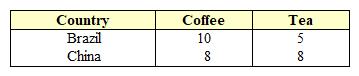 As shown in Exhibit 21-4, compared to Brazil, China has a comparative advantage in the production of:
 (Multiple Choice)
5.0/5 (87)
(87) What are the benefits and costs to a nation that participates in international trade? Do the benefits outweigh the costs or do the costs outweigh the benefits?
(Essay)
4.8/5 (73)
(73) Protectionist policies such as tariffs and quotas are beneficial to the nation imposing those trade barriers.
(True/False)
4.9/5 (92)
(92) If people's incomes decrease, their demand for other currencies shifts to the right.
(True/False)
4.8/5 (81)
(81) Suppose you are traveling from the United States to Djibouti on vacation. You would be better off on your vacation if:
(Multiple Choice)
4.7/5 (69)
(69) When an exchange rate is determined strictly by the demands and supplies for a nation's currency, it is called:
(Multiple Choice)
4.8/5 (66)
(66) Suppose the exchange rate changes so that more Japanese yen are required to buy a dollar. We could conclude that:
(Multiple Choice)
4.9/5 (72)
(72) Suppose that country X can produce 1,000 pounds of flour per hour, or catch 500 pounds of fish per hour. In contrast, country Y can produce 1,800 pounds of flour per hour, or catch 300 pounds of fish per hour. If both countries specialize in their comparative advantage and trade, by how much combined output of fish and flour per hour be greater than if there were no trade and the countries divide an hour of time equally between each output?
(Multiple Choice)
4.8/5 (85)
(85) A tariff has the effect of granting ____ a larger share of the domestic market.
(Multiple Choice)
4.7/5 (85)
(85) The argument that foreign trade should be restricted to protect domestic employment and output is based on the idea that:
(Multiple Choice)
5.0/5 (88)
(88) Exhibit 21-1 Production possibilities curves 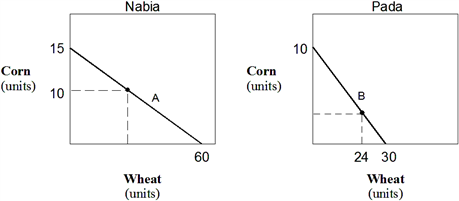 In Exhibit 21-1, the production possibilities curves of wheat and corn for Nabia and Pada are presented. In Pada the cost of producing one more unit of wheat is equal to:
 (Multiple Choice)
4.8/5 (83)
(83) Exhibit 21-4 Coffee and tea output (pounds per hour) 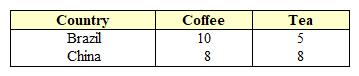 As shown in Exhibit 21-4, If each country produced according to its comparative advantage, Brazil would produce:
 (Multiple Choice)
5.0/5 (68)
(68) If the yen price of dollars falls, then the dollar price of yen rises.
(True/False)
4.8/5 (81)
(81) When countries specialize, total world output increases, and, therefore, the potential for greater total world consumption also increases.
(True/False)
4.8/5 (79)
(79) 
Filters
- Essay(0)
- Multiple Choice(0)
- Short Answer(0)
- True False(0)
- Matching(0)