



 Chat with AI
Exam 21: International Trade and Finance

Exam 1: Introducing the Economic Way of Thinking254 Questions
Exam 2: Production Possibilities, Opportunity Cost, and Economic Growth209 Questions
Exam 3: Market Demand and Supply361 Questions
Exam 4: Markets in Action259 Questions
Exam 5: Price Elasticity of Demand181 Questions
Exam 6: Production Costs254 Questions
Exam 7: Perfect Competition226 Questions
Exam 8: Monopoly175 Questions
Exam 9: Monopolistic Competition and Oligopoly166 Questions
Exam 10: Labor Markets and Income Distribution185 Questions
Exam 11: Gross Domestic Product207 Questions
Exam 12: Business Cycles and Unemployment199 Questions
Exam 13: Inflation131 Questions
Exam 14: Aggregate Demand and Supply83 Questions
Exam 15: Fiscal Policy205 Questions
Exam 16: The Public Sector131 Questions
Exam 17: Federal Deficits, Surpluses, and the National Debt102 Questions
Exam 18: Money and the Federal Reserve System159 Questions
Exam 19: Money Creation250 Questions
Exam 20: Policy Disputes Using the Self-Correcting Aggregate Demand and Supply Model246 Questions
Exam 21: International Trade and Finance251 Questions
Exam 22: Economies in Transition108 Questions
Exam 23: Growth and the Less-Developed Countries121 Questions
Select questions type


An increase in the value of the dollar in international exchange rate markets will cause the relative price of U.S. produced goods to foreigners to rise, the relative price of foreign produced goods to Americans to fall, causing U.S. exports to fall and U.S. imports to rise.
(True/False)
4.8/5  (97)
(97) Which of the following would be expected if the tariff on foreign-produced automobiles were increased?
(Multiple Choice)
4.9/5 (88)
(88) When Brazil can generate a product using fewer labor hours and resources than the United States, an economist would say that Brazil had:
(Multiple Choice)
4.8/5 (73)
(73) A basic problem with the infant-industry argument is that:
(Multiple Choice)
5.0/5 (74)
(74) If a nation follows a policy of being self-sufficient, its:
(Multiple Choice)
4.8/5 (76)
(76) If the United States were to adopt a policy of free trade with European countries and Japan, this policy would:
(Multiple Choice)
4.9/5 (73)
(73) Suppose a U.S.-made machine costs $500 and the exchange rate is 100 yen = $1. Now the exchange rate changes to 90 yen = $1. Then the:
(Multiple Choice)
4.9/5 (75)
(75) Exhibit 21-3 Potatoes and wheat output (tons per day) 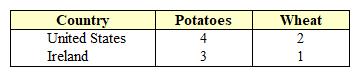 In Exhibit 21-3, the United States has a comparative advantage in producing:
 (Multiple Choice)
4.9/5 (70)
(70) An increase in a nation's trade deficit occurs when that nation's exports rise and/or its imports fall.
(True/False)
4.9/5 (93)
(93) 
Filters
- Essay(0)
- Multiple Choice(0)
- Short Answer(0)
- True False(0)
- Matching(0)