



 Chat with AI
Exam 21: International Trade and Finance

Exam 1: Introducing the Economic Way of Thinking254 Questions
Exam 2: Production Possibilities, Opportunity Cost, and Economic Growth209 Questions
Exam 3: Market Demand and Supply361 Questions
Exam 4: Markets in Action259 Questions
Exam 5: Price Elasticity of Demand181 Questions
Exam 6: Production Costs254 Questions
Exam 7: Perfect Competition226 Questions
Exam 8: Monopoly175 Questions
Exam 9: Monopolistic Competition and Oligopoly166 Questions
Exam 10: Labor Markets and Income Distribution185 Questions
Exam 11: Gross Domestic Product207 Questions
Exam 12: Business Cycles and Unemployment199 Questions
Exam 13: Inflation131 Questions
Exam 14: Aggregate Demand and Supply83 Questions
Exam 15: Fiscal Policy205 Questions
Exam 16: The Public Sector131 Questions
Exam 17: Federal Deficits, Surpluses, and the National Debt102 Questions
Exam 18: Money and the Federal Reserve System159 Questions
Exam 19: Money Creation250 Questions
Exam 20: Policy Disputes Using the Self-Correcting Aggregate Demand and Supply Model246 Questions
Exam 21: International Trade and Finance251 Questions
Exam 22: Economies in Transition108 Questions
Exam 23: Growth and the Less-Developed Countries121 Questions
Select questions type


Exhibit 21-6 Dollars per British pound 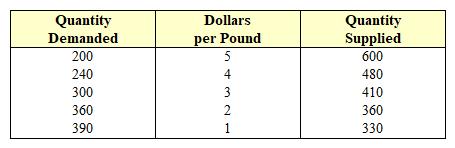 In Exhibit 21-6, the exchange rate will have no tendency to change when it is equal to:
 (Multiple Choice)
4.7/5  (73)
(73) Which of the following is excluded in the current account?
(Multiple Choice)
5.0/5 (76)
(76) Under a fixed exchange rate system, a government is at risk of running out of foreign currency reserves when the country's imports exceed its exports.
(True/False)
4.8/5 (84)
(84) If it costs the DuPont Chemical Company more to make the chemical flaxinate in the United States than it does to make it in Formosa, the Formosans must have:
(Multiple Choice)
4.9/5 (77)
(77) When a nation totally bans trade with another country, it is imposing a(n):
(Multiple Choice)
4.9/5 (70)
(70) Which of the following is included in the current account?
(Multiple Choice)
4.9/5 (74)
(74) Exhibit 21-2 Production possibilities curves for U. S. and Mexico 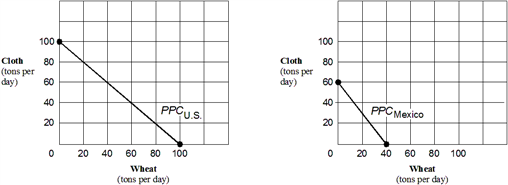 As shown in Exhibit 21-2, in Mexico, producing 1 additional ton of wheat costs:
 (Multiple Choice)
4.8/5 (85)
(85) Which of the following statements is true with respect to a tariff on imported cheese?
(Multiple Choice)
4.8/5 (83)
(83) Exhibit 21-1 Production possibilities curves 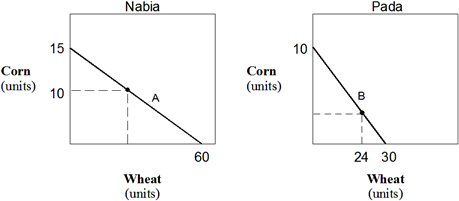 In Exhibit 21-1, the production possibilities curves of wheat and corn for Nabia and Pada are presented. Suppose Nabia produces at point A on its PPC. How many units of wheat is the country able to produce?
 (Multiple Choice)
4.9/5 (59)
(59) Which of the following transactions would be recorded as a credit in the U.S. current account?
(Multiple Choice)
4.9/5 (79)
(79) The nice thing about foreign exchange markets is that the goods are money, and they are paid for with money. This means that if the U.S. dollar ____ the Japanese yen ____.
(Multiple Choice)
4.9/5 (75)
(75) An increase in the real rate of interest that can be earned on U.S. investments above the rate that can be earned on investments in India would:
(Multiple Choice)
4.9/5 (84)
(84) If foreign exchange rates are determined by the interaction of supply and demand forces for the various currencies, then the exchange rate is:
(Multiple Choice)
4.8/5 (78)
(78) The U.S. supply curve of dollars is upward-sloping because a:
(Multiple Choice)
4.9/5 (74)
(74) A U.S. citizen's gift for famine relief in Somalia would be considered a:
(Multiple Choice)
4.7/5 (79)
(79) If a country has a comparative advantage in oil, then this means that the opportunity cost of producing oil is:
(Multiple Choice)
5.0/5 (91)
(91) Exhibit 21-5 International currency markets 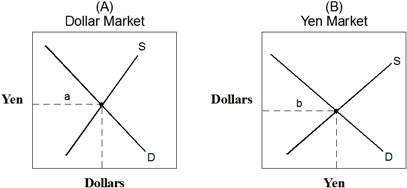 Exhibit 21-5 displays the international currency market for yen in terms of dollars and dollars in terms of yen. The demand curve in graph 5(B) is determined by:
 (Multiple Choice)
4.9/5 (74)
(74) The U.S. balance of trade has been in a large surplus since 2001.
(True/False)
4.8/5 (82)
(82) 
Filters
- Essay(0)
- Multiple Choice(0)
- Short Answer(0)
- True False(0)
- Matching(0)