



 Chat with AI
Exam 21: International Trade and Finance

Exam 1: Introducing the Economic Way of Thinking254 Questions
Exam 2: Production Possibilities, Opportunity Cost, and Economic Growth209 Questions
Exam 3: Market Demand and Supply361 Questions
Exam 4: Markets in Action259 Questions
Exam 5: Price Elasticity of Demand181 Questions
Exam 6: Production Costs254 Questions
Exam 7: Perfect Competition226 Questions
Exam 8: Monopoly175 Questions
Exam 9: Monopolistic Competition and Oligopoly166 Questions
Exam 10: Labor Markets and Income Distribution185 Questions
Exam 11: Gross Domestic Product207 Questions
Exam 12: Business Cycles and Unemployment199 Questions
Exam 13: Inflation131 Questions
Exam 14: Aggregate Demand and Supply83 Questions
Exam 15: Fiscal Policy205 Questions
Exam 16: The Public Sector131 Questions
Exam 17: Federal Deficits, Surpluses, and the National Debt102 Questions
Exam 18: Money and the Federal Reserve System159 Questions
Exam 19: Money Creation250 Questions
Exam 20: Policy Disputes Using the Self-Correcting Aggregate Demand and Supply Model246 Questions
Exam 21: International Trade and Finance251 Questions
Exam 22: Economies in Transition108 Questions
Exam 23: Growth and the Less-Developed Countries121 Questions
Select questions type


If a country's goods exports are less than its goods imports, then it experiences a:
(Multiple Choice)
4.8/5  (91)
(91) Exhibit 21-5 International currency markets 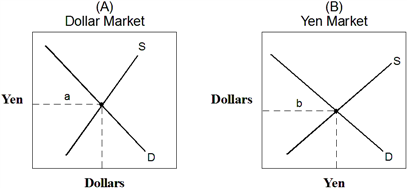 Exhibit 21-5 displays the international currency market for yen in terms of dollars and dollars in terms of yen. The demand curve in graph 5(A) is determined by:
 (Multiple Choice)
4.9/5 (88)
(88) A country's imports of goods minus its exports of goods is reported in the goods balance.
(True/False)
4.9/5 (78)
(78) The North American Free Trade Agreement affects trade between:
(Multiple Choice)
4.9/5 (72)
(72) Suppose the United States decides to impose a $1,000 tax on every Japanese minivan sold in the United States. This is an example of:
(Multiple Choice)
4.8/5 (80)
(80) "More productive workers receive higher wages than less productive workers." This observation is a major flaw in which of the following arguments for protectionism?
(Multiple Choice)
5.0/5 (77)
(77) Without trade, the consumption possibilities for two nations are:
(Multiple Choice)
4.9/5 (83)
(83) Which of the following is not included in the current account?
(Multiple Choice)
4.8/5 (91)
(91) The average National Basketball Association player is over 6 feet tall. The average horse jockey is shorter than 5 1/2 feet tall. This is because height provides NBA players with:
(Multiple Choice)
4.9/5 (84)
(84) Trade restrictions imposed in the name of national security have been recommended by protectionists in order to:
(Multiple Choice)
4.8/5 (77)
(77) Exhibit 21-1 Production possibilities curves 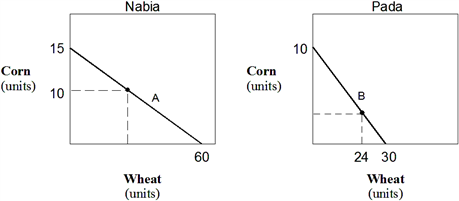 In Exhibit 21-1, the production possibilities curves of wheat and corn for Nabia and Pada are presented. In Nabia the cost of producing one more unit of wheat is equal to:
 (Multiple Choice)
4.9/5 (78)
(78) An itemized account of a nation's foreign economic transactions is its:
(Multiple Choice)
4.7/5 (76)
(76) Suppose that Spain has a comparative advantage in hats and Portugal has a comparative advantage in doormats. Under a system of free trade, each country specializes and then trades with the other. If the price starts at four hats per doormat, and then increases to five hats per doormat, then:
(Multiple Choice)
4.9/5 (75)
(75) Which of the following changes in the exchange rate represents an appreciation of the dollar?
(Multiple Choice)
4.9/5 (84)
(84) One big difference between tariffs and quotas is that tariffs:
(Multiple Choice)
4.8/5 (91)
(91) According to the infant industry argument, a new domestic industry needs protection because it has higher costs than established foreign competitors.
(True/False)
4.8/5 (89)
(89) 
Filters
- Essay(0)
- Multiple Choice(0)
- Short Answer(0)
- True False(0)
- Matching(0)