



 Chat with AI
Exam 56: Ecology and the Geography of Life

Exam 1: A View of Life72 Questions
Exam 2: Atoms and Molecules: the Chemical Basis of Life75 Questions
Exam 3: The Chemistry of Life: Organic Compounds75 Questions
Exam 4: Organization of the Cell76 Questions
Exam 5: Biological Membranes73 Questions
Exam 6: Cell Communication73 Questions
Exam 7: Energy and Metabolism73 Questions
Exam 8: How Cells Make Atp: Energy-Releasing Pathways75 Questions
Exam 9: Photosynthesis: Capturing Light Energy79 Questions
Exam 10: Chromosomes, Mitosis, and Meiosis78 Questions
Exam 11: The Basic Principles of Heredity87 Questions
Exam 12: DNA: The Carrier of Genetic Information83 Questions
Exam 13: Gene Expression92 Questions
Exam 14: Gene Regulation86 Questions
Exam 15: DNA Technology and Genomics98 Questions
Exam 16: Human Genetics and the Human Genome82 Questions
Exam 17: Developmental Genetics90 Questions
Exam 18: Introduction to Darwinian Evolution66 Questions
Exam 19: Evolutionary Change in Populations72 Questions
Exam 20: Speciation and Macroevolution72 Questions
Exam 21: The Origin and Evolutionary History of Life71 Questions
Exam 22: The Evolution of Primates73 Questions
Exam 23: Understanding Diversity: Systematics70 Questions
Exam 24: Viruses and Subviral Agents55 Questions
Exam 25: Bacteria and Archaea63 Questions
Exam 26: Protists76 Questions
Exam 27: Seedless Plants76 Questions
Exam 28: Seed Plants76 Questions
Exam 29: The Fungi78 Questions
Exam 30: An Introduction to Animal Diversity71 Questions
Exam 31: Sponges, Cnidarians, Ctenophores, and Protostomes114 Questions
Exam 32: The Deuterostomes79 Questions
Exam 33: Plant Structure, Growth, and Development94 Questions
Exam 34: Leaf Structure and Function90 Questions
Exam 35: Stem Structure and Transport91 Questions
Exam 36: Roots and Mineral Nutrition105 Questions
Exam 37: Reproduction in Flowering Plants107 Questions
Exam 38: Plant Developmental Responses to External and Internal Signals113 Questions
Exam 39: Animal Structure and Function: an Introduction106 Questions
Exam 40: Protection, Support, and Movement75 Questions
Exam 41: Neural Signaling76 Questions
Exam 42: Neural Regulation81 Questions
Exam 43: Sensory Systems83 Questions
Exam 44: Internal Transport119 Questions
Exam 45: The Immune System: Internal Defense93 Questions
Exam 46: Gas Exchange123 Questions
Exam 47: Processing Food and Nutrition127 Questions
Exam 48: Osmoregulation and Disposal of Metabolic Wastes111 Questions
Exam 49: Endocrine Regulation87 Questions
Exam 50: Reproduction121 Questions
Exam 51: Animal Development117 Questions
Exam 52: Animal Behavior91 Questions
Exam 53: Introduction to Ecology: Population Ecology99 Questions
Exam 54: Community Ecology91 Questions
Exam 55: Ecosystems and the Biosphere101 Questions
Exam 56: Ecology and the Geography of Life99 Questions
Exam 57: Biological Diversity and Conservation Biology82 Questions
Select questions type


The Southern Hemisphere has no equivalent of the boreal forest of the north. Why?
(Multiple Choice)
4.8/5  (73)
(73) Match the biome with its description.
Premises:
bison previously were the main type of grazing animal
Responses:
taiga
tropical rain forest
tundra
Correct Answer: Verified
Premises:
Responses:
(Matching)
4.8/5 (69)
(69) The oceanic province is that part of the ocean that overlies the continental shelf.
(True/False)
4.8/5 (83)
(83) Chose five biomes. Briefly describe how humans have altered those biomes. Consider how humans may have converted these biomes for commercial or agricultural use.
(Essay)
4.8/5 (60)
(60) Which of the following is a characteristic of desert plants?
(Multiple Choice)
4.9/5 (80)
(80) Match the aquatic ecosystem or zone with its description.
Premises:
habitat for migratory birds and holding area for excess water
Responses:
littoral zone
profundal zone
standing-water ecosystem
Correct Answer:Verified
VerifiedPremises:
Responses:
(Matching)
4.9/5 (76)
(76) Figure 56-2
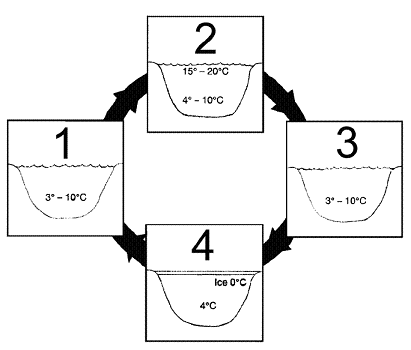
Refer to the accompanying figure. Which of the following represents the fall turnover?
Refer to the accompanying figure. Which of the following represents the fall turnover? (Multiple Choice)
4.8/5 (73)
(73) Which biome is characterized by weasels, gray wolves, ptarmigan, musk oxen, and lemmings?
(Multiple Choice)
4.8/5 (82)
(82) Which factor is most important in determining the distribution of organisms in aquatic biomes?
(Multiple Choice)
4.9/5 (72)
(72) Match the biome with its description.
Premises:
characterized by permafrost
Responses:
tundra
chaparral
taiga
Correct Answer:Verified
VerifiedPremises:
Responses:
(Matching)
4.9/5 (93)
(93) The upper part of the neritic province is called the euphotic zone.
(True/False)
4.9/5 (83)
(83) Much precipitation in the tropical rain forest is derived from:
(Multiple Choice)
4.8/5 (80)
(80) Match the biome with its description.
Premises:
vegetation is mostly conifers, such as spruce, fir, and larch
Responses:
chaparral
temperate deciduous forest
tropical rain forest
Correct Answer:Verified
VerifiedPremises:
Responses:
(Matching)
4.9/5 (76)
(76) Headwater streams depend primarily on ____ as an energy input.
(Multiple Choice)
4.9/5 (90)
(90) The greatest proportion of which two biomes have been converted to agriculture?
(Multiple Choice)
4.9/5 (86)
(86) Match the biome with its description.
Premises:
found on the northwestern coast of North America
Responses:
savanna
tundra
taiga
Correct Answer:Verified
VerifiedPremises:
Responses:
(Matching)
4.9/5 (82)
(82) 
Filters
- Essay(0)
- Multiple Choice(0)
- Short Answer(0)
- True False(0)
- Matching(0)