



 Chat with AI
Exam 54: Community Ecology

Exam 1: A View of Life72 Questions
Exam 2: Atoms and Molecules: the Chemical Basis of Life75 Questions
Exam 3: The Chemistry of Life: Organic Compounds75 Questions
Exam 4: Organization of the Cell76 Questions
Exam 5: Biological Membranes73 Questions
Exam 6: Cell Communication73 Questions
Exam 7: Energy and Metabolism73 Questions
Exam 8: How Cells Make Atp: Energy-Releasing Pathways75 Questions
Exam 9: Photosynthesis: Capturing Light Energy79 Questions
Exam 10: Chromosomes, Mitosis, and Meiosis78 Questions
Exam 11: The Basic Principles of Heredity87 Questions
Exam 12: DNA: The Carrier of Genetic Information83 Questions
Exam 13: Gene Expression92 Questions
Exam 14: Gene Regulation86 Questions
Exam 15: DNA Technology and Genomics98 Questions
Exam 16: Human Genetics and the Human Genome82 Questions
Exam 17: Developmental Genetics90 Questions
Exam 18: Introduction to Darwinian Evolution66 Questions
Exam 19: Evolutionary Change in Populations72 Questions
Exam 20: Speciation and Macroevolution72 Questions
Exam 21: The Origin and Evolutionary History of Life71 Questions
Exam 22: The Evolution of Primates73 Questions
Exam 23: Understanding Diversity: Systematics70 Questions
Exam 24: Viruses and Subviral Agents55 Questions
Exam 25: Bacteria and Archaea63 Questions
Exam 26: Protists76 Questions
Exam 27: Seedless Plants76 Questions
Exam 28: Seed Plants76 Questions
Exam 29: The Fungi78 Questions
Exam 30: An Introduction to Animal Diversity71 Questions
Exam 31: Sponges, Cnidarians, Ctenophores, and Protostomes114 Questions
Exam 32: The Deuterostomes79 Questions
Exam 33: Plant Structure, Growth, and Development94 Questions
Exam 34: Leaf Structure and Function90 Questions
Exam 35: Stem Structure and Transport91 Questions
Exam 36: Roots and Mineral Nutrition105 Questions
Exam 37: Reproduction in Flowering Plants107 Questions
Exam 38: Plant Developmental Responses to External and Internal Signals113 Questions
Exam 39: Animal Structure and Function: an Introduction106 Questions
Exam 40: Protection, Support, and Movement75 Questions
Exam 41: Neural Signaling76 Questions
Exam 42: Neural Regulation81 Questions
Exam 43: Sensory Systems83 Questions
Exam 44: Internal Transport119 Questions
Exam 45: The Immune System: Internal Defense93 Questions
Exam 46: Gas Exchange123 Questions
Exam 47: Processing Food and Nutrition127 Questions
Exam 48: Osmoregulation and Disposal of Metabolic Wastes111 Questions
Exam 49: Endocrine Regulation87 Questions
Exam 50: Reproduction121 Questions
Exam 51: Animal Development117 Questions
Exam 52: Animal Behavior91 Questions
Exam 53: Introduction to Ecology: Population Ecology99 Questions
Exam 54: Community Ecology91 Questions
Exam 55: Ecosystems and the Biosphere101 Questions
Exam 56: Ecology and the Geography of Life99 Questions
Exam 57: Biological Diversity and Conservation Biology82 Questions
Select questions type


Match the word with its definition.
Premises:
Limiting resource
Responses:
Local environment in which a species lives
Study of common patterns and processes within the community
Biological community and its abiotic environment
Correct Answer: Verified
Premises:
Responses:
(Matching)
4.9/5  (66)
(66) Match the word with its definition or key characteristic.
Premises:
May negatively impact specie richness
Responses:
Top-down processes
Edge effect
Keystone species
Correct Answer:Verified
VerifiedPremises:
Responses:
(Matching)
4.9/5 (78)
(78) Which of the following is an ideal example of where to study secondary succession?
(Multiple Choice)
4.9/5 (69)
(69) The orderly replacement of one community by another is known as:
(Multiple Choice)
4.8/5 (76)
(76) Competition between species 1 and species 2 is beneficial for species 1 and harmful for species 2.
(True/False)
4.8/5 (92)
(92) The association of nitrogen fixing bacteria of the genus Rhizobium with legumes such as peas is an example of mutualism.
(True/False)
4.8/5 (84)
(84) Nicotine synthesis is an adaptation of plant chemical defense against insects.
(True/False)
4.7/5 (82)
(82) Match the word with its definition or key characteristic.
Premises:
Regulate ecosystem function by nutrient cycling and resource availability.
Responses:
Bottom-up processes
Top-down processes
Edge effect
Correct Answer:Verified
VerifiedPremises:
Responses:
(Matching)
4.8/5 (82)
(82) In a lake, a certain native species of zooplankton is found evenly distributed in the water column. After introduction of a different species of zooplankton, the native species is only found in the shallow water zone. This is most likely an illustration of:
(Multiple Choice)
4.7/5 (79)
(79) The idea that older, more stable habitats have greater species richness than habitats subjected to frequent, widespread disturbances is known as:
(Multiple Choice)
4.8/5 (77)
(77) One reason that the realized niche and fundamental niche are not typically the same is:
(Multiple Choice)
4.8/5 (85)
(85) Match the word with its definition.
Premises:
Ecological niche
Responses:
Study of common patterns and processes within the community
Local environment in which a species lives
Species' ecological role within the structure and function of a community
Correct Answer:Verified
VerifiedPremises:
Responses:
(Matching)
5.0/5 (77)
(77) Based on latitude only, which of the following U.S. states would be expected to have the highest species richness?
(Multiple Choice)
4.9/5 (96)
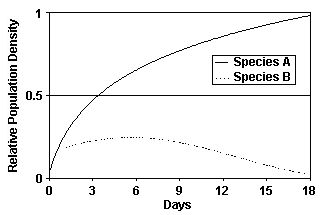
(96) The associated figure provides support for which of the following processes?
(Multiple Choice)
4.8/5 (69)
(69) Traditionally, most ecologists have assumed that community stability is a consequence of:
(Multiple Choice)
4.9/5 (88)
(88) Match the community model with its definition or term.
Premises:
Developed by Henry Gleason
Responses:
Organismic model
Individualistic model
Correct Answer:Verified
VerifiedPremises:
Responses:
(Matching)
4.7/5 (84)
(84) In an ecosystem's bottom-up processes, predators affect the abundances of other populations in the ecological community.
(True/False)
4.9/5 (79)
(79) Which organisms may be a keystone species in a tropical rain forest?
(Multiple Choice)
4.8/5 (68)
(68) 
Filters
- Essay(0)
- Multiple Choice(0)
- Short Answer(0)
- True False(0)
- Matching(0)