



 Chat with AI
Exam 50: Reproduction

Exam 1: A View of Life72 Questions
Exam 2: Atoms and Molecules: the Chemical Basis of Life75 Questions
Exam 3: The Chemistry of Life: Organic Compounds75 Questions
Exam 4: Organization of the Cell76 Questions
Exam 5: Biological Membranes73 Questions
Exam 6: Cell Communication73 Questions
Exam 7: Energy and Metabolism73 Questions
Exam 8: How Cells Make Atp: Energy-Releasing Pathways75 Questions
Exam 9: Photosynthesis: Capturing Light Energy79 Questions
Exam 10: Chromosomes, Mitosis, and Meiosis78 Questions
Exam 11: The Basic Principles of Heredity87 Questions
Exam 12: DNA: The Carrier of Genetic Information83 Questions
Exam 13: Gene Expression92 Questions
Exam 14: Gene Regulation86 Questions
Exam 15: DNA Technology and Genomics98 Questions
Exam 16: Human Genetics and the Human Genome82 Questions
Exam 17: Developmental Genetics90 Questions
Exam 18: Introduction to Darwinian Evolution66 Questions
Exam 19: Evolutionary Change in Populations72 Questions
Exam 20: Speciation and Macroevolution72 Questions
Exam 21: The Origin and Evolutionary History of Life71 Questions
Exam 22: The Evolution of Primates73 Questions
Exam 23: Understanding Diversity: Systematics70 Questions
Exam 24: Viruses and Subviral Agents55 Questions
Exam 25: Bacteria and Archaea63 Questions
Exam 26: Protists76 Questions
Exam 27: Seedless Plants76 Questions
Exam 28: Seed Plants76 Questions
Exam 29: The Fungi78 Questions
Exam 30: An Introduction to Animal Diversity71 Questions
Exam 31: Sponges, Cnidarians, Ctenophores, and Protostomes114 Questions
Exam 32: The Deuterostomes79 Questions
Exam 33: Plant Structure, Growth, and Development94 Questions
Exam 34: Leaf Structure and Function90 Questions
Exam 35: Stem Structure and Transport91 Questions
Exam 36: Roots and Mineral Nutrition105 Questions
Exam 37: Reproduction in Flowering Plants107 Questions
Exam 38: Plant Developmental Responses to External and Internal Signals113 Questions
Exam 39: Animal Structure and Function: an Introduction106 Questions
Exam 40: Protection, Support, and Movement75 Questions
Exam 41: Neural Signaling76 Questions
Exam 42: Neural Regulation81 Questions
Exam 43: Sensory Systems83 Questions
Exam 44: Internal Transport119 Questions
Exam 45: The Immune System: Internal Defense93 Questions
Exam 46: Gas Exchange123 Questions
Exam 47: Processing Food and Nutrition127 Questions
Exam 48: Osmoregulation and Disposal of Metabolic Wastes111 Questions
Exam 49: Endocrine Regulation87 Questions
Exam 50: Reproduction121 Questions
Exam 51: Animal Development117 Questions
Exam 52: Animal Behavior91 Questions
Exam 53: Introduction to Ecology: Population Ecology99 Questions
Exam 54: Community Ecology91 Questions
Exam 55: Ecosystems and the Biosphere101 Questions
Exam 56: Ecology and the Geography of Life99 Questions
Exam 57: Biological Diversity and Conservation Biology82 Questions
Select questions type


Which hormone that signals the mother's corpus luteum to continue to function?
(Multiple Choice)
4.8/5  (90)
(90) Following fertilization, human chorionic gonadotropin is responsible for maintaining the corpus luteum.
(True/False)
5.0/5 (76)
(76) Match the reproductive structure with its description.
Premises:
The endometrium is a portion of this structure
Responses:
Ovary
Oviduct
Epididymis
Correct Answer: Verified
Premises:
Responses:
(Matching)
4.9/5 (77)
(77) Sketch the rise and fall of LH, FSH, estrogen, and progesterone levels during a 28-day menstrual cycle. Indicate the day(s) of ovulation, menstruation, pre-ovulatory phase, and post-ovulatory phase.
(Essay)
4.9/5 (67)
(67) Figure 50-3
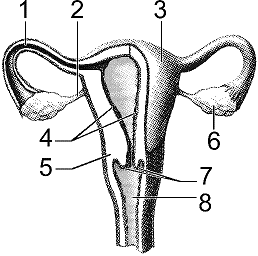
Refer to the accompanying figure. The cervix is labeled
Refer to the accompanying figure. The cervix is labeled (Multiple Choice)
4.8/5 (77)
(77) Figure 50-2
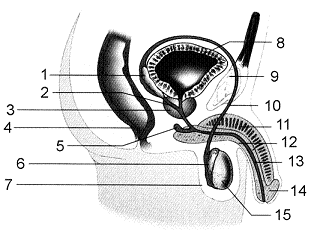
Refer to the accompanying figure. The function of the structure labeled as 3 is to
Refer to the accompanying figure. The function of the structure labeled as 3 is to (Multiple Choice)
4.8/5 (76)
(76) During the first stage of labor, the amnion becomes effaced to allow the fetal head to pass through.
(True/False)
4.7/5 (82)
(82) In an adult male, the ____ extends through the inguinal canal.
(Multiple Choice)
4.9/5 (79)
(79) Match the sexually transmitted disease with its symptoms or treatment.
Premises:
Pelvic inflammatory disease in women
Responses:
"Yeast" infections
Trichomoniasis
AIDS
Correct Answer:Verified
VerifiedPremises:
Responses:
(Matching)
4.9/5 (77)
(77) In the female, the____ serves as a temporary endocrine gland and secretes ____.
(Multiple Choice)
4.7/5 (72)
(72) In females, a primary oocyte completes meiosis II at the time of fertilization.
(True/False)
4.9/5 (84)
(84) Match the reproductive structure with its description.
Premises:
The vulva surrounds the external opening of this structure
Responses:
Uterus
Testes
Epididymis
Correct Answer:Verified
VerifiedPremises:
Responses:
(Matching)
4.8/5 (83)
(83) Sperm travel from the epididymis directly into the vas deferens.
(True/False)
4.8/5 (81)
(81) Acrosomes contain nutrients for the developing sperm cells, and they also secrete hormones and other signaling molecules.
(True/False)
4.9/5 (76)
(76) ______ blocks the action of an enzyme that breaks down the signaling molecule that sustains erection.
(Multiple Choice)
4.9/5 (77)
(77) 
Filters
- Essay(0)
- Multiple Choice(0)
- Short Answer(0)
- True False(0)
- Matching(0)