



 Chat with AI
Exam 44: Internal Transport

Exam 1: A View of Life72 Questions
Exam 2: Atoms and Molecules: the Chemical Basis of Life75 Questions
Exam 3: The Chemistry of Life: Organic Compounds75 Questions
Exam 4: Organization of the Cell76 Questions
Exam 5: Biological Membranes73 Questions
Exam 6: Cell Communication73 Questions
Exam 7: Energy and Metabolism73 Questions
Exam 8: How Cells Make Atp: Energy-Releasing Pathways75 Questions
Exam 9: Photosynthesis: Capturing Light Energy79 Questions
Exam 10: Chromosomes, Mitosis, and Meiosis78 Questions
Exam 11: The Basic Principles of Heredity87 Questions
Exam 12: DNA: The Carrier of Genetic Information83 Questions
Exam 13: Gene Expression92 Questions
Exam 14: Gene Regulation86 Questions
Exam 15: DNA Technology and Genomics98 Questions
Exam 16: Human Genetics and the Human Genome82 Questions
Exam 17: Developmental Genetics90 Questions
Exam 18: Introduction to Darwinian Evolution66 Questions
Exam 19: Evolutionary Change in Populations72 Questions
Exam 20: Speciation and Macroevolution72 Questions
Exam 21: The Origin and Evolutionary History of Life71 Questions
Exam 22: The Evolution of Primates73 Questions
Exam 23: Understanding Diversity: Systematics70 Questions
Exam 24: Viruses and Subviral Agents55 Questions
Exam 25: Bacteria and Archaea63 Questions
Exam 26: Protists76 Questions
Exam 27: Seedless Plants76 Questions
Exam 28: Seed Plants76 Questions
Exam 29: The Fungi78 Questions
Exam 30: An Introduction to Animal Diversity71 Questions
Exam 31: Sponges, Cnidarians, Ctenophores, and Protostomes114 Questions
Exam 32: The Deuterostomes79 Questions
Exam 33: Plant Structure, Growth, and Development94 Questions
Exam 34: Leaf Structure and Function90 Questions
Exam 35: Stem Structure and Transport91 Questions
Exam 36: Roots and Mineral Nutrition105 Questions
Exam 37: Reproduction in Flowering Plants107 Questions
Exam 38: Plant Developmental Responses to External and Internal Signals113 Questions
Exam 39: Animal Structure and Function: an Introduction106 Questions
Exam 40: Protection, Support, and Movement75 Questions
Exam 41: Neural Signaling76 Questions
Exam 42: Neural Regulation81 Questions
Exam 43: Sensory Systems83 Questions
Exam 44: Internal Transport119 Questions
Exam 45: The Immune System: Internal Defense93 Questions
Exam 46: Gas Exchange123 Questions
Exam 47: Processing Food and Nutrition127 Questions
Exam 48: Osmoregulation and Disposal of Metabolic Wastes111 Questions
Exam 49: Endocrine Regulation87 Questions
Exam 50: Reproduction121 Questions
Exam 51: Animal Development117 Questions
Exam 52: Animal Behavior91 Questions
Exam 53: Introduction to Ecology: Population Ecology99 Questions
Exam 54: Community Ecology91 Questions
Exam 55: Ecosystems and the Biosphere101 Questions
Exam 56: Ecology and the Geography of Life99 Questions
Exam 57: Biological Diversity and Conservation Biology82 Questions
Select questions type


Which of the white blood cells primarily function in phagocytosis?
(Multiple Choice)
4.9/5  (90)
(90) Match the modifiable cardiovascular disease risk factor with its description, effect, or cause.
Premises:
Affects cholesterol levels, hypertension, and diabetes
Responses:
Hypertension
Elevated LDL-cholesterol in the blood
Cigarette smoking
Correct Answer: Verified
Premises:
Responses:
(Matching)
4.8/5 (85)
(85) Which of the following is a hormone that increases sodium excretion, which results in production of a large volume of dilute urine, thereby reducing blood pressure?
(Multiple Choice)
4.7/5 (78)
(78) Figure 44-1
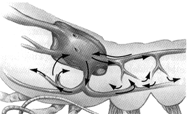
Consider the fluid transported by the system depicted in the accompanying figure. Which statement is FALSE with regard to this system?
Consider the fluid transported by the system depicted in the accompanying figure. Which statement is FALSE with regard to this system? (Multiple Choice)
5.0/5 (82)
(82) Match the modifiable cardiovascular disease risk factor with its description, effect, or cause.
Premises:
May be impacted by high levels of angiotensin II, which also causes inflammation
Responses:
Physical inactivity
Cigarette smoking
Obesity
Correct Answer:Verified
VerifiedPremises:
Responses:
(Matching)
4.9/5 (73)
(73) What is the correct order for the following events that follow a nerve impulse along a sympathetic neuron to innervate the heart?
1) G protein activates adenylyl cyclase.
2) Neuron releases norepinephrine.
3) Cyclic AMP activates protein kinase.
4) Receptor activates G protein.
5) Protein kinase phosphorylates Ca2+ channels.
6) Receptors activated on the membrane of the cardiac muscle.
(Multiple Choice)
4.9/5 (68)
(68) Which chemical, contained in the granules of basophils, helps prevent blood clot formation?
(Multiple Choice)
4.9/5 (80)
(80) Trace the flow of blood entirely through both the pulmonary and systemic circulations. Start and end with the right atrium. Be sure to list all structures through which the blood will pass, including all valves and major blood vessels entering and exiting the heart.
(Essay)
4.8/5 (66)
(66) The capillary walls of blood vessels are how many cells thick?
(Multiple Choice)
4.7/5 (78)
(78) Match the blood vessel with its description.
Premises:
Largest artery in the body
Responses:
Capillary
Superior vena cava
Inferior vena cava
Correct Answer:Verified
VerifiedPremises:
Responses:
(Matching)
4.9/5 (88)
(88) The characteristic that enables efficient gas exchange in capillaries is:
(Multiple Choice)
4.7/5 (85)
(85) Match the blood vessel with its description.
Premises:
Transports blood out of the right ventricle
Responses:
Pulmonary artery
Inferior vena cava
Superior vena cava
Correct Answer:Verified
VerifiedPremises:
Responses:
(Matching)
4.9/5 (85)
(85) Match the modifiable cardiovascular disease risk factor with its description, effect, or cause.
Premises:
Higher levels correlated with greater risk of cardiovascular disease
Responses:
Physical inactivity
Obesity
Elevated LDL-cholesterol in the blood
Correct Answer:Verified
VerifiedPremises:
Responses:
(Matching)
4.9/5 (72)
(72) Define cardiac output , describe its regulation, and summarize the factors that affect it.
(Essay)
4.8/5 (72)
(72) Match the blood components with their function or pathology.
Premises:
Active in allergic responses
Responses:
Neutrophils
Lymphocytes
Monocytes
Correct Answer:Verified
VerifiedPremises:
Responses:
(Matching)
4.9/5 (77)
(77) Match the blood components with their function or pathology.
Premises:
Easy bruising or excess bleeding
Responses:
Red blood cells
B asophils
Monocytes
Correct Answer:Verified
VerifiedPremises:
Responses:
(Matching)
4.9/5 (81)
(81) 
Filters
- Essay(0)
- Multiple Choice(0)
- Short Answer(0)
- True False(0)
- Matching(0)