



 Chat with AI
Exam 40: Protection, Support, and Movement

Exam 1: A View of Life72 Questions
Exam 2: Atoms and Molecules: the Chemical Basis of Life75 Questions
Exam 3: The Chemistry of Life: Organic Compounds75 Questions
Exam 4: Organization of the Cell76 Questions
Exam 5: Biological Membranes73 Questions
Exam 6: Cell Communication73 Questions
Exam 7: Energy and Metabolism73 Questions
Exam 8: How Cells Make Atp: Energy-Releasing Pathways75 Questions
Exam 9: Photosynthesis: Capturing Light Energy79 Questions
Exam 10: Chromosomes, Mitosis, and Meiosis78 Questions
Exam 11: The Basic Principles of Heredity87 Questions
Exam 12: DNA: The Carrier of Genetic Information83 Questions
Exam 13: Gene Expression92 Questions
Exam 14: Gene Regulation86 Questions
Exam 15: DNA Technology and Genomics98 Questions
Exam 16: Human Genetics and the Human Genome82 Questions
Exam 17: Developmental Genetics90 Questions
Exam 18: Introduction to Darwinian Evolution66 Questions
Exam 19: Evolutionary Change in Populations72 Questions
Exam 20: Speciation and Macroevolution72 Questions
Exam 21: The Origin and Evolutionary History of Life71 Questions
Exam 22: The Evolution of Primates73 Questions
Exam 23: Understanding Diversity: Systematics70 Questions
Exam 24: Viruses and Subviral Agents55 Questions
Exam 25: Bacteria and Archaea63 Questions
Exam 26: Protists76 Questions
Exam 27: Seedless Plants76 Questions
Exam 28: Seed Plants76 Questions
Exam 29: The Fungi78 Questions
Exam 30: An Introduction to Animal Diversity71 Questions
Exam 31: Sponges, Cnidarians, Ctenophores, and Protostomes114 Questions
Exam 32: The Deuterostomes79 Questions
Exam 33: Plant Structure, Growth, and Development94 Questions
Exam 34: Leaf Structure and Function90 Questions
Exam 35: Stem Structure and Transport91 Questions
Exam 36: Roots and Mineral Nutrition105 Questions
Exam 37: Reproduction in Flowering Plants107 Questions
Exam 38: Plant Developmental Responses to External and Internal Signals113 Questions
Exam 39: Animal Structure and Function: an Introduction106 Questions
Exam 40: Protection, Support, and Movement75 Questions
Exam 41: Neural Signaling76 Questions
Exam 42: Neural Regulation81 Questions
Exam 43: Sensory Systems83 Questions
Exam 44: Internal Transport119 Questions
Exam 45: The Immune System: Internal Defense93 Questions
Exam 46: Gas Exchange123 Questions
Exam 47: Processing Food and Nutrition127 Questions
Exam 48: Osmoregulation and Disposal of Metabolic Wastes111 Questions
Exam 49: Endocrine Regulation87 Questions
Exam 50: Reproduction121 Questions
Exam 51: Animal Development117 Questions
Exam 52: Animal Behavior91 Questions
Exam 53: Introduction to Ecology: Population Ecology99 Questions
Exam 54: Community Ecology91 Questions
Exam 55: Ecosystems and the Biosphere101 Questions
Exam 56: Ecology and the Geography of Life99 Questions
Exam 57: Biological Diversity and Conservation Biology82 Questions
Select questions type


Describe the three major types of skeletal muscle fibers found in vertebrates.
(Essay)
4.8/5  (63)
(63) The repeating units of muscle contraction are called myofibrils.
(True/False)
4.9/5 (75)
(75) What is the correct order of events that occur during muscle contraction? 1) Muscle shortens
2) Calcium binds to troponin
3) Filaments slide
4) T tubules are depolarized
5) Acetylcholine is released
6) ATP molecule is split
(Multiple Choice)
4.8/5 (95)
(95) Figure 40-3
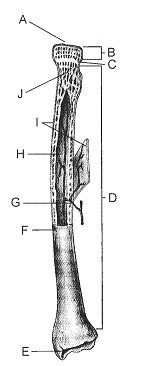
In the accompanying figure, the function of the structure labeled C, particularly in small children, is to
In the accompanying figure, the function of the structure labeled C, particularly in small children, is to (Multiple Choice)
4.9/5 (68)
(68) Figure 40-1
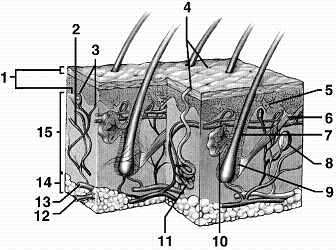
Refer to the accompanying figure. Which region of the skin is composed mainly of collagen fibers?
Refer to the accompanying figure. Which region of the skin is composed mainly of collagen fibers? (Multiple Choice)
4.9/5 (95)
(95) Figure 40-4 Use the figure to answer the corresponding question(s).
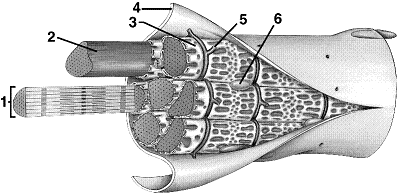
Refer to the accompanying figure. An action potential spreads and triggers Ca2+ release through the structure labeled as
Refer to the accompanying figure. An action potential spreads and triggers Ca2+ release through the structure labeled as (Multiple Choice)
4.8/5 (77)
(77) What is the major difference between the endoskeleton and the exoskeleton?
(Multiple Choice)
4.8/5 (94)
(94) Which process is a specialized function carried out by epithelial tissue?
(Multiple Choice)
4.8/5 (77)
(77) Figure 40-3
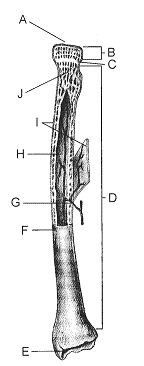
The portion of the bone labeled I in the accompanying figure is called the
The portion of the bone labeled I in the accompanying figure is called the (Multiple Choice)
4.8/5 (89)
(89) Match each term with its description. Use each term only once.
Premises:
Called a "thick filament"
Responses:
Myosin
Sarcoplasmic reticulum
Sarcomere
Correct Answer: Verified
Premises:
Responses:
(Matching)
4.8/5 (85)
(85) Match each term with its description. Use each term only once.
Premises:
Called a "thin filament"
Responses:
Myosin
Sarcomere
Sarcoplasmic reticulum
Correct Answer:Verified
VerifiedPremises:
Responses:
(Matching)
4.9/5 (83)
(83) Figure 40-3
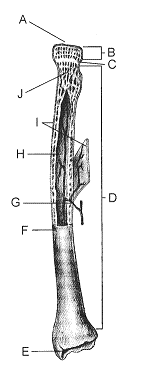
The portion of the bone labeled E in the accompanying figure is called the
The portion of the bone labeled E in the accompanying figure is called the (Multiple Choice)
4.9/5 (84)
(84) Which class of bones is part of the appendicular skeletal division?
(Multiple Choice)
4.7/5 (79)
(79) Compare and contrast the function of the external epithelium and its derivatives in invertebrates and vertebrates.
(Essay)
4.7/5 (76)
(76) Figure 40-1
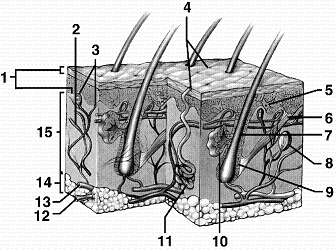
Refer to the accompanying figure. Which structure is the source of sebum, a substance that inhibits bacterial growth on the surface of the skin?
Refer to the accompanying figure. Which structure is the source of sebum, a substance that inhibits bacterial growth on the surface of the skin? (Multiple Choice)
4.9/5 (76)
(76) What are joints? Describe the main types of vertebrate joints and provide examples.
(Essay)
4.9/5 (71)
(71) 
Filters
- Essay(0)
- Multiple Choice(0)
- Short Answer(0)
- True False(0)
- Matching(0)