



 Chat with AI
Exam 31: Sponges, Cnidarians, Ctenophores, and Protostomes

Exam 1: A View of Life72 Questions
Exam 2: Atoms and Molecules: the Chemical Basis of Life75 Questions
Exam 3: The Chemistry of Life: Organic Compounds75 Questions
Exam 4: Organization of the Cell76 Questions
Exam 5: Biological Membranes73 Questions
Exam 6: Cell Communication73 Questions
Exam 7: Energy and Metabolism73 Questions
Exam 8: How Cells Make Atp: Energy-Releasing Pathways75 Questions
Exam 9: Photosynthesis: Capturing Light Energy79 Questions
Exam 10: Chromosomes, Mitosis, and Meiosis78 Questions
Exam 11: The Basic Principles of Heredity87 Questions
Exam 12: DNA: The Carrier of Genetic Information83 Questions
Exam 13: Gene Expression92 Questions
Exam 14: Gene Regulation86 Questions
Exam 15: DNA Technology and Genomics98 Questions
Exam 16: Human Genetics and the Human Genome82 Questions
Exam 17: Developmental Genetics90 Questions
Exam 18: Introduction to Darwinian Evolution66 Questions
Exam 19: Evolutionary Change in Populations72 Questions
Exam 20: Speciation and Macroevolution72 Questions
Exam 21: The Origin and Evolutionary History of Life71 Questions
Exam 22: The Evolution of Primates73 Questions
Exam 23: Understanding Diversity: Systematics70 Questions
Exam 24: Viruses and Subviral Agents55 Questions
Exam 25: Bacteria and Archaea63 Questions
Exam 26: Protists76 Questions
Exam 27: Seedless Plants76 Questions
Exam 28: Seed Plants76 Questions
Exam 29: The Fungi78 Questions
Exam 30: An Introduction to Animal Diversity71 Questions
Exam 31: Sponges, Cnidarians, Ctenophores, and Protostomes114 Questions
Exam 32: The Deuterostomes79 Questions
Exam 33: Plant Structure, Growth, and Development94 Questions
Exam 34: Leaf Structure and Function90 Questions
Exam 35: Stem Structure and Transport91 Questions
Exam 36: Roots and Mineral Nutrition105 Questions
Exam 37: Reproduction in Flowering Plants107 Questions
Exam 38: Plant Developmental Responses to External and Internal Signals113 Questions
Exam 39: Animal Structure and Function: an Introduction106 Questions
Exam 40: Protection, Support, and Movement75 Questions
Exam 41: Neural Signaling76 Questions
Exam 42: Neural Regulation81 Questions
Exam 43: Sensory Systems83 Questions
Exam 44: Internal Transport119 Questions
Exam 45: The Immune System: Internal Defense93 Questions
Exam 46: Gas Exchange123 Questions
Exam 47: Processing Food and Nutrition127 Questions
Exam 48: Osmoregulation and Disposal of Metabolic Wastes111 Questions
Exam 49: Endocrine Regulation87 Questions
Exam 50: Reproduction121 Questions
Exam 51: Animal Development117 Questions
Exam 52: Animal Behavior91 Questions
Exam 53: Introduction to Ecology: Population Ecology99 Questions
Exam 54: Community Ecology91 Questions
Exam 55: Ecosystems and the Biosphere101 Questions
Exam 56: Ecology and the Geography of Life99 Questions
Exam 57: Biological Diversity and Conservation Biology82 Questions
Select questions type


Match the organism or its characteristic with the correct phylum.
Premises:
centipedes
Responses:
Annelida
Porifera
Mollusca
Correct Answer: Verified
Premises:
Responses:
(Matching)
4.9/5  (77)
(77) The body of a tapeworm consists of segments, each of which is called a proglottid.
(True/False)
4.9/5 (92)
(92) An elongate uniramid with many legs as well as poison claws is known as a(n):
(Multiple Choice)
4.8/5 (79)
(79) Choanocytes are a characteristic of members of the phylum Cnidaria .
(True/False)
4.9/5 (71)
(71) What specialized structure do crustaceans use to sense gravity?
(Multiple Choice)
4.8/5 (80)
(80) Members of the Ecdysozoa clade are characterized by having a cuticle.
(True/False)
4.9/5 (71)
(71) Match the organism or its characteristic with the correct phylum.
Premises:
earthworms
Responses:
Mollusca
Platyhelminthes
Annelida
Correct Answer:Verified
VerifiedPremises:
Responses:
(Matching)
4.8/5 (78)
(78) Which structure do numerous mollusks use to scrape algae off rocks?
(Multiple Choice)
4.8/5 (79)
(79) In cnidarians, nematocysts are housed within why type of specialized cell?
(Multiple Choice)
5.0/5 (70)
(70) A radula is characteristic of certain members of phylum Platyhelminthes .
(True/False)
4.8/5 (92)
(92) Figure 31-4
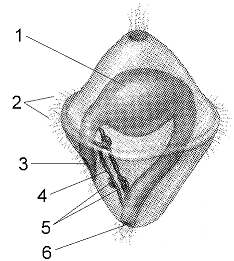 The larva in the accompanying figure is characteristic of which group of organisms?
 (Multiple Choice)
4.9/5 (83)
(83) Which of the following terms is associated with polychaetes?
(Multiple Choice)
4.8/5 (72)
(72) Match the organism or its characteristic with the correct phylum.
Premises:
snails and slugs
Responses:
Platyhelminthes
Porifera
Nemertea
Correct Answer:Verified
VerifiedPremises:
Responses:
(Matching)
4.9/5 (71)
(71) Which arthropods have mandibles, gills, excretory glands, and statocysts?
(Multiple Choice)
4.9/5 (76)
(76) Which is a unique adaptation in insects not found in any other arthropod?
(Multiple Choice)
4.9/5 (75)
(75) 
Filters
- Essay(0)
- Multiple Choice(0)
- Short Answer(0)
- True False(0)
- Matching(0)