



 Chat with AI
Exam 17: Oligopoly.

Exam 1: Ten Principles of Economics.349 Questions
Exam 2: Thinking Like an Economist.535 Questions
Exam 3: Interdependence and the Gains from Trade.443 Questions
Exam 4: The Market Forces of Supply and Demand.571 Questions
Exam 5: Elasticity and Its Application510 Questions
Exam 6: Supply, Demand, And Government Policies.557 Questions
Exam 7: Consumers, Producers, and the Efficiency of Markets.460 Questions
Exam 8: Application: The Costs of Taxation.424 Questions
Exam 9: Application: International Trade.410 Questions
Exam 10: Externalities.441 Questions
Exam 11: Public Goods and Common Resources.349 Questions
Exam 12: The Design of the Tax System.478 Questions
Exam 13: The Costs of Production.533 Questions
Exam 14: Firms in Competitive Markets.478 Questions
Exam 15: Monopoly.526 Questions
Exam 16: Monopolistic Competition.497 Questions
Exam 17: Oligopoly.410 Questions
Exam 18: The Market For the Factors of Production.463 Questions
Exam 19: Earnings and Discrimination.398 Questions
Exam 20: Income Inequality and Poverty.374 Questions
Exam 21: The Theory of Consumer Choice.462 Questions
Exam 22: Frontiers in Microeconomics.353 Questions
Select questions type


Figure 17-1. Two companies, ABC and XYZ, each decide whether to produce a high level of output or a low level of output. In the figure, the dollar amounts are payoffs and they represent annual profits for the two companies.
 -Refer to Figure 17-1.Which of the following statements is correct?
 (Multiple Choice)
4.8/5  (91)
(91) Table 17-3. The information in the table below shows the total demand for premium-channel digital cable TV subscriptions in a small urban market. Assume that each digital cable TV operator pays a fixed cost of $200,000 (per year) to provide premium digital channels in the market area and that the marginal cost of providing the premium channel service to a household is zero.
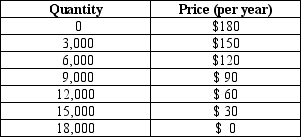 -Refer to Table 17-3.Assume there are two profit-maximizing digital cable TV companies operating in this market.Further assume that they are able to collude on the quantity of subscriptions that will be sold and on the price that will be charged for subscriptions.How much profit will each company earn?
 (Multiple Choice)
4.8/5 (70)
(70) If one firm left a duopoly market where the firms did not cooperate then
(Multiple Choice)
4.9/5 (83)
(83) An agreement between two duopolists to function as a monopolist usually breaks down because
(Multiple Choice)
4.8/5 (87)
(87) If duopolists individually pursue their own self-interest when deciding how much to produce,the profit-maximizing price they will charge for their product will be
(Multiple Choice)
4.9/5 (86)
(86) Table 17-22
Brian and Matt own the only two bicycle repair shops in town. Each must choose between a low price for repair work and a high price. The annual economic profit from each strategy is indicated in the table. The profits are shown as (Matt, Brian) in each cell.
 -Refer to Table 17-22.Which of the following statements is correct?
 (Multiple Choice)
4.9/5 (71)
(71) Table 17-21
The Chicken Game is named for a contest in which drivers test their courage by driving straight at each other. John and Paul have a common interest to avoid crashing into each other, but they also have a personal, competing interest to not turn first to demonstrate their courage to those observing the contest. The payoff table for this situation is provided below. The payoffs are shown as (John, Paul).
 -Refer to Table 17-21.How many Nash equilibria are there in this Chicken game?
 (Multiple Choice)
4.8/5 (79)
(79) Table 17-12
Each year the United States considers renewal of Most Favored Nation (MFN) trading status with Farland (a mythical nation). Historically, legislators have made threats of not renewing MFN status because of human rights abuses in Farland. The non-renewal of MFN trading status is likely to involve some retaliatory measures by Farland. The payoff table below shows the potential economic gains associated with a game in which Farland may impose trade sanctions against U.S. firms and the United States may not renew MFN status with Farland. The table contains the dollar value of all trade-flow benefits to the United States and Farland.
 -Refer to Table 17-12.Assume that trade negotiators meet to discuss trade policy between the United States and Farland.If neither party to the negotiation is able to trust the other party,then
 (Multiple Choice)
4.9/5 (81)
(81) Figure 17-1. Two companies, ABC and XYZ, each decide whether to produce a high level of output or a low level of output. In the figure, the dollar amounts are payoffs and they represent annual profits for the two companies.
-Refer to Figure 17-1.If this game is played only once,then the most likely outcome is that
-Refer to Figure 17-1.If this game is played only once,then the most likely outcome is that (Multiple Choice)
4.7/5 (86)
(86) Table 17-13
Two home-improvement stores (Lopes and HomeMax) in a growing urban area are interested in expanding their market share. Both are interested in expanding the size of their store and parking lot to accommodate potential growth in their customer base. The following game depicts the strategic outcomes that result from the game. Increases in annual profits of the two home-improvement stores are shown in the table below.
 -Refer to Table 17-13.Increasing the size of its store and parking lot is a dominant strategy for
 (Multiple Choice)
4.8/5 (74)
(74) Table 17-24
Two firms are considering going out of business and selling their assets. Each considers what happens if the other goes out of business. The payoff matrix below shows the net gain or loss to each firm.
 -Refer to Table 17-24.What is the Nash equilibrium?
 (Multiple Choice)
4.9/5 (91)
(91) Table 17-3. The information in the table below shows the total demand for premium-channel digital cable TV subscriptions in a small urban market. Assume that each digital cable TV operator pays a fixed cost of $200,000 (per year) to provide premium digital channels in the market area and that the marginal cost of providing the premium channel service to a household is zero.
-Refer to Table 17-3.Assume that there are two profit-maximizing digital cable TV companies operating in this market.Further assume that they are not able to collude on the price and quantity of premium digital channel subscriptions to sell.How much profit will each firm earn when this market reaches a Nash equilibrium?
-Refer to Table 17-3.Assume that there are two profit-maximizing digital cable TV companies operating in this market.Further assume that they are not able to collude on the price and quantity of premium digital channel subscriptions to sell.How much profit will each firm earn when this market reaches a Nash equilibrium? (Multiple Choice)
4.9/5 (73)
(73) Table 17-14
This table shows a game played between two players, A and B. The payoffs in the table are shown as (Payoff to A, Payoff to B).
 -Refer to Table 17-14.Which of the following statements about this game is true?
 (Multiple Choice)
4.8/5 (76)
(76) Table 17-2. The table shows the town of Pittsville's demand schedule for gasoline. For simplicity, assume the town's gasoline seller(s) incur no costs in selling gasoline.
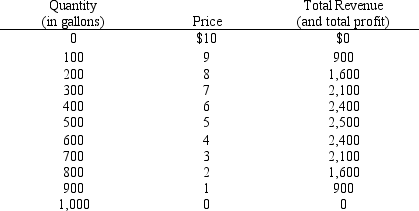 -Refer to Table 17-2.If there are exactly three sellers of gasoline in Pittsville and if they collude,then which of the following outcomes is most likely?
 (Multiple Choice)
4.8/5 (84)
(84) Some business practices that appear to reduce competition,such as resale price maintenance,may have legitimate economic purposes.
(True/False)
4.9/5 (90)
(90) Table 17-9
Only two firms, Acme and Pinnacle, sell a particular product. The table below shows the demand curve for their product. Each firm has the same constant marginal cost of $10 and zero fixed cost.
 -Refer to Table 17-9.Acme and Pinnacle agree to maximize joint profits.However,while Acme produces the agreed upon amount,Pinnacle breaks the agreement and produces 100 more than agreed,how much profit does Pinnacle make?
 (Multiple Choice)
4.7/5 (88)
(88) 
Filters
- Essay(0)
- Multiple Choice(0)
- Short Answer(0)
- True False(0)
- Matching(0)