



 Chat with AI
Exam 17: Oligopoly.

Exam 1: Ten Principles of Economics.349 Questions
Exam 2: Thinking Like an Economist.535 Questions
Exam 3: Interdependence and the Gains from Trade.443 Questions
Exam 4: The Market Forces of Supply and Demand.571 Questions
Exam 5: Elasticity and Its Application510 Questions
Exam 6: Supply, Demand, And Government Policies.557 Questions
Exam 7: Consumers, Producers, and the Efficiency of Markets.460 Questions
Exam 8: Application: The Costs of Taxation.424 Questions
Exam 9: Application: International Trade.410 Questions
Exam 10: Externalities.441 Questions
Exam 11: Public Goods and Common Resources.349 Questions
Exam 12: The Design of the Tax System.478 Questions
Exam 13: The Costs of Production.533 Questions
Exam 14: Firms in Competitive Markets.478 Questions
Exam 15: Monopoly.526 Questions
Exam 16: Monopolistic Competition.497 Questions
Exam 17: Oligopoly.410 Questions
Exam 18: The Market For the Factors of Production.463 Questions
Exam 19: Earnings and Discrimination.398 Questions
Exam 20: Income Inequality and Poverty.374 Questions
Exam 21: The Theory of Consumer Choice.462 Questions
Exam 22: Frontiers in Microeconomics.353 Questions
Select questions type


Scenario 17-5
Assume that a local bank sells two services, checking accounts and ATM card services. The bank's only two customers are Mr. Donethat and Ms. Beenthere. Mr. Donethat is willing to pay $8 a month for the bank to service his checking account and $2 a month for unlimited use of his ATM card. Ms. Beenthere is willing to pay only $5 for a checking account, but is willing to pay $9 for unlimited use of her ATM card. Assume that the bank can provide each of these services at zero marginal cost.
-Refer to Scenario 17-5.How much additional profit can the bank earn by switching to the use of a tying strategy to price checking accounts and ATM service rather than pricing these services separately?
(Multiple Choice)
4.8/5  (85)
(85) An agreement among firms in a market about quantities to produce or prices to charge is called
(Multiple Choice)
4.7/5 (89)
(89) Table 17-12
Each year the United States considers renewal of Most Favored Nation (MFN) trading status with Farland (a mythical nation). Historically, legislators have made threats of not renewing MFN status because of human rights abuses in Farland. The non-renewal of MFN trading status is likely to involve some retaliatory measures by Farland. The payoff table below shows the potential economic gains associated with a game in which Farland may impose trade sanctions against U.S. firms and the United States may not renew MFN status with Farland. The table contains the dollar value of all trade-flow benefits to the United States and Farland.
 -Refer to Table 17-12.Pursuing its own best interests,the U.S.will renew MFN status with Farland
 (Multiple Choice)
4.7/5 (95)
(95) Figure 17-2. Hector and Bart are roommates. On a particular day, their apartment needs to be cleaned. Each person has to decide whether to take part in cleaning. At the end of the day, either the apartment will be completely clean (if one or both roommates take part in cleaning), or it will remain dirty (if neither roommate cleans). With happiness measured on a scale of 1 (very unhappy) to 10 (very happy), the possible outcomes are as follows:
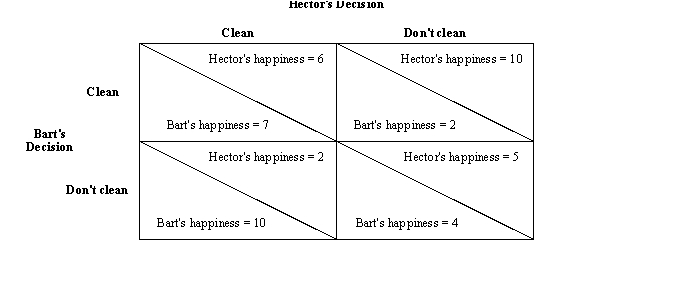 -Refer to Figure 17-2.In pursuing his own self-interest,Bart will
 (Multiple Choice)
4.8/5 (78)
(78) Table 17-4. The information in the table below shows the total demand for high-speed Internet subscriptions in a small urban market. Assume that each company that provides these subscriptions incurs an annual fixed cost of $200,000 (per year) and that the marginal cost of providing an additional subscription is always $80.
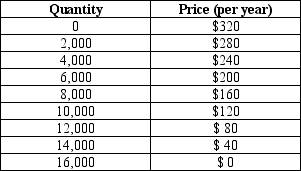 -Refer to Table 17-4.Assume there are two high-speed Internet service providers that operate in this market.If they are able to collude on the quantity of subscriptions that will be sold and on the price that will be charged for subscriptions,then their agreement will stipulate that
 (Multiple Choice)
4.9/5 (78)
(78) Although the practice of predatory pricing is a common claim in antitrust suits,some economists are skeptical of this argument because they believe
(Multiple Choice)
4.8/5 (84)
(84) Table 17-20
Nadia and Maddie are two college roommates who both prefer a clean common space in their dorm room, but neither enjoys cleaning. The roommates must each make a decision to either clean or not clean the dorm room's common space. The payoff table for this situation is provided below, where the higher a player's payoff number, the better off that player is. The payoffs in each cell are shown as (payoff for Nadia, payoff for Maddie).
 -Refer to Table 17-20.If Maddie chooses not to clean,then Nadia will
 (Multiple Choice)
4.8/5 (90)
(90) Scenario 17-2. Imagine that two oil companies, Mobile and Cargo, own adjacent oil fields. Under the fields is a common pool of oil worth $96 million. Drilling a well to recover oil costs $3 million per well. If each company drills one well, each will get half of the oil and earn a $45 million profit ($48 million in revenue - $3 million in costs). Assume that having X percent of the total wells means that a company will collect X percent of the total revenue.
-Refer to Scenario 17-2.If Mobile were to drill a second well and Cargo also drilled a second well,what would Mobile's profit be?
(Multiple Choice)
4.8/5 (81)
(81) Oligopolists may well be able to reach their preferred,cooperative outcome if
(Multiple Choice)
4.8/5 (89)
(89) Scenario 17-2. Imagine that two oil companies, Mobile and Cargo, own adjacent oil fields. Under the fields is a common pool of oil worth $96 million. Drilling a well to recover oil costs $3 million per well. If each company drills one well, each will get half of the oil and earn a $45 million profit ($48 million in revenue - $3 million in costs). Assume that having X percent of the total wells means that a company will collect X percent of the total revenue.
-Refer to Scenario 17-2.Cargo's dominant strategy would lead to what sort of well-drilling behavior?
(Multiple Choice)
4.9/5 (68)
(68) Table 17-1
Imagine a small town in which only two residents, Rochelle and Alec, own wells that produce safe drinking water. Each week Rochelle and Alec work together to decide how many gallons of water to pump. They bring the water to town and sell it at whatever price the market will bear. To keep things simple, suppose that Rochelle and Alec can pump as much water as they want without cost so that the marginal cost of water equals zero. The weekly town demand schedule and total revenue schedule for water is shown in the table below:
 -Refer to Table 17-1.Suppose the town enacts new antitrust laws that prohibit Rochelle and Alec from operating as a monopoly.What will be the price of water once Rochelle and Alec reach a Nash equilibrium?
 (Multiple Choice)
4.8/5 (82)
(82) If a person can prove that she was damaged by an illegal arrangement to restrain trade,that person can sue and recover
(Multiple Choice)
4.9/5 (87)
(87) Scenario 17-3. Consider two countries, Muria and Zenya, that are engaged in an arms race. Each country must decide whether to build new weapons or to disarm existing weapons. Each country prefers to have more arms than the other because a large arsenal gives it more influence in world affairs. But each country also prefers to live in a world safe from the other country's weapons. The following table shows the possible outcomes for each decision combination. The numbers in each cell represent the country's ranking of the outcome (4 = best outcome, 1 = worst outcome).
 -Refer to Scenario 17-3.If Zenya chooses to disarm its existing weapons,then Muria will
 (Multiple Choice)
4.9/5 (83)
(83) Table 17-10
The table shows the town of Driveaway's demand schedule for gasoline. Assume the town's gasoline seller(s) incurs a cost of $2 for each gallon sold, with no fixed cost.
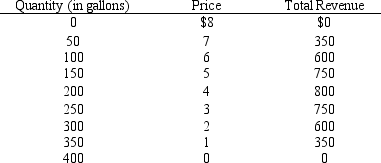 -Refer to Table 17-10.If there are exactly two sellers of gasoline in Driveaway and if they collude,then which of the following outcomes is most likely?
 (Multiple Choice)
4.8/5 (74)
(74) George and Jerry are competitors in a local market.Each is trying to decide if it is better to advertise on TV,on radio,or not at all.If they both advertise on TV,each will earn a profit of $3,000.If they both advertise on radio,each will earn a profit of $5,000.If neither advertises at all,each will earn a profit of $10,000.If one advertises on TV and the other advertises on radio,then the one advertising on TV will earn $4,000 and the other will earn $2,000.If one advertises on TV and the other does not advertise,then the one advertising on TV will earn $8,000 and the other will earn $5,000.If one advertises on radio and the other does not advertise,then the one advertising on radio will earn $9,000 and the other will earn $6,000.If both follow their dominant strategy,then George will
(Multiple Choice)
4.8/5 (83)
(83) In which case do firms have some control over their price?
(Multiple Choice)
4.8/5 (88)
(88) Which of the following groups or entities has the authority to initiate legal suits to enforce antitrust laws?
(Multiple Choice)
4.7/5 (73)
(73) The theory of oligopoly provides another reason that free trade can benefit all countries because
(Multiple Choice)
4.9/5 (86)
(86) 
Filters
- Essay(0)
- Multiple Choice(0)
- Short Answer(0)
- True False(0)
- Matching(0)