



 Chat with AI
Exam 17: Oligopoly.

Exam 1: Ten Principles of Economics.349 Questions
Exam 2: Thinking Like an Economist.535 Questions
Exam 3: Interdependence and the Gains from Trade.443 Questions
Exam 4: The Market Forces of Supply and Demand.571 Questions
Exam 5: Elasticity and Its Application510 Questions
Exam 6: Supply, Demand, And Government Policies.557 Questions
Exam 7: Consumers, Producers, and the Efficiency of Markets.460 Questions
Exam 8: Application: The Costs of Taxation.424 Questions
Exam 9: Application: International Trade.410 Questions
Exam 10: Externalities.441 Questions
Exam 11: Public Goods and Common Resources.349 Questions
Exam 12: The Design of the Tax System.478 Questions
Exam 13: The Costs of Production.533 Questions
Exam 14: Firms in Competitive Markets.478 Questions
Exam 15: Monopoly.526 Questions
Exam 16: Monopolistic Competition.497 Questions
Exam 17: Oligopoly.410 Questions
Exam 18: The Market For the Factors of Production.463 Questions
Exam 19: Earnings and Discrimination.398 Questions
Exam 20: Income Inequality and Poverty.374 Questions
Exam 21: The Theory of Consumer Choice.462 Questions
Exam 22: Frontiers in Microeconomics.353 Questions
Select questions type


Table 17-3. The information in the table below shows the total demand for premium-channel digital cable TV subscriptions in a small urban market. Assume that each digital cable TV operator pays a fixed cost of $200,000 (per year) to provide premium digital channels in the market area and that the marginal cost of providing the premium channel service to a household is zero.
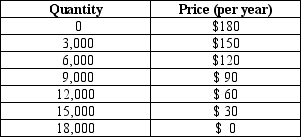 -Refer to Table 17-3.Assume there are two profit-maximizing digital cable TV companies operating in this market.Further assume that they are not able to collude on the price and quantity of premium digital channel subscriptions to sell.How many premium digital channel cable TV subscriptions will be sold altogether when this market reaches a Nash equilibrium?
 (Multiple Choice)
4.9/5  (70)
(70) Table 17-20
Nadia and Maddie are two college roommates who both prefer a clean common space in their dorm room, but neither enjoys cleaning. The roommates must each make a decision to either clean or not clean the dorm room's common space. The payoff table for this situation is provided below, where the higher a player's payoff number, the better off that player is. The payoffs in each cell are shown as (payoff for Nadia, payoff for Maddie).
 -Refer to Table 17-20.If Nadia chooses to not clean,then Maddie will
 (Multiple Choice)
4.7/5 (73)
(73) The decisions of the US and Soviet Union to build nuclear weapons is much like the prisoners' dilemma.
(True/False)
4.7/5 (75)
(75) As the number of firms in an oligopoly becomes very large,the price effect disappears.
(True/False)
4.8/5 (80)
(80) Describe the source of tension between cooperation and self-interest in a market characterized by oligopoly.Use an example of an actual cartel arrangement to demonstrate why this tension creates instability in cartels.
(Essay)
4.8/5 (73)
(73) Table 17-13
Two home-improvement stores (Lopes and HomeMax) in a growing urban area are interested in expanding their market share. Both are interested in expanding the size of their store and parking lot to accommodate potential growth in their customer base. The following game depicts the strategic outcomes that result from the game. Increases in annual profits of the two home-improvement stores are shown in the table below.
 -Refer to Table 17-13.Pursuing its own best interest,HomeMax will
 (Multiple Choice)
4.9/5 (83)
(83) Table 17-22
Brian and Matt own the only two bicycle repair shops in town. Each must choose between a low price for repair work and a high price. The annual economic profit from each strategy is indicated in the table. The profits are shown as (Matt, Brian) in each cell.
 -Refer to Table 17-22.Which of the following statements is correct if Brian and Matt will play this game only once?
 (Multiple Choice)
4.9/5 (70)
(70) Figure 17-1. Two companies, ABC and XYZ, each decide whether to produce a high level of output or a low level of output. In the figure, the dollar amounts are payoffs and they represent annual profits for the two companies.
 -Refer to Figure 17-1.If this game is played repeatedly and ABC uses a tit-for-tat strategy,it will choose a
 (Multiple Choice)
4.7/5 (63)
(63) A lack of cooperation by oligopolists trying to maintain monopoly profits
(Multiple Choice)
4.9/5 (75)
(75) As the number of sellers in an oligopoly becomes very large,
(Multiple Choice)
4.9/5 (97)
(97) Two CEOs from different firms in the same market collude to fix the price in the market.This action violates the
(Multiple Choice)
4.7/5 (78)
(78) There are two types of markets in which firms face some competition yet are still able to have some control over the prices of their products.Those two types of market are
(Multiple Choice)
4.8/5 (67)
(67) Very often,the reason that players can solve the prisoners' dilemma and reach the most profitable outcome is that
(Multiple Choice)
4.9/5 (73)
(73) In a particular town,Comvision and Veriview are the only two providers of cable TV service.Comvision and Veriview constitute a
(Multiple Choice)
4.9/5 (71)
(71) Table 17-6. The table shows the demand schedule for a particular product.
 -Refer to Table 17-6.Suppose the market for this product is served by two firms that have formed a cartel.If the marginal cost of production is $4 and the fixed cost is $6,the combined profit of the cartel will be
 (Multiple Choice)
4.9/5 (75)
(75) Table 17-13
Two home-improvement stores (Lopes and HomeMax) in a growing urban area are interested in expanding their market share. Both are interested in expanding the size of their store and parking lot to accommodate potential growth in their customer base. The following game depicts the strategic outcomes that result from the game. Increases in annual profits of the two home-improvement stores are shown in the table below.
-Refer to Table 17-13.Pursuing its own best interest,Lopes will
-Refer to Table 17-13.Pursuing its own best interest,Lopes will (Multiple Choice)
4.9/5 (95)
(95) Two suspected drug dealers are stopped by the highway patrol for speeding.The officer searches the car and finds a small bag of marijuana and arrests the two.During the interrogation,each is separately offered the following: "If you confess to dealing drugs and testify against your partner,you will be given immunity and released while your partner will get 10 years in prison.If you both confess,you will each get 5 years." If neither confesses,there is no evidence of drug dealing,and the most they could get is one year each for possession of marijuana.If each suspected drug dealer follows a dominant strategy,what should he/she do?
(Multiple Choice)
4.8/5 (68)
(68) Table 17-25
There are just two producers of a certain product. Each is considering offering promotional discounts.
 -Refer to Table 17-25.The dominant strategy
 (Multiple Choice)
4.9/5 (83)
(83) 
Filters
- Essay(0)
- Multiple Choice(0)
- Short Answer(0)
- True False(0)
- Matching(0)