



 Chat with AI
Exam 17: Oligopoly.

Exam 1: Ten Principles of Economics.349 Questions
Exam 2: Thinking Like an Economist.535 Questions
Exam 3: Interdependence and the Gains from Trade.443 Questions
Exam 4: The Market Forces of Supply and Demand.571 Questions
Exam 5: Elasticity and Its Application510 Questions
Exam 6: Supply, Demand, And Government Policies.557 Questions
Exam 7: Consumers, Producers, and the Efficiency of Markets.460 Questions
Exam 8: Application: The Costs of Taxation.424 Questions
Exam 9: Application: International Trade.410 Questions
Exam 10: Externalities.441 Questions
Exam 11: Public Goods and Common Resources.349 Questions
Exam 12: The Design of the Tax System.478 Questions
Exam 13: The Costs of Production.533 Questions
Exam 14: Firms in Competitive Markets.478 Questions
Exam 15: Monopoly.526 Questions
Exam 16: Monopolistic Competition.497 Questions
Exam 17: Oligopoly.410 Questions
Exam 18: The Market For the Factors of Production.463 Questions
Exam 19: Earnings and Discrimination.398 Questions
Exam 20: Income Inequality and Poverty.374 Questions
Exam 21: The Theory of Consumer Choice.462 Questions
Exam 22: Frontiers in Microeconomics.353 Questions
Select questions type


Table 17-4. The information in the table below shows the total demand for high-speed Internet subscriptions in a small urban market. Assume that each company that provides these subscriptions incurs an annual fixed cost of $200,000 (per year) and that the marginal cost of providing an additional subscription is always $80.
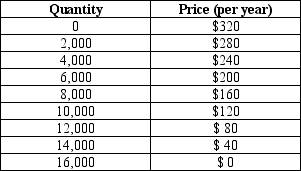 -Refer to Table 17-4.Assume there are two profit-maximizing high-speed Internet service providers operating in this market.Further assume that they are able to collude on the quantity of subscriptions that will be sold and on the price that will be charged for subscriptions.How much profit will each company earn?
 (Multiple Choice)
4.8/5  (68)
(68) In which of the following markets are strategic interactions among firms most likely to occur?
(Multiple Choice)
4.9/5 (89)
(89) Why would lack of cooperation between criminal suspects be desirable for society as a whole?
(Multiple Choice)
4.8/5 (81)
(81) Firms do not need to be concerned about striking a balance between the price effect and the output effect when making production decisions in which of the following types of markets?
(Multiple Choice)
4.9/5 (81)
(81) Table 17-1
Imagine a small town in which only two residents, Rochelle and Alec, own wells that produce safe drinking water. Each week Rochelle and Alec work together to decide how many gallons of water to pump. They bring the water to town and sell it at whatever price the market will bear. To keep things simple, suppose that Rochelle and Alec can pump as much water as they want without cost so that the marginal cost of water equals zero. The weekly town demand schedule and total revenue schedule for water is shown in the table below:
 -Refer to Table 17-1.If Rochelle and Alec operate as a profit-maximizing monopoly in the market for water,how many gallons of water will be produced and sold?
 (Multiple Choice)
4.9/5 (63)
(63) Figure 17-2. Hector and Bart are roommates. On a particular day, their apartment needs to be cleaned. Each person has to decide whether to take part in cleaning. At the end of the day, either the apartment will be completely clean (if one or both roommates take part in cleaning), or it will remain dirty (if neither roommate cleans). With happiness measured on a scale of 1 (very unhappy) to 10 (very happy), the possible outcomes are as follows:
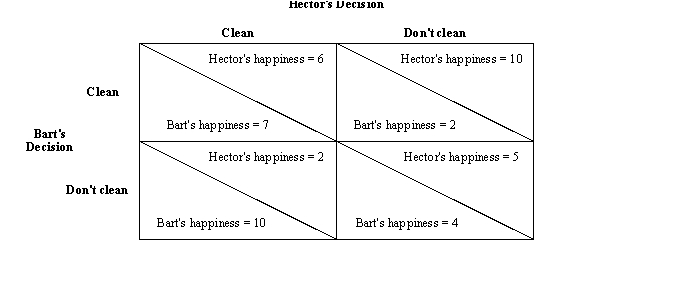 -Refer to Figure 17-2.If this game is played only once,then the most likely outcome is that
 (Multiple Choice)
5.0/5 (98)
(98) Table 17-15
This table shows a game played between two players, A and B. The payoffs in the table are shown as (Payoff to A, Payoff to B).
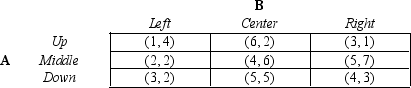 -Refer to Table 17-15.Which of the following outcomes represents a Nash equilibrium in the game?
 (Multiple Choice)
4.9/5 (90)
(90) Table 17-1
Imagine a small town in which only two residents, Rochelle and Alec, own wells that produce safe drinking water. Each week Rochelle and Alec work together to decide how many gallons of water to pump. They bring the water to town and sell it at whatever price the market will bear. To keep things simple, suppose that Rochelle and Alec can pump as much water as they want without cost so that the marginal cost of water equals zero. The weekly town demand schedule and total revenue schedule for water is shown in the table below:
-Refer to Table 17-1.If this market for water were perfectly competitive instead of monopolistic,what price would be charged?
-Refer to Table 17-1.If this market for water were perfectly competitive instead of monopolistic,what price would be charged? (Multiple Choice)
4.8/5 (64)
(64) Other things the same,in which case is the quantity produced the highest?
(Multiple Choice)
4.9/5 (68)
(68) Because each oligopolist cares about its own profit rather than the collective profit of all the oligopolists together,
(Multiple Choice)
4.9/5 (91)
(91) In which of the following games is it clearly the case that the cooperative outcome of the game is good for the two players and bad for society?
(Multiple Choice)
4.8/5 (75)
(75) Table 17-11
Two cigarette manufacturers (Firm A and Firm B) are faced with lawsuits from states to recover the healthcare related expenses associated with cigarette smoking. Both cigarette firms have evidence that indicates that cigarette smoke causes lung cancer (and other related illnesses). State prosecutors do not have access to the same data used by cigarette manufacturers and thus will have difficulty recovering full costs without the help of at least one cigarette firm study. Each firm has been presented with an opportunity to lower its liability in the suit if it cooperates with attorneys representing the states.
 -Refer to Table 17-11.Pursuing its own best interests,Firm B will concede that cigarette smoke causes lung cancer
 (Multiple Choice)
4.9/5 (76)
(76) Even when allowed to collude,firms in an oligopoly may choose to cheat on their agreements with the rest of the cartel.Why?
(Essay)
4.9/5 (75)
(75) In the prisoners' dilemma game,confessing is a dominant strategy for each of the two prisoners.
(True/False)
4.9/5 (76)
(76) In an oligopoly,the total output produced in the market is
(Multiple Choice)
4.8/5 (71)
(71) Scenario 17-3. Consider two countries, Muria and Zenya, that are engaged in an arms race. Each country must decide whether to build new weapons or to disarm existing weapons. Each country prefers to have more arms than the other because a large arsenal gives it more influence in world affairs. But each country also prefers to live in a world safe from the other country's weapons. The following table shows the possible outcomes for each decision combination. The numbers in each cell represent the country's ranking of the outcome (4 = best outcome, 1 = worst outcome).
 -Refer to Scenario 17-3.Suppose the two countries agreed to disarm existing weapons.In reality these two countries may have a hard time keeping this agreement due to which of the following reasons?
(i)Even though Muria has no incentive to cheat on the agreement,Zenya has an incentive to cheat on the agreement.
(ii)Much like the prisoners' dilemma,both countries are better off reneging on the agreement and building new weapons.
(iii)Both countries want to increase their world power by building new weapons.
-Refer to Scenario 17-3.Suppose the two countries agreed to disarm existing weapons.In reality these two countries may have a hard time keeping this agreement due to which of the following reasons?
(i)Even though Muria has no incentive to cheat on the agreement,Zenya has an incentive to cheat on the agreement.
(ii)Much like the prisoners' dilemma,both countries are better off reneging on the agreement and building new weapons.
(iii)Both countries want to increase their world power by building new weapons. (Multiple Choice)
4.8/5 (69)
(69) The Clayton Act of 1914 allows those harmed by illegal arrangements to restrain trade to
(Multiple Choice)
5.0/5 (77)
(77) 
Filters
- Essay(0)
- Multiple Choice(0)
- Short Answer(0)
- True False(0)
- Matching(0)