



 Chat with AI
Exam 17: Oligopoly.

Exam 1: Ten Principles of Economics.349 Questions
Exam 2: Thinking Like an Economist.535 Questions
Exam 3: Interdependence and the Gains from Trade.443 Questions
Exam 4: The Market Forces of Supply and Demand.571 Questions
Exam 5: Elasticity and Its Application510 Questions
Exam 6: Supply, Demand, And Government Policies.557 Questions
Exam 7: Consumers, Producers, and the Efficiency of Markets.460 Questions
Exam 8: Application: The Costs of Taxation.424 Questions
Exam 9: Application: International Trade.410 Questions
Exam 10: Externalities.441 Questions
Exam 11: Public Goods and Common Resources.349 Questions
Exam 12: The Design of the Tax System.478 Questions
Exam 13: The Costs of Production.533 Questions
Exam 14: Firms in Competitive Markets.478 Questions
Exam 15: Monopoly.526 Questions
Exam 16: Monopolistic Competition.497 Questions
Exam 17: Oligopoly.410 Questions
Exam 18: The Market For the Factors of Production.463 Questions
Exam 19: Earnings and Discrimination.398 Questions
Exam 20: Income Inequality and Poverty.374 Questions
Exam 21: The Theory of Consumer Choice.462 Questions
Exam 22: Frontiers in Microeconomics.353 Questions
Select questions type


Table 17-11
Two cigarette manufacturers (Firm A and Firm B) are faced with lawsuits from states to recover the healthcare related expenses associated with cigarette smoking. Both cigarette firms have evidence that indicates that cigarette smoke causes lung cancer (and other related illnesses). State prosecutors do not have access to the same data used by cigarette manufacturers and thus will have difficulty recovering full costs without the help of at least one cigarette firm study. Each firm has been presented with an opportunity to lower its liability in the suit if it cooperates with attorneys representing the states.
 -Refer to Table 17-11.Pursuing its own best interests,Firm A will concede that cigarette smoke causes lung cancer
 (Multiple Choice)
4.9/5  (86)
(86) Consider a market served by a monopolist,Firm A.A new firm,Firm B,enters the market and,as a result,Firm A lowers its price to try to drive Firm B out of the market.This practice is known as
(Multiple Choice)
5.0/5 (90)
(90) Figure 17-4. Two companies, Acme and Bilco, are sellers in the same market. Each company decides whether to charge a high price or a low price. In the figure, the dollar amounts are payoffs and they represent annual profits for the two companies.
 -Refer to Figure 17-4.Suppose the outcome of the game is one in which Acme's profit is $2 million and Bilco's profit is $7 million.The most likely explanation for this outcome is that
 (Multiple Choice)
4.9/5 (97)
(97) Table 17-20
Nadia and Maddie are two college roommates who both prefer a clean common space in their dorm room, but neither enjoys cleaning. The roommates must each make a decision to either clean or not clean the dorm room's common space. The payoff table for this situation is provided below, where the higher a player's payoff number, the better off that player is. The payoffs in each cell are shown as (payoff for Nadia, payoff for Maddie).
 -Refer to Table 17-20.What is Maddie's dominant strategy?
 (Multiple Choice)
4.9/5 (90)
(90) Game theory is just as necessary for understanding competitive or monopoly markets as it is for understanding oligopolistic markets.
(True/False)
4.7/5 (89)
(89) If Levi Strauss & Co.were to require every retailer that carried its clothing to charge customers $42 for each pair of jeans,Levi Strauss & Co.would be practicing
(Multiple Choice)
4.9/5 (66)
(66) Scenario 17-1. Assume that the countries of Irun and Urun are the only two producers of crude oil. Further assume that both countries have entered into an agreement to maintain certain production levels in order to maximize profits. In the world market for oil, the demand curve is downward sloping.
-Refer to Scenario 17-1.As long as the combined level of output is less than the Nash equilibrium level,both Irun and Urun have the individual incentive to
(Multiple Choice)
4.7/5 (76)
(76) Table 17-4. The information in the table below shows the total demand for high-speed Internet subscriptions in a small urban market. Assume that each company that provides these subscriptions incurs an annual fixed cost of $200,000 (per year) and that the marginal cost of providing an additional subscription is always $80.
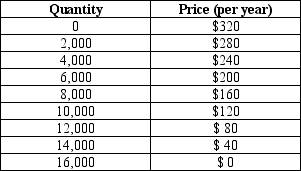 -Refer to Table 17-4.Suppose there is only one high-speed Internet service provider in this market and it seeks to maximize its profit.The company will
 (Multiple Choice)
4.8/5 (80)
(80) In imperfectly competitive markets,increasing production will decrease the price of all units sold.This concept is known as the
(Multiple Choice)
4.9/5 (78)
(78) In pursing its own interest,an oligopoly firm will decide to increase production by 1 unit as long as
(Multiple Choice)
4.7/5 (90)
(90) Suppose two companies own adjacent oil fields.Under the two fields is a common pool of oil worth $30 million.For each well that is drilled,the company that drills the well incurs a cost of $3 million.Each company can drill up to two wells.What is the likely outcome of this game if each company pursues its own self-interest?
(Multiple Choice)
4.9/5 (67)
(67) The players in a two-person game are choosing between Strategy X and Strategy Y.If the second player chooses Strategy X,the first player's best outcome is to select X.If the second player chooses Strategy Y,the first player's best outcome is to select X.For the first player,Strategy X is called a
(Multiple Choice)
4.8/5 (81)
(81) Figure 17-1
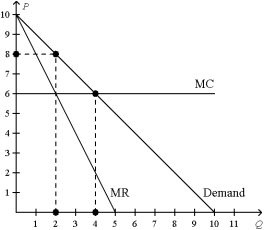 -Refer to Figure 17-1.Suppose this market is served by two firms who each face the marginal cost curve shown in the diagram.The marginal revenue curve that a monopolist would face in this market is also shown.If the firms are able to collude successfully,
 (Multiple Choice)
4.8/5 (83)
(83) For cartels,as the number of firms (members of the cartel)increases,
(Multiple Choice)
4.9/5 (66)
(66) Nike and Reebok (athletic shoe companies)are considering whether to advertise during the Super Bowl.Devise a simple prisoners' dilemma game to demonstrate the strategic considerations that are relevant to this decision.Does the repeated game scenario differ from a single period game? Is it possible that a repeated game (without collusive agreements)could lead to an outcome that is better than a single-period game? Explain the circumstances in which this may be true.
(Essay)
4.8/5 (85)
(85) A manufacturer of light bulbs sells its products to retail stores and requires the stores to sell the bulbs to customers for $2 per bulb.This practice is known as tying.
(True/False)
4.9/5 (79)
(79) Table 17-14
This table shows a game played between two players, A and B. The payoffs in the table are shown as (Payoff to A, Payoff to B).
 -Refer to Table 17-14.Which outcome is the Nash equilibrium in this game?
 (Multiple Choice)
4.9/5 (74)
(74) Table 17-9
Only two firms, Acme and Pinnacle, sell a particular product. The table below shows the demand curve for their product. Each firm has the same constant marginal cost of $10 and zero fixed cost.
 -Refer to Table 17-9.What is the socially efficient quantity of the product?
 (Multiple Choice)
4.7/5 (83)
(83) Figure 17-4. Two companies, Acme and Bilco, are sellers in the same market. Each company decides whether to charge a high price or a low price. In the figure, the dollar amounts are payoffs and they represent annual profits for the two companies.
-Refer to Figure 17-4.The situation faced by Acme and Bilco is
-Refer to Figure 17-4.The situation faced by Acme and Bilco is (Multiple Choice)
4.9/5 (71)
(71) 
Filters
- Essay(0)
- Multiple Choice(0)
- Short Answer(0)
- True False(0)
- Matching(0)