



 Chat with AI
Exam 17: Oligopoly.

Exam 1: Ten Principles of Economics.349 Questions
Exam 2: Thinking Like an Economist.535 Questions
Exam 3: Interdependence and the Gains from Trade.443 Questions
Exam 4: The Market Forces of Supply and Demand.571 Questions
Exam 5: Elasticity and Its Application510 Questions
Exam 6: Supply, Demand, And Government Policies.557 Questions
Exam 7: Consumers, Producers, and the Efficiency of Markets.460 Questions
Exam 8: Application: The Costs of Taxation.424 Questions
Exam 9: Application: International Trade.410 Questions
Exam 10: Externalities.441 Questions
Exam 11: Public Goods and Common Resources.349 Questions
Exam 12: The Design of the Tax System.478 Questions
Exam 13: The Costs of Production.533 Questions
Exam 14: Firms in Competitive Markets.478 Questions
Exam 15: Monopoly.526 Questions
Exam 16: Monopolistic Competition.497 Questions
Exam 17: Oligopoly.410 Questions
Exam 18: The Market For the Factors of Production.463 Questions
Exam 19: Earnings and Discrimination.398 Questions
Exam 20: Income Inequality and Poverty.374 Questions
Exam 21: The Theory of Consumer Choice.462 Questions
Exam 22: Frontiers in Microeconomics.353 Questions
Select questions type


Table 17-10
The table shows the town of Driveaway's demand schedule for gasoline. Assume the town's gasoline seller(s) incurs a cost of $2 for each gallon sold, with no fixed cost.
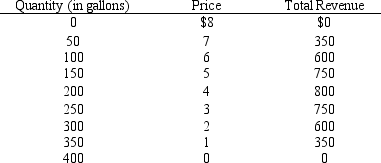 -Refer to Table 17-10.If the market for gasoline in Driveaway is a monopoly,then the profit-maximizing monopolist will charge a price of
 (Multiple Choice)
4.8/5  (71)
(71) A cooperative agreement among oligopolists is more likely to be maintained,
(Multiple Choice)
5.0/5 (80)
(80) The Sherman Antitrust Act prohibits executives of competing companies from
(Multiple Choice)
4.9/5 (80)
(80) Table 17-8. For a certain small town, the table shows the demand schedule for water. Assume the marginal cost of supplying water is constant at $4 per bottle.
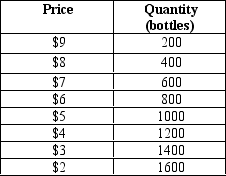 -Refer to Table 17-8.If there are two suppliers of water,Victor and Sami,and if they have successfully formed a cartel and split the market evenly,then how many bottles will Sami supply?
 (Multiple Choice)
4.8/5 (75)
(75) Table 17-11
Two cigarette manufacturers (Firm A and Firm B) are faced with lawsuits from states to recover the healthcare related expenses associated with cigarette smoking. Both cigarette firms have evidence that indicates that cigarette smoke causes lung cancer (and other related illnesses). State prosecutors do not have access to the same data used by cigarette manufacturers and thus will have difficulty recovering full costs without the help of at least one cigarette firm study. Each firm has been presented with an opportunity to lower its liability in the suit if it cooperates with attorneys representing the states.
 -Refer to Table 17-11.If both firms follow a dominant strategy,Firm A's profits (losses)will be
 (Multiple Choice)
4.8/5 (68)
(68) An oligopolist will increase production if the output effect is
(Multiple Choice)
4.8/5 (80)
(80) Which of the following questions about predatory pricing remains unresolved?
(Multiple Choice)
4.7/5 (73)
(73) The Sherman Antitrust Act prohibits price-fixing in the sense that
(Multiple Choice)
4.9/5 (69)
(69) In a competitive market,strategic interactions among the firms are not important.
(True/False)
4.9/5 (78)
(78) An agreement among firms regarding price and/or production levels is called
(Multiple Choice)
4.8/5 (85)
(85) A particular cable TV company requires a household to subscribe to its high-speed Internet service if it subscribes to cable TV,and vice versa.This practice
(Multiple Choice)
4.8/5 (60)
(60) Table 17-24
Two firms are considering going out of business and selling their assets. Each considers what happens if the other goes out of business. The payoff matrix below shows the net gain or loss to each firm.
 -Refer to Table 17-24.Which firm's dominant strategy is to sell?
 (Multiple Choice)
4.9/5 (79)
(79) Table 17-7. The table shows the demand schedule for a particular product.
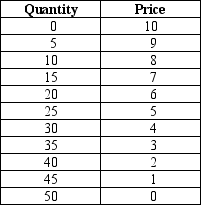 -Refer to Table 17-7.If this market is perfectly competitive and the marginal cost is constant at $2 per unit,then how much output will be produced?
 (Multiple Choice)
4.9/5 (86)
(86) Table 17-5. Imagine a small town in which only two residents, Kunal and Naj, own wells that produce safe drinking water. Each week Kunal and Naj work together to decide how many gallons of water to pump, to bring the water to town, and to sell it at whatever price the market will bear. Assume Kunal and Naj can pump as much water as they want without cost so that the marginal cost of water equals zero.
The weekly town demand schedule and total revenue schedule for water are shown in the table below.
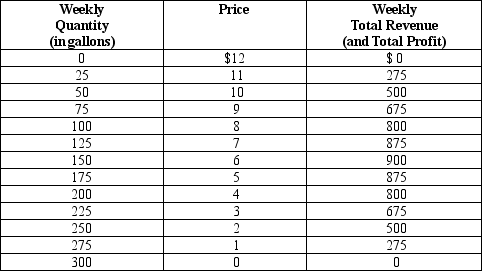 -Refer to Table 17-5.The socially efficient level of water supplied to the market would be
 (Multiple Choice)
4.9/5 (76)
(76) In a typical cartel agreement,the cartel maximizes profit when it
(Multiple Choice)
4.7/5 (80)
(80) In the prisoners' dilemma game with Bonnie and Clyde as the players,the likely outcome is
(Multiple Choice)
4.8/5 (77)
(77) Assuming that oligopolists do not have the opportunity to collude,once they have reached the Nash equilibrium,it
(Multiple Choice)
4.9/5 (75)
(75) To increase their individual profits,members of a cartel have an incentive to
(Multiple Choice)
4.9/5 (89)
(89) Table 17-12
Each year the United States considers renewal of Most Favored Nation (MFN) trading status with Farland (a mythical nation). Historically, legislators have made threats of not renewing MFN status because of human rights abuses in Farland. The non-renewal of MFN trading status is likely to involve some retaliatory measures by Farland. The payoff table below shows the potential economic gains associated with a game in which Farland may impose trade sanctions against U.S. firms and the United States may not renew MFN status with Farland. The table contains the dollar value of all trade-flow benefits to the United States and Farland.
 -Refer to Table 17-12.When this game reaches a Nash equilibrium,the value of trade flow benefits will be
 (Multiple Choice)
4.7/5 (75)
(75) 
Filters
- Essay(0)
- Multiple Choice(0)
- Short Answer(0)
- True False(0)
- Matching(0)