



 Chat with AI
Exam 17: Oligopoly.

Exam 1: Ten Principles of Economics.349 Questions
Exam 2: Thinking Like an Economist.535 Questions
Exam 3: Interdependence and the Gains from Trade.443 Questions
Exam 4: The Market Forces of Supply and Demand.571 Questions
Exam 5: Elasticity and Its Application510 Questions
Exam 6: Supply, Demand, And Government Policies.557 Questions
Exam 7: Consumers, Producers, and the Efficiency of Markets.460 Questions
Exam 8: Application: The Costs of Taxation.424 Questions
Exam 9: Application: International Trade.410 Questions
Exam 10: Externalities.441 Questions
Exam 11: Public Goods and Common Resources.349 Questions
Exam 12: The Design of the Tax System.478 Questions
Exam 13: The Costs of Production.533 Questions
Exam 14: Firms in Competitive Markets.478 Questions
Exam 15: Monopoly.526 Questions
Exam 16: Monopolistic Competition.497 Questions
Exam 17: Oligopoly.410 Questions
Exam 18: The Market For the Factors of Production.463 Questions
Exam 19: Earnings and Discrimination.398 Questions
Exam 20: Income Inequality and Poverty.374 Questions
Exam 21: The Theory of Consumer Choice.462 Questions
Exam 22: Frontiers in Microeconomics.353 Questions
Select questions type


Table 17-12
Each year the United States considers renewal of Most Favored Nation (MFN) trading status with Farland (a mythical nation). Historically, legislators have made threats of not renewing MFN status because of human rights abuses in Farland. The non-renewal of MFN trading status is likely to involve some retaliatory measures by Farland. The payoff table below shows the potential economic gains associated with a game in which Farland may impose trade sanctions against U.S. firms and the United States may not renew MFN status with Farland. The table contains the dollar value of all trade-flow benefits to the United States and Farland.
 -Refer to Table 17-12.If trade negotiators are able to communicate effectively about the consequences of various trade policies (i.e.,enter into an agreement about the policy they should adopt),then we would expect the countries to agree to which outcome?
 (Multiple Choice)
4.8/5  (73)
(73) Table 17-1
Imagine a small town in which only two residents, Rochelle and Alec, own wells that produce safe drinking water. Each week Rochelle and Alec work together to decide how many gallons of water to pump. They bring the water to town and sell it at whatever price the market will bear. To keep things simple, suppose that Rochelle and Alec can pump as much water as they want without cost so that the marginal cost of water equals zero. The weekly town demand schedule and total revenue schedule for water is shown in the table below:
 -Refer to Table 17-1.What is the socially efficient quantity of water?
 (Multiple Choice)
5.0/5 (89)
(89) If an oligopolist is part of a cartel that is collectively producing the monopoly level of output,then that oligopolist has the incentive to lower production with the aim of
(Multiple Choice)
4.8/5 (72)
(72) The essence of an oligopolistic market is that there are only a few sellers.
(True/False)
4.8/5 (95)
(95) The equilibrium quantity in markets characterized by oligopoly is
(Multiple Choice)
4.8/5 (72)
(72) Scenario 17-1. Assume that the countries of Irun and Urun are the only two producers of crude oil. Further assume that both countries have entered into an agreement to maintain certain production levels in order to maximize profits. In the world market for oil, the demand curve is downward sloping.
-Refer to Scenario 17-1.The fact that both countries have colluded to earn higher profit shows their desire to keep their combined level of output
(Multiple Choice)
4.9/5 (76)
(76) Table 17-12
Each year the United States considers renewal of Most Favored Nation (MFN) trading status with Farland (a mythical nation). Historically, legislators have made threats of not renewing MFN status because of human rights abuses in Farland. The non-renewal of MFN trading status is likely to involve some retaliatory measures by Farland. The payoff table below shows the potential economic gains associated with a game in which Farland may impose trade sanctions against U.S. firms and the United States may not renew MFN status with Farland. The table contains the dollar value of all trade-flow benefits to the United States and Farland.
-Refer to Table 17-12.If both countries follow a dominant strategy,the value of trade flow benefits for the United States will be
-Refer to Table 17-12.If both countries follow a dominant strategy,the value of trade flow benefits for the United States will be (Multiple Choice)
4.9/5 (88)
(88) When strategic interactions are important to pricing and production decisions,a typical firm will
(Multiple Choice)
4.8/5 (75)
(75) Suppose that two poker players believe that they are superior players to the rest of the people at their table.Further suppose that the two players make an agreement to concede hands to each other in order to drive the other players from the game first.Economists would model such behavior as
(Multiple Choice)
4.8/5 (80)
(80) Scenario 17-4. Consider two cigarette companies, PM Inc. and Brown Inc. If neither company advertises, the two companies split the market and earn $50 million each. If they both advertise, they again split the market, but profits are lower by $10 million since each company must bear the cost of advertising. Yet if one company advertises while the other does not, the one that advertises attracts customers from the other. In this case, the company that advertises earns $60 million while the company that does not advertise earns only $30 million.
-Refer to Scenario 17-4.If these two companies collude and agree upon the best joint strategy,
(Multiple Choice)
4.9/5 (91)
(91) Which of the following is correct? When oligopolies collude
(Multiple Choice)
4.8/5 (71)
(71) Cartels with a small number of firms have a greater probability of reaching the monopoly outcome than do cartels with a larger number of firms.
(True/False)
4.8/5 (76)
(76) After initial success,the OPEC cartel saw the price of oil and the revenues of its members decline due,in part,to
(Multiple Choice)
4.8/5 (86)
(86) Table 17-9
Only two firms, Acme and Pinnacle, sell a particular product. The table below shows the demand curve for their product. Each firm has the same constant marginal cost of $10 and zero fixed cost.
 -Refer to Table 17-9.If Acme and Pinnacle operate to jointly maximize profits,then what quantity is sold?
 (Multiple Choice)
4.8/5 (83)
(83) Table 17-6. The table shows the demand schedule for a particular product.
 -Refer to Table 17-6.Suppose the market for this product is served by two firms that have formed a cartel.What price will the cartel charge in this market if the marginal cost of production is $0?
 (Multiple Choice)
4.7/5 (72)
(72) Table 17-5. Imagine a small town in which only two residents, Kunal and Naj, own wells that produce safe drinking water. Each week Kunal and Naj work together to decide how many gallons of water to pump, to bring the water to town, and to sell it at whatever price the market will bear. Assume Kunal and Naj can pump as much water as they want without cost so that the marginal cost of water equals zero.
The weekly town demand schedule and total revenue schedule for water are shown in the table below.
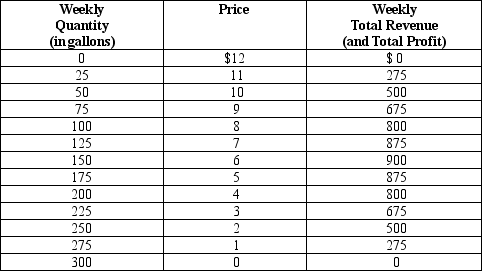 -Refer to Table 17-5.Since Kunal and Naj operate as a profit-maximizing monopoly in the market for water,what price will they charge for water?
 (Multiple Choice)
4.8/5 (77)
(77) Table 17-5. Imagine a small town in which only two residents, Kunal and Naj, own wells that produce safe drinking water. Each week Kunal and Naj work together to decide how many gallons of water to pump, to bring the water to town, and to sell it at whatever price the market will bear. Assume Kunal and Naj can pump as much water as they want without cost so that the marginal cost of water equals zero.
The weekly town demand schedule and total revenue schedule for water are shown in the table below.
-Refer to Table 17-5.Suppose the town enacts new antitrust laws that prohibit Kunal and Naj from operating as a monopolist.What will the new price of water be once the Nash equilibrium is reached?
-Refer to Table 17-5.Suppose the town enacts new antitrust laws that prohibit Kunal and Naj from operating as a monopolist.What will the new price of water be once the Nash equilibrium is reached? (Multiple Choice)
4.9/5 (92)
(92) 
Filters
- Essay(0)
- Multiple Choice(0)
- Short Answer(0)
- True False(0)
- Matching(0)