



 Chat with AI
Exam 17: Oligopoly.

Exam 1: Ten Principles of Economics.349 Questions
Exam 2: Thinking Like an Economist.535 Questions
Exam 3: Interdependence and the Gains from Trade.443 Questions
Exam 4: The Market Forces of Supply and Demand.571 Questions
Exam 5: Elasticity and Its Application510 Questions
Exam 6: Supply, Demand, And Government Policies.557 Questions
Exam 7: Consumers, Producers, and the Efficiency of Markets.460 Questions
Exam 8: Application: The Costs of Taxation.424 Questions
Exam 9: Application: International Trade.410 Questions
Exam 10: Externalities.441 Questions
Exam 11: Public Goods and Common Resources.349 Questions
Exam 12: The Design of the Tax System.478 Questions
Exam 13: The Costs of Production.533 Questions
Exam 14: Firms in Competitive Markets.478 Questions
Exam 15: Monopoly.526 Questions
Exam 16: Monopolistic Competition.497 Questions
Exam 17: Oligopoly.410 Questions
Exam 18: The Market For the Factors of Production.463 Questions
Exam 19: Earnings and Discrimination.398 Questions
Exam 20: Income Inequality and Poverty.374 Questions
Exam 21: The Theory of Consumer Choice.462 Questions
Exam 22: Frontiers in Microeconomics.353 Questions
Select questions type


Table 17-1
Imagine a small town in which only two residents, Rochelle and Alec, own wells that produce safe drinking water. Each week Rochelle and Alec work together to decide how many gallons of water to pump. They bring the water to town and sell it at whatever price the market will bear. To keep things simple, suppose that Rochelle and Alec can pump as much water as they want without cost so that the marginal cost of water equals zero. The weekly town demand schedule and total revenue schedule for water is shown in the table below:
 -Refer to Table 17-1.If Rochelle and Alec operate as a profit-maximizing monopoly in the market for water,how much profit will each of them earn?
 (Multiple Choice)
4.9/5  (76)
(76) Table 17-11
Two cigarette manufacturers (Firm A and Firm B) are faced with lawsuits from states to recover the healthcare related expenses associated with cigarette smoking. Both cigarette firms have evidence that indicates that cigarette smoke causes lung cancer (and other related illnesses). State prosecutors do not have access to the same data used by cigarette manufacturers and thus will have difficulty recovering full costs without the help of at least one cigarette firm study. Each firm has been presented with an opportunity to lower its liability in the suit if it cooperates with attorneys representing the states.
 -Refer to Table 17-11.When this game reaches a Nash equilibrium,profits for Firm A and Firm B will be
 (Multiple Choice)
4.8/5 (69)
(69) Table 17-10
The table shows the town of Driveaway's demand schedule for gasoline. Assume the town's gasoline seller(s) incurs a cost of $2 for each gallon sold, with no fixed cost.
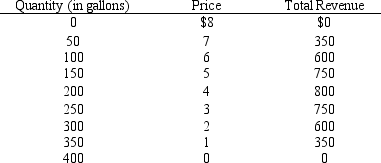 -Refer to Table 17-10.If the market for gasoline in Driveaway is a monopoly,then the monopolist's maximum profit is
 (Multiple Choice)
4.8/5 (61)
(61) Table 17-20
Nadia and Maddie are two college roommates who both prefer a clean common space in their dorm room, but neither enjoys cleaning. The roommates must each make a decision to either clean or not clean the dorm room's common space. The payoff table for this situation is provided below, where the higher a player's payoff number, the better off that player is. The payoffs in each cell are shown as (payoff for Nadia, payoff for Maddie).
 -Refer to Table 17-20.What is Nadia's dominant strategy?
 (Multiple Choice)
4.9/5 (85)
(85) Table 17-5. Imagine a small town in which only two residents, Kunal and Naj, own wells that produce safe drinking water. Each week Kunal and Naj work together to decide how many gallons of water to pump, to bring the water to town, and to sell it at whatever price the market will bear. Assume Kunal and Naj can pump as much water as they want without cost so that the marginal cost of water equals zero.
The weekly town demand schedule and total revenue schedule for water are shown in the table below.
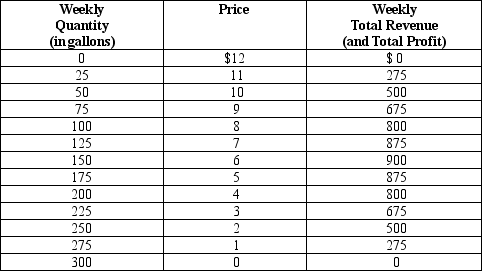 -Refer to Table 17-5.If the market for water were perfectly competitive instead of monopolistic,how many gallons of water would be produced and sold?
 (Multiple Choice)
4.9/5 (72)
(72) Table 17-17
This table shows a game played between two firms, Firm A and Firm B. In this game each firm must decide how much output (Q) to produce: 2 units or 3 units. The profit for each firm is given in the table as (Profit for Firm A, Profit for Firm B).
 -Refer to Table 17-17.Which of the following outcomes represent the Nash equilibrium in this game?
 (Multiple Choice)
4.8/5 (88)
(88) Table 17-19
Consider a small town that has two grocery stores from which residents can choose to buy a gallon of milk. The store owners each must make a decision to set a high milk price or a low milk price. The payoff table, showing profit per week, is provided below. The profit in each cell is shown as (Store 1, Store 2).
 -Refer to Table 17-19.What is the Nash Equilibrium of this price-setting game?
 (Multiple Choice)
4.8/5 (69)
(69) When the prisoners' dilemma game is generalized to describe situations other than those that literally involve two prisoners,we see that cooperation between the players of the game
(Multiple Choice)
4.8/5 (79)
(79) All examples of the prisoner's dilemma game are characterized by one and only one Nash equilibrium.
(True/False)
4.7/5 (70)
(70) Table 17-21
The Chicken Game is named for a contest in which drivers test their courage by driving straight at each other. John and Paul have a common interest to avoid crashing into each other, but they also have a personal, competing interest to not turn first to demonstrate their courage to those observing the contest. The payoff table for this situation is provided below. The payoffs are shown as (John, Paul).
 -Refer to Table 17-21.What is Paul's dominant strategy?
 (Multiple Choice)
4.9/5 (75)
(75) Barb and Sue are competitors in a local market.Each is trying to decide if it is better to advertise on TV,on radio,or not at all.If they both advertise on TV,each will earn a profit of $5,000.If they both advertise on radio,each will earn a profit of $7,000.If neither advertises at all,each will earn a profit of $10,000.If one advertises on TV and other advertises on radio,then the one advertising on TV will earn $8,000 and the other will earn $3,000.If one advertises on TV and the other does not advertise,then the one advertising on TV will earn $15,000 and the other will earn $2,000.If one advertises on radio and the other does not advertise,then the one advertising on radio will earn $12,000 and the other will earn $4,000.If both follow their dominant strategy,then Barb will
(Multiple Choice)
4.9/5 (74)
(74) The problems faced by oligopolies with three or more members are entirely different from the problems faced by duopolies.
(True/False)
4.8/5 (73)
(73) Figure 17-1
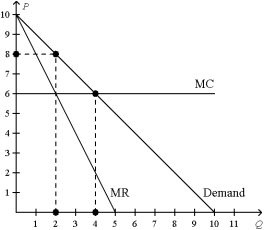 -Refer to Figure 17-1.Suppose this market is served by a duopoly in which each firm faces the marginal cost curve shown in the diagram.The marginal revenue curve that a monopolist would face in this market is also shown.Which of the following statements is true?
 (Multiple Choice)
4.9/5 (81)
(81) Table 17-18
This table shows a game played between two firms, Firm A and Firm B. In this game each firm must decide how much output (Q) to produce: 10 units or 12 units. The profit for each firm is given in the table as (Profit for Firm A, Profit for Firm B).
 -Refer to Table 17-18.The dominant strategy For Firm A is to produce
 (Multiple Choice)
4.8/5 (74)
(74) In which of the following games is it clearly the case that the cooperative outcome of the game is good for the two players and good for society?
(Multiple Choice)
4.9/5 (81)
(81) Scenario 17-2. Imagine that two oil companies, Mobile and Cargo, own adjacent oil fields. Under the fields is a common pool of oil worth $96 million. Drilling a well to recover oil costs $3 million per well. If each company drills one well, each will get half of the oil and earn a $45 million profit ($48 million in revenue - $3 million in costs). Assume that having X percent of the total wells means that a company will collect X percent of the total revenue.
-Refer to Scenario 17-2.If Mobile and Cargo are able to successfully collude to maximize their joint profits,Mobile will
(Multiple Choice)
4.9/5 (67)
(67) Table 17-18
This table shows a game played between two firms, Firm A and Firm B. In this game each firm must decide how much output (Q) to produce: 10 units or 12 units. The profit for each firm is given in the table as (Profit for Firm A, Profit for Firm B).
-Refer to Table 17-18.If these two firms play this game repeatedly,the likely outcome will be
-Refer to Table 17-18.If these two firms play this game repeatedly,the likely outcome will be (Multiple Choice)
4.8/5 (101)
(101) Martha and Oleg are competitors in a local market and each is trying to decide if it is worthwhile to advertise.If both of them advertise,each will earn a profit of $5,000.If neither of them advertise,each will earn a profit of $10,000.If one advertises and the other doesn't,then the one who advertises will earn a profit of $15,000 and the other will earn $7,000.To earn the highest profit,Martha
(Multiple Choice)
4.9/5 (88)
(88) 
Filters
- Essay(0)
- Multiple Choice(0)
- Short Answer(0)
- True False(0)
- Matching(0)