



 Chat with AI
Exam 17: Oligopoly.

Exam 1: Ten Principles of Economics.349 Questions
Exam 2: Thinking Like an Economist.535 Questions
Exam 3: Interdependence and the Gains from Trade.443 Questions
Exam 4: The Market Forces of Supply and Demand.571 Questions
Exam 5: Elasticity and Its Application510 Questions
Exam 6: Supply, Demand, And Government Policies.557 Questions
Exam 7: Consumers, Producers, and the Efficiency of Markets.460 Questions
Exam 8: Application: The Costs of Taxation.424 Questions
Exam 9: Application: International Trade.410 Questions
Exam 10: Externalities.441 Questions
Exam 11: Public Goods and Common Resources.349 Questions
Exam 12: The Design of the Tax System.478 Questions
Exam 13: The Costs of Production.533 Questions
Exam 14: Firms in Competitive Markets.478 Questions
Exam 15: Monopoly.526 Questions
Exam 16: Monopolistic Competition.497 Questions
Exam 17: Oligopoly.410 Questions
Exam 18: The Market For the Factors of Production.463 Questions
Exam 19: Earnings and Discrimination.398 Questions
Exam 20: Income Inequality and Poverty.374 Questions
Exam 21: The Theory of Consumer Choice.462 Questions
Exam 22: Frontiers in Microeconomics.353 Questions
Select questions type


As a group,oligopolists would always earn the highest profit if they would
(Multiple Choice)
4.9/5  (86)
(86) Policymakers should be aggressive in using their powers to place limits on firm behavior,because business practices that appear to reduce competition never have any legitimate purposes.
(True/False)
4.7/5 (79)
(79) In the language of game theory,a situation in which each person must consider how others might respond to his or her own actions is called a
(Multiple Choice)
5.0/5 (81)
(81) Table 17-21
The Chicken Game is named for a contest in which drivers test their courage by driving straight at each other. John and Paul have a common interest to avoid crashing into each other, but they also have a personal, competing interest to not turn first to demonstrate their courage to those observing the contest. The payoff table for this situation is provided below. The payoffs are shown as (John, Paul).
 -Refer to Table 17-21.If John chooses Turn,what will Paul choose to do and what will Paul's payoff equal?
 (Multiple Choice)
5.0/5 (88)
(88) The game that oligopolists play in trying to reach the oligopoly outcome is similar to the game that the two prisoners play in the prisoners' dilemma.
(True/False)
4.8/5 (68)
(68) The prisoners' dilemma is an important game to study because
(Multiple Choice)
4.9/5 (90)
(90) Suppose three firms form a cartel and agree to charge a specific price for their output.Each individual firm has an incentive to maintain the agreement because the firm's individual profits will be the greatest under the cartel arrangement.
(True/False)
4.9/5 (88)
(88) Assume oligopoly firms are profit maximizers,they do not form a cartel,and they take other firms' production levels as given.Then in equilibrium the output effect
(Multiple Choice)
4.8/5 (81)
(81) Oligopolies produce more when they collude then when they do not.
(True/False)
4.8/5 (77)
(77) If duopoly firms that are not colluding were able to successfully collude,then
(Multiple Choice)
4.9/5 (75)
(75) Who wrote,"People of the same trade seldom meet together,but the conversation ends in a conspiracy against the public,or in some diversion to raise prices."?
(Multiple Choice)
4.9/5 (80)
(80) Table 17-21
The Chicken Game is named for a contest in which drivers test their courage by driving straight at each other. John and Paul have a common interest to avoid crashing into each other, but they also have a personal, competing interest to not turn first to demonstrate their courage to those observing the contest. The payoff table for this situation is provided below. The payoffs are shown as (John, Paul).
-Refer to Table 17-21.If Paul chooses Drive Straight,what will John choose to do and what will John's payoff equal?
-Refer to Table 17-21.If Paul chooses Drive Straight,what will John choose to do and what will John's payoff equal? (Multiple Choice)
4.8/5 (78)
(78) The notion of a tit-for-tat strategy applies to a prisoners' dilemma game that is played repeatedly,but it does not apply if the game is played only once.
(True/False)
4.8/5 (82)
(82) Table 17-10
The table shows the town of Driveaway's demand schedule for gasoline. Assume the town's gasoline seller(s) incurs a cost of $2 for each gallon sold, with no fixed cost.
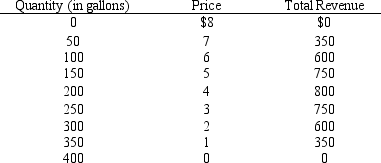 -Refer to Table 17-10.Suppose we observe that the price of a gallon of gasoline in Driveaway is $5; we observe as well that a particular seller's profit is $150.Given this observation,which of the following scenarios is most likely?
 (Multiple Choice)
4.9/5 (85)
(85) Table 17-8. For a certain small town, the table shows the demand schedule for water. Assume the marginal cost of supplying water is constant at $4 per bottle.
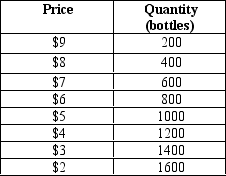 -Refer to Table 17-8.If there were many suppliers of bottled water,what would be the price and quantity?
 (Multiple Choice)
4.8/5 (67)
(67) Scenario 17-3. Consider two countries, Muria and Zenya, that are engaged in an arms race. Each country must decide whether to build new weapons or to disarm existing weapons. Each country prefers to have more arms than the other because a large arsenal gives it more influence in world affairs. But each country also prefers to live in a world safe from the other country's weapons. The following table shows the possible outcomes for each decision combination. The numbers in each cell represent the country's ranking of the outcome (4 = best outcome, 1 = worst outcome).
 -Refer to Scenario 17-3.Which of these statements is correct?
(i)Muria is better off building new weapons if Zenya builds new weapons.
(ii)Muria is better off building new weapons if Zenya disarms existing weapons.
(iii)Building new weapons is Muria's dominant strategy.
-Refer to Scenario 17-3.Which of these statements is correct?
(i)Muria is better off building new weapons if Zenya builds new weapons.
(ii)Muria is better off building new weapons if Zenya disarms existing weapons.
(iii)Building new weapons is Muria's dominant strategy. (Multiple Choice)
4.9/5 (89)
(89) Table 17-9
Only two firms, Acme and Pinnacle, sell a particular product. The table below shows the demand curve for their product. Each firm has the same constant marginal cost of $10 and zero fixed cost.
 -Refer to Table 17-9.How much less do each of these firms earn in the Nash equilibrium than if they jointly maximize profits?
 (Multiple Choice)
4.8/5 (73)
(73) 
Filters
- Essay(0)
- Multiple Choice(0)
- Short Answer(0)
- True False(0)
- Matching(0)