



 Chat with AI
Exam 17: Oligopoly.

Exam 1: Ten Principles of Economics.349 Questions
Exam 2: Thinking Like an Economist.535 Questions
Exam 3: Interdependence and the Gains from Trade.443 Questions
Exam 4: The Market Forces of Supply and Demand.571 Questions
Exam 5: Elasticity and Its Application510 Questions
Exam 6: Supply, Demand, And Government Policies.557 Questions
Exam 7: Consumers, Producers, and the Efficiency of Markets.460 Questions
Exam 8: Application: The Costs of Taxation.424 Questions
Exam 9: Application: International Trade.410 Questions
Exam 10: Externalities.441 Questions
Exam 11: Public Goods and Common Resources.349 Questions
Exam 12: The Design of the Tax System.478 Questions
Exam 13: The Costs of Production.533 Questions
Exam 14: Firms in Competitive Markets.478 Questions
Exam 15: Monopoly.526 Questions
Exam 16: Monopolistic Competition.497 Questions
Exam 17: Oligopoly.410 Questions
Exam 18: The Market For the Factors of Production.463 Questions
Exam 19: Earnings and Discrimination.398 Questions
Exam 20: Income Inequality and Poverty.374 Questions
Exam 21: The Theory of Consumer Choice.462 Questions
Exam 22: Frontiers in Microeconomics.353 Questions
Select questions type


Explain the practice of resale price maintenance and discuss why it is controversial.
(Essay)
4.8/5  (83)
(83) The Sherman Antitrust Act states that if a person can prove that he was damaged by an illegal arrangement to restrain trade,he could sue and recover three times the damages he sustained.
(True/False)
4.8/5 (80)
(80) What effect does the number of firms in an oligopoly have on the characteristics of the market?
(Essay)
4.8/5 (72)
(72) As the number of firms in an oligopoly increases,the price approaches
(Multiple Choice)
4.7/5 (85)
(85) When oligopolistic firms interacting with one another each choose their best strategy given the strategies chosen by other firms in the market,we have
(Multiple Choice)
4.8/5 (72)
(72) Table 17-17
This table shows a game played between two firms, Firm A and Firm B. In this game each firm must decide how much output (Q) to produce: 2 units or 3 units. The profit for each firm is given in the table as (Profit for Firm A, Profit for Firm B).
 -Refer to Table 17-17.In this game,
 (Multiple Choice)
4.9/5 (94)
(94) Scenario 17-3. Consider two countries, Muria and Zenya, that are engaged in an arms race. Each country must decide whether to build new weapons or to disarm existing weapons. Each country prefers to have more arms than the other because a large arsenal gives it more influence in world affairs. But each country also prefers to live in a world safe from the other country's weapons. The following table shows the possible outcomes for each decision combination. The numbers in each cell represent the country's ranking of the outcome (4 = best outcome, 1 = worst outcome).
 -Refer to Scenario 17-3.Building new weapons is a dominant strategy for
 (Multiple Choice)
4.8/5 (67)
(67) Table 17-14
This table shows a game played between two players, A and B. The payoffs in the table are shown as (Payoff to A, Payoff to B).
 -Refer to Table 17-14.If both players choose their best strategies,player A will earn a payoff of
 (Multiple Choice)
4.7/5 (74)
(74) Scenario 17-1. Assume that the countries of Irun and Urun are the only two producers of crude oil. Further assume that both countries have entered into an agreement to maintain certain production levels in order to maximize profits. In the world market for oil, the demand curve is downward sloping.
-Refer to Scenario 17-1.If Irun fails to live up to the production agreement and overproduces,which of the following statements will be true of Urun's condition?
(Multiple Choice)
4.8/5 (88)
(88) Table 17-4. The information in the table below shows the total demand for high-speed Internet subscriptions in a small urban market. Assume that each company that provides these subscriptions incurs an annual fixed cost of $200,000 (per year) and that the marginal cost of providing an additional subscription is always $80.
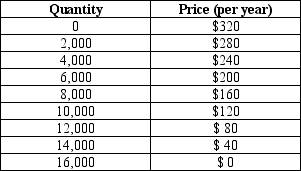 -Refer to Table 17-4.Assume there are two profit-maximizing high-speed Internet service providers operating in this market.Further assume that they are not able to collude on the price and quantity of subscriptions to sell.How many subscriptions will be sold altogether when this market reaches a Nash equilibrium?
 (Multiple Choice)
4.9/5 (60)
(60) Which of the following prohibits executives of competing firms from even talking about fixing prices?
(Multiple Choice)
4.8/5 (76)
(76) The story of the prisoners' dilemma contains a general lesson that applies to any group trying to maintain cooperation among its members.
(True/False)
5.0/5 (92)
(92) Figure 17-4. Two companies, Acme and Bilco, are sellers in the same market. Each company decides whether to charge a high price or a low price. In the figure, the dollar amounts are payoffs and they represent annual profits for the two companies.
 -Refer to Figure 17-4.If the two companies make their pricing decisions independently,then it is likely that Acme will
 (Multiple Choice)
4.9/5 (74)
(74) Table 17-13
Two home-improvement stores (Lopes and HomeMax) in a growing urban area are interested in expanding their market share. Both are interested in expanding the size of their store and parking lot to accommodate potential growth in their customer base. The following game depicts the strategic outcomes that result from the game. Increases in annual profits of the two home-improvement stores are shown in the table below.
 -Refer to Table 17-13.Suppose the owners of Lopes and HomeMax meet for a friendly game of golf one afternoon and happen to discuss a strategy to optimize growth related profit.They should both agree to
 (Multiple Choice)
4.9/5 (84)
(84) When prisoners' dilemma games are repeated over and over,sometimes the threat of penalty causes both parties to cooperate.
(True/False)
4.9/5 (70)
(70) 
Filters
- Essay(0)
- Multiple Choice(0)
- Short Answer(0)
- True False(0)
- Matching(0)