



 Chat with AI
Exam 17: Oligopoly.

Exam 1: Ten Principles of Economics.349 Questions
Exam 2: Thinking Like an Economist.535 Questions
Exam 3: Interdependence and the Gains from Trade.443 Questions
Exam 4: The Market Forces of Supply and Demand.571 Questions
Exam 5: Elasticity and Its Application510 Questions
Exam 6: Supply, Demand, And Government Policies.557 Questions
Exam 7: Consumers, Producers, and the Efficiency of Markets.460 Questions
Exam 8: Application: The Costs of Taxation.424 Questions
Exam 9: Application: International Trade.410 Questions
Exam 10: Externalities.441 Questions
Exam 11: Public Goods and Common Resources.349 Questions
Exam 12: The Design of the Tax System.478 Questions
Exam 13: The Costs of Production.533 Questions
Exam 14: Firms in Competitive Markets.478 Questions
Exam 15: Monopoly.526 Questions
Exam 16: Monopolistic Competition.497 Questions
Exam 17: Oligopoly.410 Questions
Exam 18: The Market For the Factors of Production.463 Questions
Exam 19: Earnings and Discrimination.398 Questions
Exam 20: Income Inequality and Poverty.374 Questions
Exam 21: The Theory of Consumer Choice.462 Questions
Exam 22: Frontiers in Microeconomics.353 Questions
Select questions type


Table 17-6. The table shows the demand schedule for a particular product.
 -Refer to Table 17-6.Suppose the market for this product is served by two firms that have formed a cartel.If the marginal cost of production is $0 and there is no fixed cost,the combined profit of the cartel will be
 (Multiple Choice)
4.9/5  (73)
(73) Table 17-21
The Chicken Game is named for a contest in which drivers test their courage by driving straight at each other. John and Paul have a common interest to avoid crashing into each other, but they also have a personal, competing interest to not turn first to demonstrate their courage to those observing the contest. The payoff table for this situation is provided below. The payoffs are shown as (John, Paul).
 -Refer to Table 17-21.What is John's dominant strategy?
 (Multiple Choice)
4.8/5 (83)
(83) In the prisoners' dilemma game with Bonnie and Clyde as the players,the likely outcome is one
(Multiple Choice)
4.8/5 (93)
(93) Scenario 17-4. Consider two cigarette companies, PM Inc. and Brown Inc. If neither company advertises, the two companies split the market and earn $50 million each. If they both advertise, they again split the market, but profits are lower by $10 million since each company must bear the cost of advertising. Yet if one company advertises while the other does not, the one that advertises attracts customers from the other. In this case, the company that advertises earns $60 million while the company that does not advertise earns only $30 million.
-Refer to Scenario 17-4.In 1971,Congress passed a law that banned cigarette advertising on television.If cigarette companies are profit maximizers,it is likely that
(Multiple Choice)
4.9/5 (83)
(83) Table 17-12
Each year the United States considers renewal of Most Favored Nation (MFN) trading status with Farland (a mythical nation). Historically, legislators have made threats of not renewing MFN status because of human rights abuses in Farland. The non-renewal of MFN trading status is likely to involve some retaliatory measures by Farland. The payoff table below shows the potential economic gains associated with a game in which Farland may impose trade sanctions against U.S. firms and the United States may not renew MFN status with Farland. The table contains the dollar value of all trade-flow benefits to the United States and Farland.
 -Refer to Table 17-12.Pursuing its own best interests,Farland will impose trade sanctions against U.S.firms
 (Multiple Choice)
4.9/5 (83)
(83) Assume that Peach Computers has entered into a resale price maintenance agreement with Computer Super Stores Inc.(CSS Inc.)but not with CompuMart.In this case,
(Multiple Choice)
4.8/5 (75)
(75) Table 17-25
There are just two producers of a certain product. Each is considering offering promotional discounts.
 -Refer to Table 17-25.At the Nash equilibrium,how much profit will Firm A earn?
 (Multiple Choice)
4.9/5 (92)
(92) A situation in which firms choose their best strategy given the strategies chosen by the other firms in the market is called
(Multiple Choice)
4.9/5 (86)
(86) A dominant strategy is a strategy that is best for a player in a game regardless of the strategies chosen by the other players.
(True/False)
4.9/5 (79)
(79) Consider a game of the "Jack and Jill" type in which a market is a duopoly and each firm decides to produce either a "high" quantity of output or a "low" quantity of output.If the two firms successfully reach and maintain the cooperative outcome of the game,then
(Multiple Choice)
5.0/5 (75)
(75) What happens when the prisoners' dilemma game is repeated numerous times in an oligopoly market?
(i)The firms may well reach the monopoly outcome.
(ii)The firms may well reach the competitive outcome.
(iii)Buyers of the oligopolists' product will likely be worse off as a result.
(Multiple Choice)
4.7/5 (66)
(66) As the number of firms in an oligopoly increases,the magnitude of the price effect increases.
(True/False)
4.9/5 (87)
(87) Table 17-20
Nadia and Maddie are two college roommates who both prefer a clean common space in their dorm room, but neither enjoys cleaning. The roommates must each make a decision to either clean or not clean the dorm room's common space. The payoff table for this situation is provided below, where the higher a player's payoff number, the better off that player is. The payoffs in each cell are shown as (payoff for Nadia, payoff for Maddie).
 -Refer to Table 17-20.If Maddie chooses to clean,then Nadia will
 (Multiple Choice)
4.8/5 (91)
(91) Table 17-15
This table shows a game played between two players, A and B. The payoffs in the table are shown as (Payoff to A, Payoff to B).
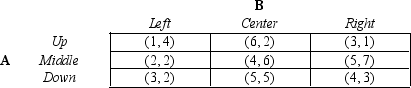 -Refer to Table 17-15.If player B chooses Right,player A should choose
 (Multiple Choice)
4.8/5 (89)
(89) Figure 17-4. Two companies, Acme and Bilco, are sellers in the same market. Each company decides whether to charge a high price or a low price. In the figure, the dollar amounts are payoffs and they represent annual profits for the two companies.
 -Refer to Figure 17-4.If this game is played only once,then the most likely outcome is that
 (Multiple Choice)
4.9/5 (75)
(75) 
Filters
- Essay(0)
- Multiple Choice(0)
- Short Answer(0)
- True False(0)
- Matching(0)