



 Chat with AI
Exam 17: Oligopoly.

Exam 1: Ten Principles of Economics.349 Questions
Exam 2: Thinking Like an Economist.535 Questions
Exam 3: Interdependence and the Gains from Trade.443 Questions
Exam 4: The Market Forces of Supply and Demand.571 Questions
Exam 5: Elasticity and Its Application510 Questions
Exam 6: Supply, Demand, And Government Policies.557 Questions
Exam 7: Consumers, Producers, and the Efficiency of Markets.460 Questions
Exam 8: Application: The Costs of Taxation.424 Questions
Exam 9: Application: International Trade.410 Questions
Exam 10: Externalities.441 Questions
Exam 11: Public Goods and Common Resources.349 Questions
Exam 12: The Design of the Tax System.478 Questions
Exam 13: The Costs of Production.533 Questions
Exam 14: Firms in Competitive Markets.478 Questions
Exam 15: Monopoly.526 Questions
Exam 16: Monopolistic Competition.497 Questions
Exam 17: Oligopoly.410 Questions
Exam 18: The Market For the Factors of Production.463 Questions
Exam 19: Earnings and Discrimination.398 Questions
Exam 20: Income Inequality and Poverty.374 Questions
Exam 21: The Theory of Consumer Choice.462 Questions
Exam 22: Frontiers in Microeconomics.353 Questions
Select questions type


Table 17-15
This table shows a game played between two players, A and B. The payoffs in the table are shown as (Payoff to A, Payoff to B).
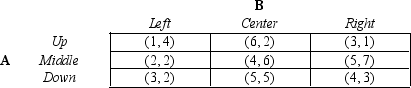 -Refer to Table 17-15.Which of the following statements regarding this game is true?
 (Multiple Choice)
4.8/5  (89)
(89) Describe the output and price effects that influence the profit-maximizing decision faced by a firm in an oligopoly market.How does this differ from output and price effects in a monopoly market?
(Essay)
5.0/5 (84)
(84) In a duopoly if the firms have agreed to jointly maximize profits,then each firm can increase its current profits by producing more.
(True/False)
4.9/5 (69)
(69) Table 17-9
Only two firms, Acme and Pinnacle, sell a particular product. The table below shows the demand curve for their product. Each firm has the same constant marginal cost of $10 and zero fixed cost.
 -Refer to Table 17-9.Acme and Pinnacle agree to jointly maximize profits.If Acme and Pinnacle each break the agreement and each produce 100 more than agreed upon,how much less profit does each make?
 (Multiple Choice)
4.9/5 (66)
(66) Table 17-19
Consider a small town that has two grocery stores from which residents can choose to buy a gallon of milk. The store owners each must make a decision to set a high milk price or a low milk price. The payoff table, showing profit per week, is provided below. The profit in each cell is shown as (Store 1, Store 2).
 -Refer to Table 17-19.What is grocery store 1's dominant strategy?
 (Multiple Choice)
4.9/5 (88)
(88) Table 17-20
Nadia and Maddie are two college roommates who both prefer a clean common space in their dorm room, but neither enjoys cleaning. The roommates must each make a decision to either clean or not clean the dorm room's common space. The payoff table for this situation is provided below, where the higher a player's payoff number, the better off that player is. The payoffs in each cell are shown as (payoff for Nadia, payoff for Maddie).
 -Refer to Table 17-20.What is the Nash Equilibrium in this dorm room cleaning game?
 (Multiple Choice)
4.9/5 (71)
(71) Table 17-19
Consider a small town that has two grocery stores from which residents can choose to buy a gallon of milk. The store owners each must make a decision to set a high milk price or a low milk price. The payoff table, showing profit per week, is provided below. The profit in each cell is shown as (Store 1, Store 2).
-Refer to Table 17-19.If grocery store 2 sets a low price,what price should grocery store 1 set? And what will grocery store 1's payoff equal?
-Refer to Table 17-19.If grocery store 2 sets a low price,what price should grocery store 1 set? And what will grocery store 1's payoff equal? (Multiple Choice)
4.8/5 (72)
(72) Table 17-14
This table shows a game played between two players, A and B. The payoffs in the table are shown as (Payoff to A, Payoff to B).
 -Refer to Table 17-14.If player A chooses his/her best strategy,player B should
 (Multiple Choice)
4.7/5 (99)
(99) Figure 17-2. Hector and Bart are roommates. On a particular day, their apartment needs to be cleaned. Each person has to decide whether to take part in cleaning. At the end of the day, either the apartment will be completely clean (if one or both roommates take part in cleaning), or it will remain dirty (if neither roommate cleans). With happiness measured on a scale of 1 (very unhappy) to 10 (very happy), the possible outcomes are as follows:
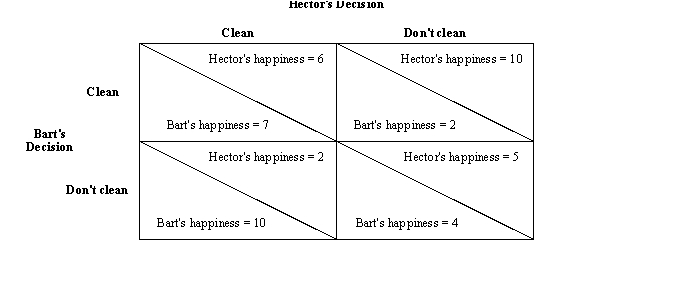 -Refer to Figure 17-2.In pursuing his own self-interest,Hector will
 (Multiple Choice)
4.9/5 (84)
(84) Figure 17-3. Katie and Taylor are roommates. On a particular day, their lawn needs to be mowed. Each person has to decide whether to take part in mowing the lawn. At the end of the day, either the lawn will be mowed (if one or both roommates take part in mowing), or it will remain unmowed (if neither roommate mows). With happiness measured on a scale of 1 (very unhappy) to 10 (very happy), the possible outcomes are as follows:
 -Refer to Figure 17-3.The dominant strategy for Taylor is to
 (Multiple Choice)
4.8/5 (71)
(71) Table 17-1
Imagine a small town in which only two residents, Rochelle and Alec, own wells that produce safe drinking water. Each week Rochelle and Alec work together to decide how many gallons of water to pump. They bring the water to town and sell it at whatever price the market will bear. To keep things simple, suppose that Rochelle and Alec can pump as much water as they want without cost so that the marginal cost of water equals zero. The weekly town demand schedule and total revenue schedule for water is shown in the table below:
 -Refer to Table 17-1.If the market for water were perfectly competitive instead of monopolistic,how many gallons of water would be produced and sold?
 (Multiple Choice)
4.9/5 (83)
(83) In a two-person repeated game,a tit-for-tat strategy starts with
(Multiple Choice)
4.7/5 (87)
(87) Table 17-20
Nadia and Maddie are two college roommates who both prefer a clean common space in their dorm room, but neither enjoys cleaning. The roommates must each make a decision to either clean or not clean the dorm room's common space. The payoff table for this situation is provided below, where the higher a player's payoff number, the better off that player is. The payoffs in each cell are shown as (payoff for Nadia, payoff for Maddie).
-Refer to Table 17-20.If Nadia chooses to clean,then Maddie will
-Refer to Table 17-20.If Nadia chooses to clean,then Maddie will (Multiple Choice)
4.9/5 (95)
(95) Table 17-21
The Chicken Game is named for a contest in which drivers test their courage by driving straight at each other. John and Paul have a common interest to avoid crashing into each other, but they also have a personal, competing interest to not turn first to demonstrate their courage to those observing the contest. The payoff table for this situation is provided below. The payoffs are shown as (John, Paul).
 -Refer to Table 17-21.If John chooses Drive Straight,what will Paul choose to do and what will Paul's payoff equal?
 (Multiple Choice)
4.8/5 (68)
(68) For a firm,strategic interactions with other firms in the market become more important as the number of firms in the market becomes larger.
(True/False)
5.0/5 (74)
(74) If a market is a duopoly and additional firms enter and do not cooperate,then
(Multiple Choice)
4.9/5 (68)
(68) We must be knowledgeable of how people behave in strategic situations if we are to understand
(Multiple Choice)
4.8/5 (82)
(82) 
Filters
- Essay(0)
- Multiple Choice(0)
- Short Answer(0)
- True False(0)
- Matching(0)