



 Chat with AI
Exam 17: Immunization and Immune Testing

Exam 1: A Brief History of Microbiology73 Questions
Exam 2: The Chemistry of Microbiology76 Questions
Exam 3: Cell Structure and Function80 Questions
Exam 4: Microscopy, Staining, and Classification80 Questions
Exam 5: Microbial Metabolism77 Questions
Exam 6: Microbial Nutrition and Growth75 Questions
Exam 7: Microbial Genetics75 Questions
Exam 8: Recombinant DNA Technology75 Questions
Exam 9: Controlling Microbial Growth in the Environment75 Questions
Exam 10:Controlling Microbial Growth in the Body: Antimicrobial Drugs75 Questions
Exam 11: Characterizing and Classifying Prokaryotes75 Questions
Exam 12: Characterizing and Classifying Eukaryotes75 Questions
Exam 13: Characterizing and Classifying Viruses, Viroids, and Prions75 Questions
Exam 14: Infection, Infectious Diseases, and Epidemiology76 Questions
Exam 15: Innate Immunity75 Questions
Exam 16: Adaptive Immunity75 Questions
Exam 17: Immunization and Immune Testing75 Questions
Exam 18: Immune Disorders75 Questions
Exam 19: Microbial Diseases of the Skin and Wounds72 Questions
Exam 20: Microbial Diseases of the Nervous System and Eyes71 Questions
Exam 21: Microbial Cardiovascular and Systemic Diseases71 Questions
Exam 22: Microbial Diseases of the Respiratory System70 Questions
Exam 23: Microbial Diseases of the Digestive System70 Questions
Exam 24: Microbial Diseases of the Urinary and Reproductive Systems65 Questions
Exam 25: Applied and Industrial Microbiology73 Questions
Exam 26: Microbial Ecology and Microbiomes73 Questions
Select questions type


A technician places a serum sample in a well in an agar plate and a solution of antigens in a second well in the plate. The technician has set up a(n) (agglutination/immunodiffusion/immunoblot) assay.
(Short Answer)
4.8/5  (81)
(81) Analysis of blood to detect specific antigens or antibodies is known as
(Multiple Choice)
4.8/5 (83)
(83) Which of the following diagnostic procedures depends on precipitation of antigen-antibody complexes?
(Multiple Choice)
4.9/5 (82)
(82) The polio vaccine currently administered in the U.S., known as IPV, is an example of a(n) ________ vaccine.
(Multiple Choice)
4.8/5 (87)
(87) Tuberculosis may be diagnosed using a(n) ________ on sputum (lung fluid) samples.
(Multiple Choice)
4.8/5 (81)
(81) Deliberate infection of young children with particles of ground smallpox scabs from children who had survived mild cases of smallpox was known as (vaccination/variolation/immunization).
(Short Answer)
4.8/5 (90)
(90) An advantage of (attenuated/inactivated/subunit) vaccines is that they usually elicit cell-mediated immune responses.
(Short Answer)
4.9/5 (64)
(64) An infectious disease researcher isolates the pathogen responsible for an emerging disease. The microbe is grown in the lab. A preparation of the laboratory-grown microbe is treated with a lethal dose of ionizing radiation and then tested for its potential as a vaccine. What type of vaccine is this?
(Multiple Choice)
4.9/5 (82)
(82) Which of the following substances is commonly used to inactivate microbes?
(Multiple Choice)
5.0/5 (63)
(63) Compare and contrast viral neutralization and viral hemagglutination tests.
(Essay)
4.8/5 (79)
(79) 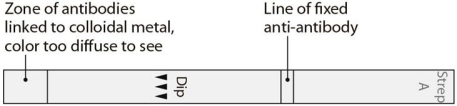 The "dipstick" illustrated in Figure 17.3 is used in a(n) (immunodiffusion/immunochromatographic/ immunofluorescent) assay.
 (Short Answer)
4.8/5 (83)
(83) Which of the following statements regarding toxoids is FALSE?
(Multiple Choice)
4.9/5 (78)
(78) Rabies virus can be directly detected in brain tissue using a(n) ________ assay.
(Multiple Choice)
4.8/5 (71)
(71) In precipitation tests, maximum precipitation takes place when
(Multiple Choice)
4.9/5 (83)
(83) Antisera directed against toxins are known as (antibodies/antitoxins/anti-antibodies).
(Short Answer)
4.9/5 (82)
(82) One way to measure the antibody levels in the blood is by (neutralization/titration/turbidimetry) using agglutination tests.
(Short Answer)
4.8/5 (87)
(87) 
Filters
- Essay(0)
- Multiple Choice(0)
- Short Answer(0)
- True False(0)
- Matching(0)