



 Chat with AI
Exam 7: Microbial Genetics

Exam 1: A Brief History of Microbiology73 Questions
Exam 2: The Chemistry of Microbiology76 Questions
Exam 3: Cell Structure and Function80 Questions
Exam 4: Microscopy, Staining, and Classification80 Questions
Exam 5: Microbial Metabolism77 Questions
Exam 6: Microbial Nutrition and Growth75 Questions
Exam 7: Microbial Genetics75 Questions
Exam 8: Recombinant DNA Technology75 Questions
Exam 9: Controlling Microbial Growth in the Environment75 Questions
Exam 10:Controlling Microbial Growth in the Body: Antimicrobial Drugs75 Questions
Exam 11: Characterizing and Classifying Prokaryotes75 Questions
Exam 12: Characterizing and Classifying Eukaryotes75 Questions
Exam 13: Characterizing and Classifying Viruses, Viroids, and Prions75 Questions
Exam 14: Infection, Infectious Diseases, and Epidemiology76 Questions
Exam 15: Innate Immunity75 Questions
Exam 16: Adaptive Immunity75 Questions
Exam 17: Immunization and Immune Testing75 Questions
Exam 18: Immune Disorders75 Questions
Exam 19: Microbial Diseases of the Skin and Wounds72 Questions
Exam 20: Microbial Diseases of the Nervous System and Eyes71 Questions
Exam 21: Microbial Cardiovascular and Systemic Diseases71 Questions
Exam 22: Microbial Diseases of the Respiratory System70 Questions
Exam 23: Microbial Diseases of the Digestive System70 Questions
Exam 24: Microbial Diseases of the Urinary and Reproductive Systems65 Questions
Exam 25: Applied and Industrial Microbiology73 Questions
Exam 26: Microbial Ecology and Microbiomes73 Questions
Select questions type


The (codon/anticodon/loop) of a transfer RNA molecule is complementary to a codon in a messenger RNA molecule.

Free
(Short Answer)
4.9/5  (84)
(84) Correct Answer: Verified
anticodon
The structure of DNA explains both its ability to encode genetic information and the way in which it is copied during cell reproduction.
Free
(True/False)
4.8/5 (87)
(87) Correct Answer:Verified
VerifiedTrue
Which of the following processes is involved in the "central dogma" of genetics?
Free
(Multiple Choice)
4.9/5 (88)
(88) Correct Answer:Verified
VerifiedD
Which of the following is characteristic of prokaryotic genomes but not eukaryotic genomes?
(Multiple Choice)
4.8/5 (75)
(75) The term "semiconservative replication" means that both strands of a DNA molecule are a mix of newly replicated and original template DNA.
(True/False)
4.8/5 (78)
(78) A(n) (genome/codon/operon) is a set of prokaryotic genes that are regulated and transcribed as a unit.
(Short Answer)
4.9/5 (86)
(86) Which of the following is found in both archaeal and eukaryotic genomes?
(Multiple Choice)
4.9/5 (70)
(70) Which of the following is found at the 5' end of a DNA strand?
(Multiple Choice)
4.7/5 (92)
(92) You observe a microbiologist examining two plates and notice the pattern of colonies are nearly identical with the exception of a few colonies that are absent on one of them. The plates likely were produced by
(Multiple Choice)
4.9/5 (93)
(93) While studying a bacterial strain, a scientist notes a short DNA sequence between inverted repeats is present in both the chromosome and a plasmid within the cell. This sequence is most likely a(n) (phage/transposon/F plasmid).
(Short Answer)
4.8/5 (86)
(86) Loosely packed, transcriptionally active regions of a eukaryotic chromosome are called (euchromatin/heterochromatin/nucleosomes).
(Short Answer)
4.9/5 (82)
(82) 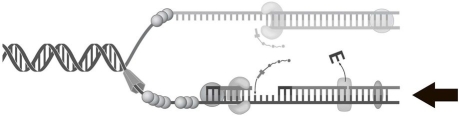 The process indicated by the arrow in Figure 7.1 represents
 (Multiple Choice)
4.8/5 (95)
(95) Transfer of random pieces of DNA mediated by phage is known as
(Multiple Choice)
5.0/5 (73)
(73) Two bacterial strains have the same genes for metabolizing a carbohydrate, but one is wild-type for a regulatory inducer while the other does not produce the inducer. Which of the following statements is CORRECT with regard to the metabolism of the bacteria?
(Multiple Choice)
4.8/5 (80)
(80) Which of the following is NOT involved in the regulation of the lac operon?
(Multiple Choice)
4.8/5 (64)
(64) Which of the following is both a codon for an amino acid and a start signal?
(Multiple Choice)
4.9/5 (90)
(90) 
Filters
- Essay(0)
- Multiple Choice(0)
- Short Answer(0)
- True False(0)
- Matching(0)