



 Chat with AI
Exam 22: Microbial Diseases of the Respiratory System

Exam 1: A Brief History of Microbiology73 Questions
Exam 2: The Chemistry of Microbiology76 Questions
Exam 3: Cell Structure and Function80 Questions
Exam 4: Microscopy, Staining, and Classification80 Questions
Exam 5: Microbial Metabolism77 Questions
Exam 6: Microbial Nutrition and Growth75 Questions
Exam 7: Microbial Genetics75 Questions
Exam 8: Recombinant DNA Technology75 Questions
Exam 9: Controlling Microbial Growth in the Environment75 Questions
Exam 10:Controlling Microbial Growth in the Body: Antimicrobial Drugs75 Questions
Exam 11: Characterizing and Classifying Prokaryotes75 Questions
Exam 12: Characterizing and Classifying Eukaryotes75 Questions
Exam 13: Characterizing and Classifying Viruses, Viroids, and Prions75 Questions
Exam 14: Infection, Infectious Diseases, and Epidemiology76 Questions
Exam 15: Innate Immunity75 Questions
Exam 16: Adaptive Immunity75 Questions
Exam 17: Immunization and Immune Testing75 Questions
Exam 18: Immune Disorders75 Questions
Exam 19: Microbial Diseases of the Skin and Wounds72 Questions
Exam 20: Microbial Diseases of the Nervous System and Eyes71 Questions
Exam 21: Microbial Cardiovascular and Systemic Diseases71 Questions
Exam 22: Microbial Diseases of the Respiratory System70 Questions
Exam 23: Microbial Diseases of the Digestive System70 Questions
Exam 24: Microbial Diseases of the Urinary and Reproductive Systems65 Questions
Exam 25: Applied and Industrial Microbiology73 Questions
Exam 26: Microbial Ecology and Microbiomes73 Questions
Select questions type


Even though mycoplasmas pass through filters that normally trap bacteria, they are known to be bacteria, not viruses, because they

Free
(Multiple Choice)
4.7/5  (75)
(75) Correct Answer: Verified
D
A young man who works on a ranch and lives in the log bunkhouse experiences sudden fever with muscle aches. A few days later he begins to cough and have difficulty breathing, and goes to an urgent care clinic. His blood pressure is low. A blood sample reveals a low platelet count. A Gram stain of a sputum sample shows only a few small bacteria present. Which of the following is the most likely infecting agent?
Free
(Multiple Choice)
4.7/5 (73)
(73) Correct Answer:Verified
VerifiedB
Haemophilus influenzae is a common cause of sinus infections.
Free
(True/False)
4.8/5 (75)
(75) Correct Answer:Verified
VerifiedTrue
The attachment protein for almost all rhinoviruses is (BCG/ICAM-1/IgA). (Be sure your answer is in uppercase letters.)
(Short Answer)
4.8/5 (81)
(81) Which of the following statements is TRUE regarding tuberculosis?
(Multiple Choice)
4.9/5 (65)
(65) Otitis media is a bacterial infection of the (ear/pharynx/sinuses).
(Short Answer)
4.8/5 (80)
(80) Why is immunity to the common cold so difficult to develop, either naturally or through vaccines?
(Essay)
4.9/5 (73)
(73) Which of the following diseases is almost diagnostic for AIDS?
(Multiple Choice)
4.9/5 (78)
(78) Elongation factor, a protein required for eukaryotic (transcription/translation/expression), is the cellular target of the toxin produced by Corynebacterium diphtheriae.
(Short Answer)
5.0/5 (83)
(83) Describe the pathogenesis of tuberculosis, paying special attention to the characteristics of Mycobacterium tuberculosis that make it so pathogenic.
(Essay)
4.8/5 (86)
(86) What is the primary determinant of virulence in Streptococcus pneumoniae?
(Multiple Choice)
4.8/5 (74)
(74) 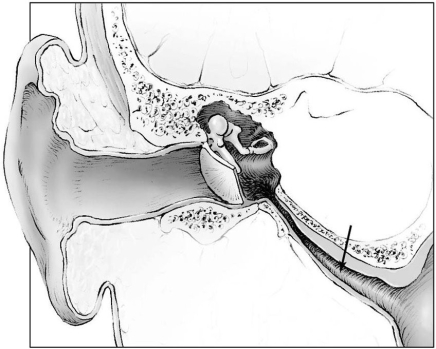 The structure indicated by the arrow connects the middle ear to what part of the respiratory system?
 (Multiple Choice)
4.9/5 (89)
(89) Otitis media is more common in adults than children because of differences in the anatomy of the head.
(True/False)
4.7/5 (68)
(68) The designation "group A," used to help classify Streptococcus pyogenes, refers to this bacterium's
(Multiple Choice)
4.9/5 (79)
(79) A nursing student develops a positive reaction to the tuberculin skin test. A history reveals possible exposure to patients with tuberculosis. A sputum sample is acid-fast negative. When asked for vaccination records, the student reports that childhood vaccination records were lost when the family emigrated from a Southeast Asian country. What is the best explanation for the test results?
(Multiple Choice)
4.8/5 (77)
(77) The "common cold" is so common because there of the large number of viruses that cause it.
(True/False)
4.7/5 (73)
(73) When Mycobacterium tuberculosis spreads to sites such as the bone marrow and spleen it results in (disseminated/secondary/reactivated) tuberculosis.
(Short Answer)
4.8/5 (93)
(93) 
Filters
- Essay(0)
- Multiple Choice(0)
- Short Answer(0)
- True False(0)
- Matching(0)