



 Chat with AI
Exam 22: Microbial Diseases of the Respiratory System

Exam 1: A Brief History of Microbiology73 Questions
Exam 2: The Chemistry of Microbiology76 Questions
Exam 3: Cell Structure and Function80 Questions
Exam 4: Microscopy, Staining, and Classification80 Questions
Exam 5: Microbial Metabolism77 Questions
Exam 6: Microbial Nutrition and Growth75 Questions
Exam 7: Microbial Genetics75 Questions
Exam 8: Recombinant DNA Technology75 Questions
Exam 9: Controlling Microbial Growth in the Environment75 Questions
Exam 10:Controlling Microbial Growth in the Body: Antimicrobial Drugs75 Questions
Exam 11: Characterizing and Classifying Prokaryotes75 Questions
Exam 12: Characterizing and Classifying Eukaryotes75 Questions
Exam 13: Characterizing and Classifying Viruses, Viroids, and Prions75 Questions
Exam 14: Infection, Infectious Diseases, and Epidemiology76 Questions
Exam 15: Innate Immunity75 Questions
Exam 16: Adaptive Immunity75 Questions
Exam 17: Immunization and Immune Testing75 Questions
Exam 18: Immune Disorders75 Questions
Exam 19: Microbial Diseases of the Skin and Wounds72 Questions
Exam 20: Microbial Diseases of the Nervous System and Eyes71 Questions
Exam 21: Microbial Cardiovascular and Systemic Diseases71 Questions
Exam 22: Microbial Diseases of the Respiratory System70 Questions
Exam 23: Microbial Diseases of the Digestive System70 Questions
Exam 24: Microbial Diseases of the Urinary and Reproductive Systems65 Questions
Exam 25: Applied and Industrial Microbiology73 Questions
Exam 26: Microbial Ecology and Microbiomes73 Questions
Select questions type


Which of the following statements is TRUE concerning diphtheria?
(Multiple Choice)
4.8/5  (82)
(82) Recent outbreaks of multidrug-resistant HAP are primarily caused by members of the genus (Bordetella/ Klebsiella/Mycobacteria), Gram-negative opportunists.
(Short Answer)
4.8/5 (82)
(82) The mycoplasmas have been successively classified as viruses, Gram-negative bacteria, and Gram-positive bacteria largely due to the lack of cell (membranes/walls/RNA) in their structure.
(Short Answer)
4.8/5 (87)
(87) Which of the following factors is primarily responsible for the ability of Mycobacterium tuberculosis to survive long periods of time in dried droplets of respiratory aerosols?
(Multiple Choice)
4.9/5 (72)
(72) The disease known as "Croup" is often a result of infection with which of the following?
(Multiple Choice)
4.9/5 (68)
(68) Inhalation anthrax is frequently fatal even with antibiotic therapy because
(Multiple Choice)
4.8/5 (69)
(69) A new vaccine for the upcoming flu season is developed from an influenza isolate designated A/Shanghai/2/2013(H7N9). This nomenclature means the isolate is
(Multiple Choice)
4.8/5 (85)
(85) The DTaP vaccine protects against which of the following respiratory diseases?
(Multiple Choice)
4.9/5 (98)
(98) Dust storms in arid regions of the Southwestern U.S. may lead to outbreaks of
(Multiple Choice)
4.8/5 (80)
(80) Diphtheria toxin kills cells by interfering with which of the following processes?
(Multiple Choice)
4.8/5 (93)
(93) Explain the necessity of producing a new vaccine for each year's flu season.
(Essay)
4.8/5 (85)
(85) Which of the following is an opportunistic pathogen commonly present in the nasal cavity as a member of the microbiota?
(Multiple Choice)
4.8/5 (76)
(76) Macrophages effectively phagocytize and kill Mycobacterium tuberculosis.
(True/False)
4.8/5 (78)
(78) 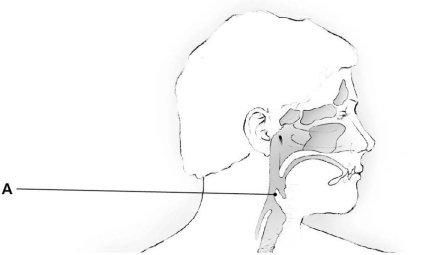 The structure indicated by the letter "A" is the (pharynx/larynx/epiglottis).
 (Short Answer)
4.7/5 (83)
(83) The smallest free-living microbes are (mycobacteria/mycoplasmas/Chlamydophila).
(Short Answer)
4.9/5 (77)
(77) Pathogenic streptococci of the upper respiratory tract (such as Streptococcus pyogenes) are distinguished from non-pathogenic streptococci by
(Multiple Choice)
4.9/5 (80)
(80) 
Filters
- Essay(0)
- Multiple Choice(0)
- Short Answer(0)
- True False(0)
- Matching(0)